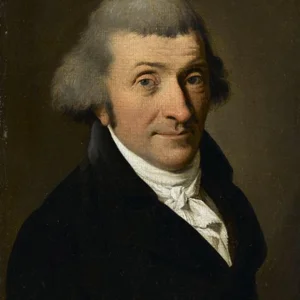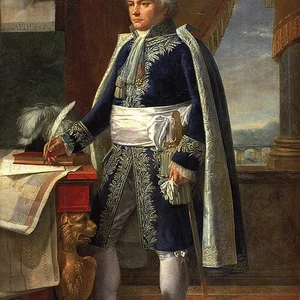

French statesman (1747-1809), Minister of the Interior under Napoleon I and first governor of the Bank of France. He played a key role in the administrative and financial reorganization of Consular and Imperial France.
Emmanuel Crétet de Champmol
Emmanuel Crétet de Champmol
9 min read
Frequently asked questions
Key Facts
- Appointed governor of the Bank of France in 1806, consolidating its institutional independence
- Minister of the Interior from 1807 to 1809 under Napoleon I
- Oversaw major infrastructure projects (canals, roads) under the Empire
- Member of the Council of State, a pillar of Napoleonic administrative reform
- Died in 1809 while still serving as minister
Works & Achievements
As its first governor, Crétet organized the Bank's early discounting operations, established governance procedures, and helped build the institution's credibility in a country deeply suspicious of paper money. His work laid the foundations of a central bank that still exists today.
As director general, Crétet oversaw the repair and expansion of France's road network, which was essential to Napoleon's military campaigns and domestic trade, while also strengthening the training of state engineers.
As Minister of the Interior, Crétet drove major hydraulic infrastructure projects, most notably work on the Saint-Quentin Canal, designed to link the Somme basin to the Oise basin and improve commercial exchange between the northern Empire and Paris.
At the head of the Ministry of the Interior, Crétet coordinated the work of prefects and sub-prefects, ensured the enforcement of imperial laws, oversaw the collection of national statistics, and reported directly to Napoleon on the internal state of the Empire.
Crétet contributed to the drafting of official reports on the state of public credit, proposing measures to consolidate confidence in the new banknote and to expand discounting operations in the provinces.
Anecdotes
Emmanuel Crétet was chosen by Napoleon Bonaparte himself to become the very first governor of the Bank of France, an institution created in January 1800 to stabilize the country's finances after the upheavals of the Revolution. This appointment rewarded his expertise as a jurist and financier: in a country still traumatized by the collapse of the revolutionary assignats, he had to convince the business community that the new banknote was genuinely worth the metal currency it promised.
A deputy of the Third Estate in 1789, Crétet sat at Versailles alongside the lawyers and bourgeois who would go on to overturn the Ancien Régime. The son of a middle-class family from the Ain, he embodied exactly the kind of educated, pragmatic provincial notable that Napoleon knew how to rally to his cause — men who had come through the Revolution without compromising themselves in its excesses and who longed for stability.
As Director General of the Ponts et Chaussées under the Consulate, Crétet was responsible for the entire French road network, which was in a sorry state after ten years of revolutionary turmoil. He oversaw the engineers trained at the famous École des Ponts et Chaussées and planned construction work on the great imperial highways, which were essential both for Napoleon's armies and for the merchants who supplied Paris.
Appointed Minister of the Interior in 1807, Crétet inherited a ministry that managed virtually everything: roads, canals, schools, hospitals, prefects, statistics, and poor relief. Napoleon demanded detailed reports and swift results, which wore out his ministers quickly. Illness forced Crétet to leave office in 1809, just a few weeks before his death, leaving behind an administration better organized than the one he had inherited.
Primary Sources
A joint-stock company is formed under the name of Bank of France, to conduct banking and discount operations under the conditions set by this decree. It shall be administered by a governor appointed by the Government.
The Bank of France is administered by a governor and two deputy governors appointed by the government. There are fifteen regents and three censors elected by the shareholders. The governor is responsible for enforcing the statutes and directing business affairs.
My intention is that the canal works be conducted with all possible urgency. You will remind the engineers that these communications are indispensable to the trade of the northern Empire and that I am counting on their zeal to hasten its completion.
Discount operations have progressed significantly since the establishment of the Bank. The banknotes in circulation inspire growing confidence among Parisian merchants, and requests for branch offices are multiplying in the provinces, testifying to the new standing enjoyed by the institution.
Key Places
Birthplace of Emmanuel Crétet, located in the Bresse Bourguignonne plain. He was born there in 1747 into a middle-class family and received his early education before going on to study law and pursue his career in Paris.
It was in Versailles that Crétet served as a deputy of the Third Estate at the Estates-General in May 1789, taking part in the historic debates that would lead to the French Revolution. He witnessed the Tennis Court Oath and the first great political upheavals of the era.
Headquarters of the Banque de France, established in the Hôtel de Toulouse from 1808 onwards, where Crétet served as its first governor from 1800 to 1806. It was here that the first discount operations were organized and the first reliable banknotes of the Napoleonic era were issued.
Headquarters of the ministry where Crétet served as minister from 1807 to 1809. From this nerve center of the imperial administration, he coordinated the work of prefects across the departments, oversaw public works, and reported directly to Napoleon.
Crétet lived in Paris for most of his Napoleonic career, in a city undergoing profound transformation under the Empire. Napoleon was reshaping the capital with new monuments, fountains, and riverbanks, aiming to make it the foremost city in Europe.
Typical Objects

The trimmed goose quill was the essential tool of the Napoleonic senior official, who drafted or signed dozens of documents each day. A crystal or porcelain inkwell held pride of place on the governor's or minister's desk.

The first banknotes issued by the Banque de France from 1800 onward, gradually replacing metal coins for large commercial transactions. Crétet oversaw their controlled issuance to restore confidence after the collapse of the revolutionary assignats.

A thick leather-bound volume in which the clerks of the Banque de France recorded all discounting operations, shareholder accounts, and notes issued. These ledgers formed the financial memory of the institution for which Crétet was responsible.

Detailed maps of the imperial road network, indispensable to the director-general of Bridges and Roads for planning maintenance and construction. Crétet consulted them to track the progress of building works and report to Napoleon on the state of communications across the Empire.

An official document signed by Napoleon and countersigned by the relevant minister, the decree was the central legal instrument of Napoleonic government. Crétet drafted and enforced hundreds of them, ranging from the appointment of prefects to the ordering of public works.

Measuring instruments used by Bridges and Roads engineers to measure distances, lay out roads, and calculate canal profiles. As director-general of the corps, Crétet was directly responsible for ensuring these tools were correctly used on construction sites throughout the Empire.
School Curriculum
Vocabulary & Tags
Key Vocabulary
Daily Life
Morning
Crétet rose early, subject to the rhythm set by a Napoleon who himself worked from dawn and demanded daily reports from his ministers. His morning began with reading correspondence from the prefects and reports from his bureau directors, before receiving his collaborators to handle current affairs.
Afternoon
The afternoon was devoted to audiences, meetings of the Council of State, or inspection visits to public works sites. As minister, he would sometimes go to the Tuileries to report to the Emperor in person — Napoleon liked to question his ministers on the details and often caught his interlocutors off guard with the precision of his questions.
Evening
Evenings blended social obligations with late work: official dinners, diplomatic receptions, or reviewing files by candlelight. In the final months of his life, the illness that carried him off in 1809 confined Crétet to quieter, more withdrawn evenings, far from the bustle of the imperial court.
Food
The table of the high imperial dignitaries was refined and plentiful: soups, roasted meats, poultry, freshwater fish, cheeses, and sweet entremets, all accompanied by Burgundy or Bordeaux wines. The midday dinner often brought together colleagues or political figures, as the table was an essential space for socializing and influence under the Empire.
Clothing
At official ceremonies, Crétet wore the embroidered coat of the imperial court — a matching jacket and breeches embroidered in gold or silver according to rank, white silk stockings, a dress sword, and a bicorne hat. In his daily office work, he wore the dark frock coat, waistcoat, trousers, and lace jabot characteristic of the bourgeois notable of the nascent Empire.
Housing
As governor and later minister, Crétet had use of official apartments in the Parisian hôtels particuliers where the Empire's dignitaries were housed. These residences combined richly furnished reception rooms for receiving dignitaries, libraries, working offices, and private apartments, all decorated in the Empire style with its classical lines, heavy drapes, and deep colors.
Historical Timeline
Period Vocabulary
Liens externes & ressources
Références
Œuvres
Réorganisation du corps des Ponts et Chaussées
1800-1806
Développement du réseau de canaux (canal de Saint-Quentin)
1807-1809
Administration des 130 départements de l'Empire
1807-1809