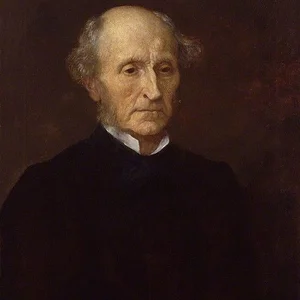

John Stuart Mill (1806-1873) was a British philosopher, economist, and politician. A major figure of liberalism and utilitarianism, he championed individual liberties, freedom of expression, and the emancipation of women.
Stuart Mill
Stuart Mill
6 min read
Frequently asked questions
Famous Quotes
« It is better to be a human being dissatisfied than a pig satisfied; better to be Socrates dissatisfied than a fool satisfied.»
« The only freedom which deserves the name is that of pursuing our own good in our own way.»
Key Facts
- Born in 1806 in London, intensively educated by his father James Mill from a very young age
- Published On Liberty in 1859, a classic defense of individual liberties
- Published Utilitarianism in 1861, which systematized and refined Bentham's doctrine
- Elected as a Member of Parliament in 1865, he championed women's right to vote in the British Parliament
- Published The Subjection of Women in 1869, a pioneering plea for gender equality; died in 1873 in Avignon
Works & Achievements
A major treatise on inductive method and the logic of the sciences, which established Mill as a leading philosopher.
The standard economics textbook for half a century, blending liberal analysis with social concerns.
A foundational essay on individual freedoms and freedom of expression, one of the most influential texts of liberalism.
A reflection on representative democracy and the conditions for good government.
The classic statement of utilitarian ethics, in which Mill distinguishes between higher and lower pleasures.
A pioneering plea for legal and social equality between men and women.
A posthumous account of his intellectual formation and his spiritual crisis, a unique testimony to his upbringing.
Anecdotes
John Stuart Mill's father, James Mill, imposed an extraordinarily precocious education on him: he learned Ancient Greek at the age of three and was reading Plato in the original at seven. By eight, he was already studying Latin and algebra.
Around the age of twenty, Mill went through a severe bout of depression, which he recounts in his autobiography. He asked himself whether achieving all his ideals would make him happy, and answered “no”: it was reading Wordsworth's poetry that helped him emerge from this distress.
Mill met Harriet Taylor in 1830, when she was married. They maintained a long intellectual friendship for twenty years before marrying in 1851, after the death of Harriet's first husband. Mill acknowledged her major influence on his thought, particularly on the emancipation of women.
Elected to the House of Commons in 1865, Mill was the first member of Parliament to formally propose women's right to vote, presenting a petition in 1866 and then an amendment to the 1867 electoral reform. The amendment was rejected, but it marked a milestone in the history of feminism.
As a teenager, Mill was briefly arrested at seventeen for distributing pamphlets on birth control intended for poor families in the streets of London, an extremely taboo subject in the Victorian era.
Primary Sources
The only purpose for which power can be rightfully exercised over any member of a civilized community, against his will, is to prevent harm to others.
It is better to be a human being dissatisfied than a pig satisfied; better to be Socrates dissatisfied than a fool satisfied.
The principle which regulates the existing social relations between the two sexes — the legal subordination of one sex to the other — is wrong in itself, and now one of the chief hindrances to human improvement.
I have no remembrance of the time when I began to learn Greek; I have been told that it was when I was three years old. My earliest recollection on the subject of Latin is that of being told it was at eight years old.
Key Places
District in north London where John Stuart Mill was born in 1806 and spent his studious childhood.
Mill worked here as an administrator for 35 years, from 1823 to 1858, while pursuing his philosophical work.
Seat of the House of Commons where Mill served as a Member of Parliament from 1865 to 1868 and championed women's right to vote.
City in southern France where Mill settled after Harriet's death in 1858 and where he died in 1873. He is buried in the Saint-Véran cemetery.
Residential district in southeast London where Mill lived with Harriet Taylor in the 1850s.
Typical Objects

Mill's everyday writing instrument, with which he penned thousands of pages of essays, letters and treatises. The quill pen, later the metal nib, was the tool of every Victorian intellectual.

The book was the main vehicle for Mill's ideas, spread by Victorian printing in large print runs. *On Liberty* and *Utilitarianism* saw many reprints during his lifetime.

The steam-powered press enabled the mass distribution of newspapers and philosophical essays in the 19th century. It made the public influence of Mill's writings possible.

The central piece of furniture in Mill's intellectual work, covered with manuscripts and books. It was there that he wrote his great treatises, often in collaboration with Harriet Taylor.

A symbol of Mill's political struggle, for he championed the expansion of the franchise, including to women. The secret ballot was in fact introduced in Great Britain in 1872.

The formal attire of the Victorian gentleman: a dark frock coat, a high-collared shirt and a top hat. Mill wore it as a Member of Parliament and a figure of polite London society.
School Curriculum
Vocabulary & Tags
Key Vocabulary
Daily Life
Morning
Mill rose early and devoted his mornings to reading and writing his philosophical treatises. From a very young age, his father imposed rigorous lessons in Greek, Latin, and mathematics upon him.
Afternoon
For thirty-five years, he spent his afternoons as an administrator at the East India Company, drafting dispatches on the administration of India. This regular work nevertheless left him time for his thinking.
Evening
His evenings were devoted to intellectual conversation, to debates in London's learned societies, and to long discussions with Harriet Taylor, who profoundly influenced his work.
Food
Mill led a sober and frugal life, typical of Victorian bourgeois austerity. He attached little importance to the table, preferring intellectual effort to material pleasures.
Clothing
He wore the strict attire of the Victorian gentleman: a dark frock coat, a high-collared shirt, a cravat, and a top hat, especially during his term as a Member of Parliament.
Housing
Mill lived in comfortable London houses of the well-to-do middle class, then retired to a house near Avignon, in France, where he enjoyed botanizing and walking in the countryside.
Historical Timeline
Period Vocabulary
Liens externes & ressources
Références
Œuvres
Système de logique (A System of Logic)
1843
Principes d'économie politique (Principles of Political Economy)
1848
De la liberté (On Liberty)
1859
Considérations sur le gouvernement représentatif
1861
L'utilitarisme (Utilitarianism)
1863
L'asservissement des femmes (The Subjection of Women)
1869
Autobiographie (Autobiography)
1873