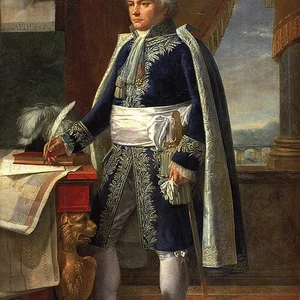

A Swiss banker based in Paris, Jean-Frédéric Perregaux was one of the co-founders of the Banque de France in 1800 and its first regent. A senator of the First Empire, he played a central role in stabilizing the finances of Napoleonic France.
Jean-Frédéric Perregaux(1744 — 1808)
Jean-Frédéric Perregaux
royaume de Prusse
8 min read
Frequently asked questions
Key Facts
- Born in 1744 in Neuchâtel, a Swiss principality, he settled in Paris as a banker
- Co-founded the Banque de France on January 18, 1800, alongside Napoleon Bonaparte and other partners
- Became the first regent of the Banque de France, a position he held from 1800 to 1808
- Appointed senator of the First Empire, he took part in Napoleonic political institutions
- Died in 1808, leaving behind a financial institution that continues to shape the French economy
Works & Achievements
Perregaux established in Paris one of the most solid banking houses of the late eighteenth century, surviving without bankruptcy through the Revolution and the monetary chaos of the assignats — a rare feat that made him a model of prudent management in a shattered financial world.
Elected among the fifteen regents tasked with governing the new national institution, Perregaux brought to the Banque de France the credibility of his name and his European network — both decisive in convincing financial markets of the seriousness of Napoleon's project.
Appointed as an irremovable senator, Perregaux represented within the imperial institution the financial bourgeoisie stabilized by the regime, embodying the reconciliation between Napoleon and the great banking fortunes that had survived the Revolution.
By welcoming and training Jacques Laffitte — future partner, regent of the Banque de France, and Prime Minister under Louis-Philippe — Perregaux established a genuine French school of banking, built on rigorous accounting and a reputation for integrity.
Anecdotes
Perregaux weathered the Terror without being troubled, protected in part by his status as a subject of the Principality of Neuchâtel, which was then under Prussian suzerainty. While many foreign bankers were arrested or ruined, he quietly kept his business running, making himself useful to successive governments that needed to finance the war.
When Bonaparte sought in 1800 men capable of founding a national bank with credibility across Europe, Perregaux was among the two hundred founding shareholders and was elected one of the fifteen regents charged with administering the new institution. His name and his reputation on the financial markets of Paris, Geneva, and Amsterdam helped reassure investors about the soundness of the establishment.
A young man from Bayonne once presented himself at the Perregaux banking house on the rue du Mont-Blanc, with no recommendation other than his good bearing and his seriousness. Perregaux took him on as a clerk: that young man's name was Jacques Laffitte, who would go on to become his partner, his successor at the head of the bank, and much later Prime Minister of France under Louis-Philippe.
Perregaux had the rare virtue of never yielding to reckless speculation on the *assignats*, the revolutionary paper currency whose value was collapsing month by month. By prudently converting his assets into real property and gold, he preserved the soundness of his banking house — earning him the lasting trust of great fortunes that needed a reliable banker in a chaotic financial world.
Primary Sources
The Bank of France is established to discount in Paris bills of exchange and other commercial paper, to order or to bearer, bearing at least two signatures… It shall be administered by fifteen regents and three censors elected by the assembly of the two hundred largest shareholders.
The following were elected as regents by the shareholders' assembly: Messrs. Perregaux, Récamier, Mallet, Perrée-Duhamel, among others, entrusted with the administration of the institution in accordance with its statutes.
Citizen Perregaux (Jean-Frédéric), banker residing in Paris, is appointed member of the Conservative Senate as an irremovable senator.
I owe everything to M. Perregaux. It was he who, seeing me without connections in a great city, deigned to place his trust in me and initiated me into the practices of banking with a rigour and a kindness for which I have always felt the deepest gratitude.
Key Places
A town in the principality of Neuchâtel, then under Prussian suzerainty, where Perregaux was born in 1744. This Protestant, watchmaking region produced merchants and financiers with a reputation across all of Europe.
Headquarters of Perregaux's banking house, located in the Chaussée-d'Antin district — the new financial hub of Paris under the Directory and the Empire. It was here that Jacques Laffitte began his career and that major financial operations were conducted.
Headquarters of the Banque de France, housed in the Hôtel de Toulouse, where the board of regents met — a body of which Perregaux was a founding member. This building remains the seat of the Banque de France to this day.
Seat of the Conservative Senate under the Consulate and the Empire, where Perregaux served as a life-appointed senator. Membership in this institution conferred considerable social prestige and personal immunity upon its members.
Liens externes & ressources
Références
Œuvres
Fondation et direction de la maison de banque Perregaux & Cie
Années 1770 — 1808
Cofondateur et régent de la Banque de France
18 janvier 1800
Sénateur du Sénat conservateur
An X (1802) — 1808
Formation et transmission à Jacques Laffitte
Fin XVIIIe siècle — 1808