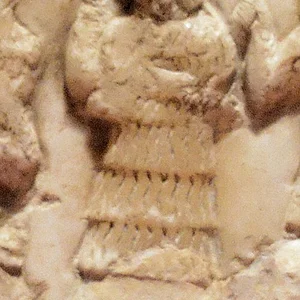

Enheduanna, high priestess of the moon god at Ur and daughter of Sargon of Akkad, is the first known author in history. Around 2300 BCE, she composed hymns to the goddess Inanna of rare poetic power, laying the foundations of world religious literature.
Enheduanna(2300 av. J.-C. — 2300 av. J.-C.)
Enheduanna
Empire akkadien
7 min read
Frequently asked questions
Key Facts
- Around 2285–2250 BCE: appointed high priestess of the moon god Nanna at Ur by her father Sargon of Akkad
- Wrote the *Exaltation of Inanna*, the first text signed by an identified author in the history of humanity
- Composed a cycle of 42 hymns to Sumerian temples, transmitted for centuries in scribal schools
- Her name means 'ornament of heaven' in Sumerian, reflecting her exceptional sacred status
- A limestone disc discovered at Ur in 1927 (now housed at the Penn Museum) depicts her officiating at a ritual
Works & Achievements
A 153-line poem in which Enheduanna celebrates and beseeches the goddess Inanna after her forced exile from the temple of Ur. It is the first text in history to express an individual inner experience signed by its author.
A hymn in which Enheduanna addresses Inanna by describing her cosmic omnipotence and her own distress as a human priestess. The text is remarkable for its alternation between theological praise and personal confession.
The third great hymn to Inanna, describing the warrior and creative power of the goddess. It completes the tripartite cycle that made Enheduanna the founding theologian of the cult of Inanna.
A corpus of 42 poems dedicated to each of the great temples of Mesopotamia, forming a religious and geographical inventory of the empire. This collection was used as a schoolbook in the edubba (scribal schools) for centuries.
Anecdotes
Enheduanna is the first author in history whose name has come down to us. Daughter of Sargon of Akkad, founder of the first world empire, she was appointed high priestess of the moon god Nanna at Ur around 2285 BCE. She signed her compositions with her own name at a time when writing was used almost exclusively for record-keeping.
A rebel named Lugal-Ane seized Ur and expelled Enheduanna from the temple. She experienced this exile as a spiritual ordeal and committed it to writing in her hymn 'The Exaltation of Inanna', imploring the goddess to restore her to her position. It is one of the earliest literary testimonies of a personal experience of injustice.
In 1927, archaeologist Leonard Woolley discovered at Ur a limestone disk depicting a woman in priestly attire surrounded by priests during a libation ceremony. An inscription on the back made it possible to identify her as Enheduanna herself — it is the oldest known nominative portrait of a woman to date.
Enheduanna composed 42 hymns dedicated to as many Sumerian temples, constituting a kind of religious cartography of Mesopotamia. This collection reveals a political as much as a spiritual intent: to unify Sumerian and Akkadian cults within her father's new empire.
Primary Sources
Queen of all divine rules, radiant light, woman clothed in divine light, beloved of Heaven and Earth, priestess of the temple of heaven... You who hold all divine rules in your hand, you have taken the sky, you have adorned yourself with it.
I am Enheduanna. I am the high priestess of Inanna. Oh Inanna, give me life. Declare that I am your servant... The month is fulfilled for me, the lyre of lamentation is laid upon the ground.
O house of Ur, founded in a pure place, ziggurat whose summit touches the sky, whose high priestess wears the divine crown upon her head, you whose charm is never exhausted...
Enheduanna, high priestess of Nanna, wife of the god Nanna, daughter of Sargon, king of Akkad — dedicated this object to the temple of the moon.
Key Places
Great Sumerian city where Enheduanna served as high priestess of the moon god Nanna. It is here that the disc depicting her and copies of her hymns were discovered.
Stepped temple dedicated to the moon god, the place of residence and priestly duties of Enheduanna. Still partially visible today, it is one of the best-preserved ziggurats in Mesopotamia.
Capital of the Akkadian Empire founded by Sargon, father of Enheduanna. Although the city has not yet been located, it was from here that the political power radiated which gave Enheduanna her role.
Major religious center of Mesopotamia and home to the most important scribal libraries. Numerous copies of Enheduanna's texts were found there, attesting to their canonization.
Typical Objects
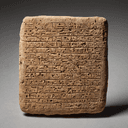
The universal writing medium in Mesopotamia, on which Enheduanna dictated or composed her hymns. Hundreds of copies of her texts have been found in scribal libraries, attesting to their circulation for more than a millennium.

A circular plaque 25 cm in diameter engraved in bas-relief depicting Enheduanna officiating at a libation. Discovered at Ur in 1927, it is the only named portrait of Enheduanna and one of the oldest portraits of an identified woman in history.

A container used in rituals to pour beer or oil as an offering to the gods. As high priestess, Enheduanna presided over these daily ceremonies at the top of the ziggurat of Ur.

A sacred musical instrument accompanying the singing of hymns in Sumerian temples. Enheduanna's compositions were most likely sung and accompanied on the lyre during religious services.

A cylindrical crown worn by high priestesses, a symbol of their divine and administrative status. It is visible on the Disk of Enheduanna.

An inscribed object driven into the walls of temples to commemorate their construction or renovation. Several cones mention Enheduanna as the dedicatee of sanctuaries.
School Curriculum
Vocabulary & Tags
Key Vocabulary
Tags
Lieu
Daily Life
Morning
At sunrise, Enheduanna led the dawn rituals at the top of the ziggurat of Nanna, offering libations of beer and scented oil to greet the moon god upon his return to the sky. She oversaw the priests and female singers (nar) in their liturgical chants, her own hymns being part of the daily program.
Afternoon
The afternoon was devoted to administering the temple estate: agricultural lands, granaries, herds, and weavers' workshops all fell under her management. She dictated or composed her texts to scribes in the temple scriptorium, working on the elaboration of her hymns and the codification of rituals.
Evening
At sunset, Enheduanna observed the rising moon — the tutelary star of Nanna, her god — and conducted the evening ceremonies. She took her meals with the senior priestesses in the reserved quarters of the sacred enclosure, surrounded by musicians playing the lyre.
Food
Enheduanna's diet, like that of the priestly elite, was based on barley bread, thick unfiltered beer, dates and figs, dried and grilled fish from the marshes and rivers, and sesame oil. Meat rations (lamb, kid) were reserved for major religious festivals and ritual banquets.
Clothing
Enheduanna wore a tiered fringed robe of dyed fine wool, characteristic of high-ranking Sumerian dress, known as 'kaunakes'. Her gilded cylindrical headdress (polos) signaled her status as high priestess. She wore jewelry in lapis lazuli, carnelian, and gold: beaded necklaces and crescent moon earrings in homage to Nanna.
Housing
Enheduanna resided in the priestly complex (gipar) adjoining the temple of Nanna at Ur, reserved for the high priestess. This fired-brick building comprised reception halls, a private sanctuary, storerooms, and quarters for attendants. Excavations have uncovered her gipar, which remained in use until the 6th century BCE.
Historical Timeline
Period Vocabulary
Visual Style
Esthétique sumérienne du XXIIIe siècle av. J.-C. : robes à franges en laine, coiffe cylindrique dorée, lapis-lazuli, bas-reliefs calcaires et tablettes d'argile gravées sous la lumière de lampes à huile.
Sound Ambience
Ambiance sonore d'un temple sumérien vers 2285 av. J.-C. : chants liturgiques, lyre dorée, tambour rituel et vent sur la ziggurat dominant la plaine alluviale du sud de la Mésopotamie.
Liens externes & ressources
Références
Œuvres
L'Exaltation d'Inanna (Inninsagurra)
vers 2285-2250 av. J.-C.
La Dame de toutes les règles divines (Ninmesarra)
vers 2270 av. J.-C.
L'Hymne à la Dame au cœur ardent (Inninmehusa)
vers 2270 av. J.-C.
Les 42 Hymnes des temples (Sumerian Temple Hymns)
vers 2270-2250 av. J.-C.