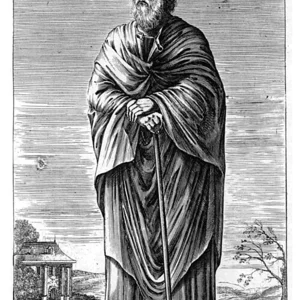

Pre-Socratic Greek philosopher and poet born in Colophon around 570 BC. He criticized the anthropomorphic polytheism of Homer and Hesiod, and argued for a single, universal, non-human god. A forerunner of rational theology and epistemology.
Xenophanes(569 av. J.-C. — 477 av. J.-C.)
Xenophanes
7 min read
Frequently asked questions
Famous Quotes
« If oxen and lions had hands and could paint, they would depict the gods in their own image.»
« The Ethiopians say their gods are dark-skinned and flat-nosed; the Thracians say theirs have blue eyes and red hair.»
Key Facts
- Born around 570 BC in Colophon (Ionia, present-day Turkey)
- Exiled from Colophon after the Persian conquest, he spent his life traveling throughout Greece
- Criticized the anthropomorphic portrayal of the gods in Homer and Hesiod
- Proposed the existence of a single, motionless god who governs all things through thought
- Died around 477 BC, having reportedly lived more than 90 years
Works & Achievements
A satirical poem in dactylic hexameters in which Xenophanes mocks popular religious beliefs, the anthropomorphic gods of Homer and Hesiod, and philosophers such as Pythagoras. It is one of the earliest literary critiques of Greek religion.
Poems in elegiac couplets intended for symposia, in which Xenophanes champions wisdom, rational piety, and moderation over violent mythological narratives. They form a program of moral and cultural reform.
A philosophical work in verse, now lost, in which Xenophanes set out his cosmology and rational theology. He developed the idea of a single, motionless, non-anthropomorphic god governing the universe by thought alone.
A historical and geographical poem recounting the origins of his hometown and the founding of Greek colonies. It reflects Xenophanes' interest in the history of his community and the memory of the Ionian cities.
Anecdotes
Xenophanes observed that the Ethiopians depicted their gods as dark-skinned and flat-nosed, while the Thracians imagined theirs as blond and blue-eyed. He drew a bold conclusion from this: if oxen and lions could draw, they would paint their gods in their own image. This observation laid the groundwork for one of the earliest critiques of religious anthropomorphism in history.
Exiled from his native city of Colophon during the Persian conquest around 545 BC, Xenophanes wandered from city to city for more than sixty-seven years, by his own account. He made his living reciting his poems at banquets and public gatherings, carrying his philosophy from one Greek city to the next like a traveling rhapsode.
Xenophanes discovered fossilized shells embedded in inland rocks and stone quarries. He concluded that these regions had once been covered by the sea, formulating one of the earliest paleontological and geological insights of antiquity — long before modern science confirmed these cycles of submersion and emergence.
In his banquet elegies, Xenophanes condemned the habit of recounting the wars of Titans and battles of giants at feasts. He believed these violent myths corrupted the mind, and that wisdom and piety should be celebrated instead. He called for a moral reform of Greek poetic culture, directly challenging the authority of Homer.
Xenophanes lived to an exceptionally old age, surpassing ninety years. In one surviving fragment, he himself mentions having wandered throughout Greece for sixty-seven years since his exile, adding that he was twenty-five when he left Colophon. This remarkable longevity fed the legend of a tireless sage who never settled in one place.
Primary Sources
If oxen, horses, and lions had hands and could paint and create works of art as men do, horses would depict the gods in the form of horses and oxen in the form of oxen.
There is one god, the greatest among gods and men, who resembles mortals neither in body nor in mind.
No man has seen certain truth, nor will any man ever know it, neither about the gods nor about all the things I speak of; for even if one should happen to say something perfectly accurate, one would still not know it — it is opinion that is woven through all things.
Xenophanes says that the mixing of the earth with the sea takes place, and that in time the earth dissolves into moisture; he claims to have proof of this in the shells found inland and in the mountains.
The floor is clean now, and clean too are everyone's hands and the cups. One man sets out woven garlands, another passes fragrance in a flask. The mixing bowl stands full of cheer. Another wine is there, one that claims never to fail, sweet in the jars and smelling of flowers.
Key Places
Xenophanes' birthplace on the western coast of Asia Minor, a hub of rich Ionian intellectual culture. It was here that he received his education before being driven out by the Persian conquest around 545 BCE.
A city of Magna Graecia where Xenophanes is said to have spent considerable time, and where ancient sources presented him as an inspiration for the Eleatic school founded by Parmenides. His influence on Eleatic thought was significant.
Major Greek cities in Sicily that Xenophanes visited during his wanderings. He is said to have stayed at the courts of Sicilian tyrants, where he recited his philosophical poems.
The intellectual capital of Ionia and birthplace of Thales, Anaximander, and Anaximenes. Xenophanes was familiar with their theories and distinguished himself from them through his theological and epistemological approach.
Typical Objects

A portable writing tool indispensable to the wandering philosopher for jotting down his poems and reflections. Xenophanes composed his verses while traveling and memorized them for recitation.

A large vessel used to mix wine and water at banquets (*symposia*). Xenophanes alluded to it in his convivial elegies, advocating moderate drinking and enlightening conversation.

A symbol of Xenophanes' philosophical wandering, as he traveled across the Greek Mediterranean world for more than sixty-seven years. The philosopher described himself as a perpetual stranger.

Xenophanes collected fossilized shells from quarries and mountains to support his theory of earthly cycles. These rock fragments became for him tangible proof of the world's transformation over time.

An adornment worn by poets and performers at banquets and festivities. As a wandering poet-philosopher, Xenophanes was crowned with laurel at the *symposia* where he declaimed his works.

An instrument that traditionally accompanied the recitation of poems at Greek banquets. Xenophanes' elegies were in all likelihood performed to the sound of music, in keeping with the practice of his era.
School Curriculum
Vocabulary & Tags
Key Vocabulary
Tags
Daily Life
Morning
Xenophanes rose at dawn in a modest guest lodging or at the home of a patron in whatever city he was visiting. He devoted the early hours to composing and memorizing his poems, using the morning quiet to work out his philosophical arguments about the gods and the nature of the world.
Afternoon
In the afternoon, he would make his way to the agora or the gymnasiums to engage citizens, local sophists, and young philosophers in debate. He also observed the surrounding natural world — fossils in cliff faces, clouds, the behavior of the stars — feeding his cosmological reflections.
Evening
Evenings were given over to the symposium, the intellectual banquet where Xenophanes recited his elegies and satires before a prosperous audience. There he criticized the myths of Homer, defended his vision of a single god, and urged his hosts to favor wisdom over tales of divine warfare.
Food
Like most Greeks of his era, Xenophanes lived primarily on grains (barley and wheat), olives, figs, pulses, and fish. At banquets he drank wine diluted with water, and he himself advocated sobriety and moderation in eating.
Clothing
Xenophanes wore the himation, a large woolen cloak draped over the body, along with a simple linen chiton. As an itinerant philosopher, his clothing was modest and practical for travel, with none of the ornamentation worn by aristocrats or priests.
Housing
Having no fixed home after his exile from Colophon, Xenophanes lived with hosts or in guest houses in the cities he passed through. These dwellings were built of stone and mudbrick, with an interior courtyard, simple rooms, and sparse furnishings, in keeping with the Archaic Greek standard.
Historical Timeline
Period Vocabulary
Visual Style
Style visuel sobre et archaïque inspiré de la céramique ionienne à figures noires et rouges, avec des tons ocre, terracotta et bleu méditerranéen profond évoquant la Grèce présocratique.
Sound Ambience
L'ambiance sonore d'un banquet philosophique grec antique : voix de récitants, lyre douce, vent marin ionien et crépitement de brasero dans une maison de pierre.
Liens externes & ressources
Références
Œuvres
Silloi (Satires)
vers 530-500 av. J.-C.
Élégies de banquet
vers 540-490 av. J.-C.
Sur la nature (Peri physeos)
vers 520-480 av. J.-C.
Fondation de Colophon et colonisation d'Élée
vers 500 av. J.-C.