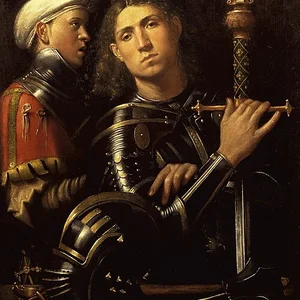

A fifteenth-century Italian condottiere, Erasmo da Narni — nicknamed "Gattamelata" (the honeyed cat) — was one of the greatest mercenary military commanders of his time. He is best known for inspiring Donatello to create the first large equestrian bronze statue of the Renaissance, erected in Padua.
Erasmo da Narni (Gattamelata)
Erasmo da Narni, known as Gattamelata
8 min read
Frequently asked questions
Key Facts
- Born around 1370 in Narni (Umbria), died in 1443 in Padua
- Condottiere in the service of the Republic of Venice from 1434
- Donatello created his bronze equestrian statue in Padua (1443–1453), the first large equestrian statue cast in bronze since Antiquity
- The Gattamelata statue on the Piazza del Santo in Padua is a masterpiece of Renaissance sculpture
- His nickname "Gattamelata" literally means "golden cat" or "honeyed cat," evoking his cunning
Works & Achievements
As Captain-General, Gattamelata commanded all Venetian land forces for eight years, consolidating the Lombard borders and repelling the offensives of the Visconti of Milan.
Gattamelata organized the resistance of Brescia, besieged by the Milanese. This campaign, crowned by the feat on Lake Garda, is considered his military masterpiece and durably consolidated Venetian dominance in Lombardy.
An unprecedented logistical undertaking: Gattamelata had Venetian galleys hauled over the Alps and launched onto Lake Garda. This feat, worthy of the great generals of antiquity, turned the military situation in Venice's favor.
Cast in bronze after his death by Donatello at the order of the Venetian Senate, this statue on the Piazza del Santo in Padua is the first large equestrian sculpture of the Renaissance and the work that immortalized Gattamelata for posterity.
Anecdotes
The nickname “Gattamelata” — literally “honeyed cat” — perfectly captured the dual nature of Erasmo da Narni: fierce and unpredictable in battle like a feline, yet charming and skillful in diplomacy. Some chroniclers traced the nickname back to his mother’s name, Melania Gattelli, but it was the image of the honey-ribboned cat that remained attached to him throughout his career.
In 1439, during the war against the Visconti of Milan, Gattamelata accomplished what was considered an impossible feat: he had a flotilla of Venetian galleys transported overland, across the mountains of Trentino, and relaunched on Lake Garda. This bold move allowed Venice to break the Milanese blockade and resupply the besieged city of Brescia, and remains one of the most spectacular military exploits of the Italian Renaissance.
When Gattamelata died in Padua in January 1443, the Republic of Venice wished to honor its faithful captain in an unprecedented way: it authorized the erection of a life-size bronze equestrian statue, entrusting this masterpiece to the sculptor Donatello. Inaugurated around 1453 on the Piazza del Santo, the statue became the first great bronze equestrian sculpture of the Renaissance, directly inspired by the equestrian monuments of ancient Rome.
Although Gattamelata is today best known through the statue that bears his name, in his own lifetime he was one of the highest-paid and most respected condottieri in Italy. The Republic of Venice granted him the title of Captain General of its land forces in 1434 and awarded him exceptional princely privileges — a mark of the absolute trust it placed in him to defend its Lombard borders.
Primary Sources
The Senate of the Most Serene Republic authorizes the erection of an equestrian monument in honor of Erasmo da Narni, known as Gattamelata, in recognition of his loyal and eminent services rendered to the Republic, at the expense of his heirs and with the blessing of the Council.
The Serenissima agrees to entrust Erasmo da Narni, known as Gattamelata, with the position of Captain General of its land forces, with the honors, wages, and prerogatives attached to this function, for the duration of the ongoing campaigns in Lombardy.
Erasmus of Narni, surnamed Gattamelata for the prudence and valor he knew how to blend in equal measure, was the most accomplished military commander of his time, and his memory is perpetuated by the admirable work of Donatello erected before the temple of the Saint in Padua.
And Captain Gattamelata, through an enterprise deemed impossible by all, had the galleys of the fleet carried over the heights of the mountains and relaunched on the other side, onto the great lake, showing everyone that boldness and the art of war can overcome even the obstacles of nature.
Key Places
Birthplace of Erasmo da Narni, perched on the heights of Umbria in central Italy. It was from this ancient city, a former Roman colony, that he took his surname — as was common practice at the time.
The city where Gattamelata spent his final years and died in 1443. It is on its main square, facing the Basilica of Saint Anthony, that Donatello erected the famous bronze equestrian statue that perpetuates his memory.
The republic that employed Gattamelata as Captain General of its land armies from 1434. The Serenissima granted him exceptional honors and privileges, and commissioned his statue after his death.
The setting of the great logistical feat of 1439: Gattamelata had Venetian galleys transported overland across the mountains to be launched on the lake, breaking the Milanese blockade and saving the besieged city of Brescia.
The Lombard city that Gattamelata helped defend and supply during Venice's wars against the Visconti. It was the central prize of the 1438–1440 campaign and the stage for his most celebrated exploit.
Typical Objects

In the 15th century, the great condottieri wore full plate armor covering the entire body, a symbol of wealth and power. Donatello immortalized Gattamelata in this military equipment, which attests to the prestige of Renaissance warlords.

Symbol of supreme military authority, the baton of command was presented by the Signoria to the Captain General. In Donatello's statue, Gattamelata holds it firmly, signifying his exceptional power over all Venetian armies.

A legal document binding the condottiere to his employer, specifying the number of lances, the duration of service, and the salary. Gattamelata negotiated several with Venice, some worth considerable sums in gold ducats.

The destrier was the powerful warhorse of heavy cavalry, trained to withstand the chaos of battle. The monumental horse depicted by Donatello beneath Gattamelata symbolizes the condottiere's tactical mastery and his dominance of the battlefield.

A prestigious weapon of the heavy cavalryman, the sword represented noble dignity and the capacity for command. The great condottieri carried richly ornamented swords, testaments to their elevated social standing.

The centerpiece of late Gothic armor, the closed helmet protected the face in combat. Donatello chose to depict Gattamelata bareheaded — a deliberate choice inspired by equestrian portraits of Roman Antiquity, intended to heroize his subject.
School Curriculum
Vocabulary & Tags
Key Vocabulary
Daily Life
Morning
Gattamelata rose before dawn to receive reports from his scouts and inspect the camp or the garrisoned troops. He held council with his lieutenants around a campaign table covered with maps, planning the day's movements and issuing orders.
Afternoon
The afternoon was devoted to troop maneuvers, negotiations with allied cities, or military operations. In peacetime, he received Venetian ambassadors, signed *condotte*, and administered the territories under his protection.
Evening
In the evening, Gattamelata dined with his staff, discussing strategy and Italian politics. He would sometimes dictate letters to the Signoria of Venice to report on the military situation or request reinforcements and supplies for his troops.
Food
Like any captain of rank, Gattamelata ate roasted meat, bread, vegetables, and drank wine mixed with water according to Italian custom. On campaign, food was more frugal: bread, salt pork, cheese, and dried legumes made up the daily fare of the mercenary soldier.
Clothing
In battle, Gattamelata wore a full plate armor of polished steel, with helmet, gauntlets, and metal sabatons. Off the battlefield, he dressed in quality garments — an embroidered surcoat, fine wool breeches, and a chaperon — reflecting his wealth and his rank as captain-general.
Housing
On campaign, Gattamelata lodged in a large command tent furnished with chests, a table, and a camp bed. In cities, he occupied the governor's palace or a patrician residence placed at his disposal by the Serenissima, as in Padua, where he spent his final years.
Historical Timeline
Period Vocabulary
Liens externes & ressources
Références
Œuvres
Capitanat général des armées de la République de Venise
1434-1442
Campagne de défense de Brescia contre les Visconti
1438-1440
Transport de la flotte vénitienne par voie terrestre sur le lac de Garde
1439