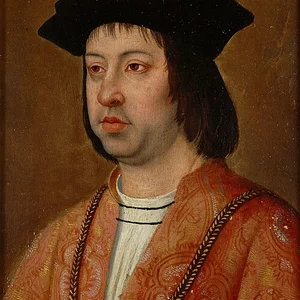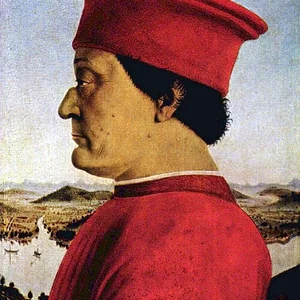

Condottiere and lord of Urbino (1422–1482), Federico da Montefeltro was one of the most cultured princes of the Italian Renaissance. An exceptional patron of the arts, he made Urbino a major artistic center, commissioning his famous profile portrait from Piero della Francesca.
Federico da Montefeltro(1422 — 1482)
Frederick III of Montefeltro
duché d'Urbino
8 min read
Frequently asked questions
Key Facts
- 1422: born in Gubbio, illegitimate son of the Count of Montefeltro
- 1444: becomes lord of Urbino following the assassination of his half-brother
- Around 1472: Piero della Francesca paints his famous diptych with his wife Battista Sforza
- 1474: elevated to the rank of Duke of Urbino by Pope Sixtus IV
- 1482: died in Ferrara, leaving behind one of the richest palace-libraries in Europe
Works & Achievements
Designed by Luciano Laurana and then Francesco di Giorgio Martini, this palace is one of the masterpieces of Renaissance architecture. It embodies Federico's ambition to make Urbino a model humanist city, and is today a UNESCO World Heritage Site.
Federico assembled more than a thousand illuminated manuscripts, creating one of the richest libraries in Europe. After his death, the collection was transferred to Rome and formed the core of the Vatican Apostolic Library.
An intimate study decorated with trompe-l'œil intarsia panels and 28 portraits of illustrious figures painted by Justus of Ghent and Pedro Berruguete. It embodies the humanist ideal of the scholarly prince who unites the sword and the pen.
Federico drew the greatest artists of his time to Urbino. The celebrated diptych painted by Piero della Francesca depicting Federico and his wife Battista Sforza (now in the Uffizi in Florence) is one of the most iconic portraits of the Renaissance.
Federico reformed the discipline and logistics of his mercenary armies, enabling him to win numerous campaigns without ever suffering a major defeat and establishing his methods as a military model throughout Italy.
Anecdotes
During a tournament in 1450, Federico da Montefeltro lost his right eye and had his nose broken. To compensate for this visual impairment, he had the bridge of his nose carved away to widen his left field of vision. This is why all his official portraits, notably that by Piero della Francesca, show him in left profile: a battle wound transformed into a posture of dignity.
Despite his reputation as a formidable condottiere, Federico had never lost a battle throughout his entire military career. Italian cities and princes competed fiercely for his services at great expense, and he accumulated victories while scrupulously honoring his contracts — a reliability so rare that it underpinned his fortune as much as his martial exploits.
Federico rose every morning before dawn and had texts by Livy, Cicero, or Saint Thomas Aquinas read aloud while he put on his armor. He employed some forty copyists to build his library, which he refused to supplement with printed books, considering that illuminated manuscripts alone were worthy of a princely collection.
In 1474, Pope Sixtus IV — who owed him several military victories — bestowed upon him the title of Duke of Urbino and sent him a blessed sword and baton of command. Federico had this honor commemorated in his studiolo and commissioned Justus of Ghent to paint a portrait showing him reading a book, armored, beside his young son Guidobaldo: the very image of the ideal prince combining strength and learning.
The studiolo of the Palazzo Ducale in Urbino, a small study decorated with wood inlay (intarsia) depicting books, scientific instruments, and suits of armor in trompe-l'œil, has remained one of the absolute masterpieces of the Renaissance. Federico received humanists there and reflected in solitude; he wished this space to embody the ideal of the prince as man of letters as much as warrior.
Primary Sources
Federico was a lord of such a nature that, when obliged to fight his enemy, he never wished to have the advantage over him, but always on equal terms; and if the enemy was inferior in number, he would wait until the enemy had reinforced his forces.
To the excellence of the lord Federico, Duke of Urbino, light of Italy, to whom this work is dedicated with all reverence, on account of his singular *virtù* and singular learning.
Among his other praiseworthy customs in the harsh exercise of war, Federico had most steadfastly maintained that no harm whatsoever should be done to the poor farm laborers in his lands.
Among the Latin and Greek books in His Lordship's possession, which are written by hand and illuminated, one finds Livy, Pliny, Cicero, Virgil, and many other ancient authors, all on the finest vellum.
Key Places
Federico's birthplace (7 February 1422), he also had a ducal palace built there, reflecting his attachment to this Umbrian city under his authority.
A masterpiece of Renaissance architecture designed by Luciano Laurana, this palace was Federico's principal residence and the radiant center of his humanist court. A UNESCO World Heritage Site, it now houses the Galleria Nazionale delle Marche.
Federico received his humanist education here at the renowned Casa Giocosa of Vittorino da Feltre, where children of Italy's great princely families studied together, forging lasting networks.
Federico led the siege and sack of the city in 1472, in the service of Lorenzo de' Medici. This brutal episode stands in stark contrast to his image as an enlightened prince and remains one of the darker chapters of his biography.
Federico died in this city on 10 September 1482, during the War of Ferrara, while commanding the forces of the Italian League against Venice, bringing a forty-year military career to an end.
Typical Objects

Symbol of military authority presented to the captain upon signing a condotta, this short staff of precious wood and metal embodied the contractual bond between Federico and his employers. He received many such staffs over the course of his career.

Federico owned high-quality armors forged by the finest Milanese armorers. He wears one magnificently depicted in the diptych by Piero della Francesca, where he appears as a triumphant warrior-prince.

A passionate book lover, Federico had more than a thousand manuscripts copied by the finest calligraphers and illuminators in Italy. His library, considered the most beautiful in Europe after the Vatican's, contained Greek, Latin, and Hebrew texts.

The studiolo of the Palazzo Ducale features, in trompe-l'œil, an armillary sphere, an astrolabe, and various geometric measuring instruments, reflecting Federico's deep interest in science and natural philosophy.

Celebrated medallists struck portrait medals of Federico that circulated throughout Italy to assert his prestige. These small, portable objects served as princely propaganda in the age before printing.

A legal document signed between Federico and his employers, specifying the number of soldiers, the length of the campaign, and the pay. These contracts, sometimes enormously lucrative, laid the financial foundation that allowed him to fund his great projects.
School Curriculum
Vocabulary & Tags
Key Vocabulary
Daily Life
Morning
Federico rose before dawn and attended a private Mass in the palace oratory. A reader would then read him texts from Livy, Cicero, or the Church Fathers while he put on his armor or court attire, depending on whether he was inspecting his troops or receiving ambassadors.
Afternoon
Afternoons were devoted to military affairs, diplomatic audiences, and negotiations with the artists and humanists he welcomed at his court. Federico personally oversaw the construction work on the Palazzo Ducale and discussed geometry and perspective with the resident architects and painters.
Evening
Evenings unfolded in long scholarly discussions at the dinner table, where Federico enjoyed debating philosophy, theology, and history with the humanists at his court. He retired early, after dictating his letters and reviewing the accounts of his *condotte*, as rigorous in managing his finances as he was in his reading.
Food
Federico's table met the aristocratic standards of the Renaissance: roasted meats, game, fish on fast days, vegetables from the princely kitchen garden, and wines from the Marche hills. By all accounts he ate soberly, preferring intellectual discussion to gastronomic excess.
Clothing
In peacetime, Federico wore velvet and silk garments in his livery colors (red and gold), lined with fur in winter. In war, he donned a full suit of Milanese-made armor; in his *studiolo*, he is often depicted in armor but without a helmet, a sign that he governed as a soldier even in his private life.
Housing
Federico lived primarily at the Palazzo Ducale in Urbino, which he had entirely rebuilt from 1465 onward to make it one of the most refined palaces in Italy. The space was organized around a central arcaded courtyard, with princely apartments, a library, artists' workshops, and the famous private *studiolo* overlooking the Marche countryside.
Historical Timeline
Period Vocabulary
Liens externes & ressources
Références
Œuvres
Construction du Palazzo Ducale d'Urbino
vers 1460-1482
Constitution de la Bibliothèque ducale d'Urbino
années 1450-1482
Studiolo du Palazzo Ducale d'Urbino
vers 1473-1476
Mécénat : commandes à Piero della Francesca, Juste de Gand, Pedro Berruguete
années 1460-1480
Modernisation de l'organisation des compagnies condottières
1444-1482