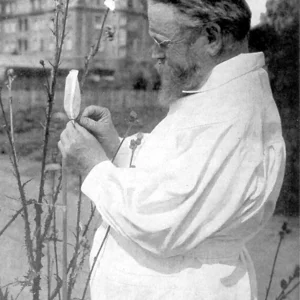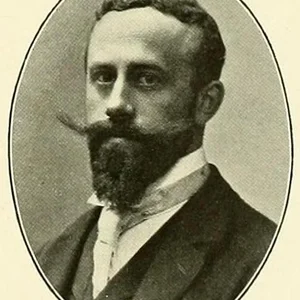

Erich von Tschermak-Seysenegg was an Austrian agronomist and botanist. He was one of three scientists who, in 1900, independently rediscovered the laws of heredity set out by Gregor Mendel, contributing to the birth of modern genetics.
Erich von Tschermak(1871 — 1962)
Erich von Tschermak-Seysenegg
Autriche, Troisième Reich, Autriche-Hongrie
5 min read
Frequently asked questions
Key Facts
- Born on 15 November 1871 in Vienna, into a family of scientists (his father was a mineralogist).
- In 1900, he rediscovered Mendel's laws of heredity, simultaneously with and independently of Hugo de Vries and Carl Correns.
- Carried out work on the improvement of cultivated plants and developed new varieties of cereals (hybridization of wheat and rye).
- A professor at the College of Agriculture in Vienna, he applied Mendelian principles to agriculture.
- Died on 11 October 1962 in Vienna.
Works & Achievements
Alongside de Vries and Correns, he brought the principles of heredity back to light, founding modern genetics.
Paper reporting his crossbreeding experiments on the cultivated pea and the regularity with which traits are passed on.
Applying genetics to the creation of more productive and resilient varieties of wheat and barley.
Development of hybrids intended to improve agricultural yields, including work on triticale (a wheat-rye cross).
Training generations of agronomists in the scientific breeding of plants according to Mendelian principles.
An autobiographical synthesis of his career and his contribution to the history of heredity.
Anecdotes
In 1900, at just 29 years old, Erich von Tschermak was one of three botanists — alongside Hugo de Vries and Carl Correns — who almost simultaneously, and independently of one another, rediscovered Gregor Mendel's forgotten laws of heredity. This triple rediscovery has remained famous as a striking example of multiple discovery in the history of science.
Erich was the grandson of the mineralogist Gustav Tschermak and the brother of the great mineralogist Armin von Tschermak: science was truly a family affair. He himself, however, chose agronomy and plant breeding over rocks.
It was while trying to understand crosses of garden peas and ornamental plants that Erich came across Mendel's old work, published in 1866 but left completely ignored for more than thirty years in a regional journal from Brno.
Tschermak did not stop at theories: he applied the young science of genetics to the improvement of cultivated plants, notably creating more resistant cereal varieties and hybrids designed to feed people better.
Some historians of science have debated the true extent of his understanding of Mendel's laws in 1900, judging that he had formulated them less clearly than de Vries or Correns; the debate over the “third rediscoverer” still fuels history of science courses.
Primary Sources
Tschermak reports his cross-breeding experiments on the cultivated pea and concludes that characters are transmitted in a regular way according to constant ratios, confirming Mendel's results.
Here he presents the rediscovery of Mendel's laws as the foundation of a new science of heredity, destined to transform agriculture.
Tschermak looks back on his career as a plant breeder and on the role he believes he played in the rediscovery of Mendelian principles in 1900.
Key Places
Birthplace of Erich von Tschermak and a major scientific center of the Austro-Hungarian Empire, where he spent most of his life.
Agricultural college where Tschermak was a professor and carried out his work in genetics applied to plant breeding.
University where Tschermak completed his training in natural sciences before devoting himself to plant breeding.
City where Mendel had conducted and published his experiments; the symbolic birthplace of the laws rediscovered in 1900 by Tschermak and his colleagues.
Typical Objects

Pisum sativum grown in rows and hand-crossed to study the transmission of traits (seed color and shape). The model plant of early genetics.

A fine brush used to transfer pollen from one flower to another and carry out controlled crosses. The basic tool of the plant breeder.

A register in which the researcher methodically records each cross and counts the offspring to establish the Mendelian ratios. The written memory of the experiment.

A handheld magnifier for examining flowers, stamens and seeds during crossings. Indispensable for telling fine traits apart.

Small paper packets that store and label the seeds from each lineage to track successive generations. They ensure the traceability of the lines.

An experimental field divided into plots where the selected varieties are grown and compared in the open air. The place where hybrids are validated on a large scale.
School Curriculum
Vocabulary & Tags
Key Vocabulary
Daily Life
Morning
Tschermak often started his day early, going out to his greenhouses and trial plots to observe the plants in the cool of the morning. He checked on the crosses in progress and jotted down his observations before classes began.
Afternoon
His afternoons were split between teaching at the College of Agriculture and laboratory work, where he counted the offspring of his crosses to work out the hereditary ratios. He also exchanged ideas with his students and assistants.
Evening
In the evening, he went through his notebooks, wrote articles and scientific correspondence, and kept up with the international debates on heredity. Reading scholarly journals took up a good part of his evenings.
Food
Like the Viennese middle class of his day, he ate bread, meats, vegetables from the garden, dairy products, and pastries typical of Austria. Viennese coffee was a welcome companion during his hours of work.
Clothing
He wore the plain attire of an early-20th-century professor: a three-piece suit, a stiff-collared shirt, and a necktie, and for fieldwork, a smock or apron to protect his clothes.
Housing
He lived in a middle-class house or apartment in Vienna, close to his institute, surrounded by books, herbaria, and notes. Greenhouses and experimental plots rounded out his working environment.
Historical Timeline
Period Vocabulary
Liens externes & ressources
Références
Œuvres
Redécouverte des lois de Mendel
1900
Über künstliche Kreuzung bei Pisum sativum
1900
Travaux de sélection des céréales
vers 1905-1930
Création d'hybrides de plantes cultivées
début du XXe siècle
Enseignement à la Hochschule für Bodenkultur
à partir de 1906
Mémoires et écrits sur la génétique végétale
1958