
American writer and journalist, a major figure of 20th-century literature. A master of a spare, stripped-down style, he left his mark on the modern novel and received the Nobel Prize in Literature in 1954.
Ernest Hemingway(1899 — 1961)
Ernest Hemingway
États-Unis
6 min read
Frequently asked questions
Famous Quotes
« Man is not made for defeat. A man can be destroyed but not defeated.»
Key Facts
- Born in 1899 in Oak Park, Illinois, he served as an ambulance driver on the Italian front in 1918
- Published The Sun Also Rises (1926) and then A Farewell to Arms (1929), successes of the Lost Generation
- Covered the Spanish Civil War, the source of For Whom the Bell Tolls (1940)
- Published The Old Man and the Sea (1952), winning the 1953 Pulitzer Prize
- Received the Nobel Prize in Literature in 1954, and took his own life in 1961 in Idaho
Works & Achievements
His first major novel, a portrait of the “Lost Generation” set between Paris and Pamplona, which established his reputation.
A novel of love and war inspired by his experience on the Italian front in 1918.
An essay on Spanish bullfighting, in which he also sets out his conception of style and writing.
A famous short story born of his African safaris, a meditation on failure and death.
A novel set during the Spanish Civil War, a huge international success.
A short tale of an old Cuban fisherman battling a giant marlin; awarded the Pulitzer Prize.
The supreme honor for his mastery of narrative and his influence on modern style.
Memoirs of his Paris years in the 1920s, published after his death.
Anecdotes
In July 1918, at the age of eighteen, Hemingway was driving a Red Cross ambulance on the Italian front when an Austrian mortar shell exploded near him at Fossalta di Piave. Though severely wounded in the legs by shrapnel, he is said to have helped an Italian soldier to safety. Italy awarded him the Silver Medal of Military Valor.
In December 1922, his first wife Hadley wanted to bring him his writings in Lausanne, where he was covering a conference. On the train, at the Gare de Lyon in Paris, the suitcase containing nearly all of the young writer's manuscripts was stolen, including the carbon copies. Hemingway thus lost the bulk of his early work, a catastrophe that haunted him for a long time.
In January 1954, during a safari in Africa, Hemingway survived two plane crashes on two consecutive days. The world believed him dead and several newspapers published his obituary: he thus had the rare chance to read his own death notices, which amused him greatly.
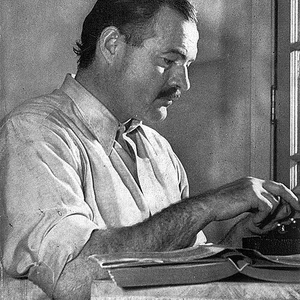
Hemingway had the habit of writing standing up, often early in the morning, scrupulously counting the words he produced each day. He championed an aesthetic of spareness, his famous “iceberg theory”: what is left unsaid, the submerged part, gives the text its power.
At his home in Key West, Florida, a ship's captain is said to have given him a six-toed (polydactyl) cat. To this day, dozens of descendants of these cats with extra toes still live in the writer's house-museum.
Primary Sources
Writing, at its best, is a lonely life. A writer works alone, and if he is a good writer, he must face eternity, or the lack of it, each day.
In the late summer of that year we lived in a house in a village that looked across the river and the plain to the mountains.
He was an old man who fished alone in a skiff in the Gulf Stream and he had gone eighty-four days now without taking a fish.
If you are lucky enough to have lived in Paris as a young man, then wherever you go for the rest of your life, it stays with you, for Paris is a moveable feast.
Key Places
Affluent suburb of Chicago where Hemingway was born on July 21, 1899 and spent his childhood.
In the early 1920s, he lived in the Latin Quarter and frequented the Shakespeare and Company bookshop as well as the expatriate writers of the “Lost Generation.”
Home of the San Fermín festival and its running of the bulls, which inspired The Sun Also Rises.
Hemingway lived here in the 1930s, writing and fishing; his house is now a museum populated by polydactyl cats.
Villa near Havana where he lived for nearly twenty years and wrote The Old Man and the Sea.
Site of his final home, where he took his own life on July 2, 1961.
Typical Objects

Hemingway typed his texts on a typewriter, but often wrote his first drafts by hand, in pencil, before producing clean copies. He frequently wrote standing up.

As a journalist and war correspondent, he took notes in the field, in Italy, in Spain and then in France.

A passionate big-game fisherman, he hunted swordfish and marlin in the Gulf Stream aboard his boat. This experience fed into *The Old Man and the Sea*.

A fishing yacht bought in 1934, the *Pilar* was his companion on outings at sea off Cuba and Florida. During the war, he even used it to patrol in search of German submarines.

A keen hunter during his safaris in Africa, he handled rifles and carbines. It was with a shotgun that he took his own life in 1961.

In Havana, Hemingway frequented bars where he enjoyed these Cuban cocktails, which became inseparable from his legend.
School Curriculum
Vocabulary & Tags
Key Vocabulary
Tags
Daily Life
Morning
Hemingway wrote early in the morning, at dawn, when the air was still cool and the mind clear. He often worked standing up at a lectern, and scrupulously noted the number of words he had written each day.
Afternoon
The afternoon was devoted to resting from writing and to physical activities: deep-sea fishing aboard the *Pilar*, hunting, swimming, or long stretches of reading. He loved being outdoors, in contact with nature and the sea.
Evening
Evenings were happily spent in cafés and bars, conversing, drinking, and meeting up with friends and fellow writers. In Paris as in Havana, the nightlife and its sociability fed his inspiration.
Food
A bon vivant, he enjoyed simple, hearty dishes and the fresh fish he caught himself, but also wine, whiskey, and Cuban cocktails such as the daiquiri. His reputation as a heavy drinker is part of his legend.
Clothing
He cultivated a rugged, casual look: open shirts, fisherman's sweaters, hunting jackets, and sometimes a cap or a pair of outdoor shorts. His salt-and-pepper beard became one of his most recognizable features.
Housing
Depending on the period, he lived in modest Paris apartments, a colonial house in Key West, and then the spacious villa of the Finca Vigía in Cuba, surrounded by trees, cats, and thousands of books.
Historical Timeline
Period Vocabulary
Liens externes & ressources
Références
Œuvres
Le Soleil se lève aussi (The Sun Also Rises)
1926
L'Adieu aux armes (A Farewell to Arms)
1929
Mort dans l'après-midi (Death in the Afternoon)
1932
Les Neiges du Kilimandjaro (The Snows of Kilimanjaro)
1936
Pour qui sonne le glas (For Whom the Bell Tolls)
1940
Le Vieil Homme et la Mer (The Old Man and the Sea)
1952
Prix Nobel de littérature
1954