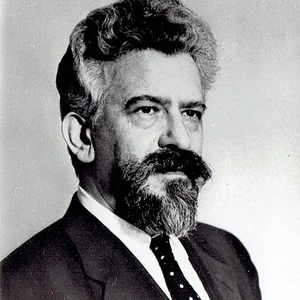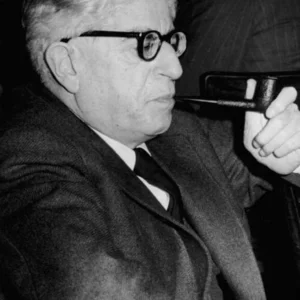

Ernst Bloch (1885-1977) was a German philosopher and a major figure of heterodox Marxism. He developed a philosophy of hope and utopia, seeing in the "hope principle" a driving force of human history.
Ernst Bloch(1885 — 1977)
Ernst Bloch
Suisse, Royaume-Uni, Allemagne, Tchéquie
5 min read
Frequently asked questions
Famous Quotes
« What is essential is not yet.»
Key Facts
- Born in 1885 in Ludwigshafen, Germany
- Forced into exile by Nazism, he emigrated to the United States in 1938, where he wrote his major work
- Published “The Principle of Hope” (Das Prinzip Hoffnung) between 1954 and 1959
- A professor in Leipzig in East Germany, he broke with the regime and moved to the West in 1961 (University of Tübingen)
- Died in 1977 in Tübingen, West Germany
Works & Achievements
First major work, written during the war, laying the foundations of a philosophy oriented toward the future and the possible.
A study of the revolutionary leader of the Peasants' War, read as a figure of revolutionary hope.
An analysis of the rise of Nazism and the way it exploits the still-unfulfilled dreams and fears of the masses.
His masterwork in three volumes, a vast exploration of hope and utopia as driving forces of human history.
A reflection on human rights and dignity as extensions of the utopian aspiration toward a just society.
A bold rereading of the Bible in which Bloch detects a core of hope and revolt at the heart of the religious tradition.
Anecdotes
During the First World War, Ernst Bloch refused to support German militarism and went into exile in Switzerland. It was there that he wrote his first major book, *The Spirit of Utopia*, composed in the fever of the upheavals of 1914-1918.
Bloch was a close friend of the philosopher Georg Lukács during their youth in Heidelberg and Budapest. The two men shared their ideas with such intensity that those around them spoke of them as a single mind in two bodies, before politics drove them apart.
When Hitler came to power in 1933, Bloch, a Jew and a Marxist, was forced to flee Germany. He spent eleven years in exile, including a long period in the United States, where he wrote his masterwork, *The Principle of Hope*, in poverty.
Having settled in East Germany after the war to teach there, Bloch ended up being sidelined by the communist regime, which considered his thought too free. In 1961, during the construction of the Berlin Wall, he was in the West and chose not to return, becoming a professor at Tübingen.
Primary Sources
To think is to venture beyond. The essential thing is to learn how to hope.
I am. We are. That is enough. Now it is up to us to begin.
Not all people live in the same Now.
Key Places
Industrial city in southwestern Germany where Ernst Bloch was born in 1885 and grew up across from the BASF chemical plant.
University town where the young Bloch frequented intellectual circles, notably around Max Weber, and struck up his friendship with Georg Lukács.
Bloch's refuge during the First World War, where he wrote *The Spirit of Utopia*.
Site of his American exile during the Nazi era, where Bloch wrote *The Principle of Hope* in precarious conditions.
University where Bloch taught philosophy from 1949, before being pushed aside by the communist regime.
University town in West Germany where Bloch taught after 1961 and died in 1977.
Typical Objects

The thousands of pages written in exile in the United States, where Bloch developed his philosophy of utopia. The manuscript followed him through his successive moves.

The philosopher's everyday working tool for putting his dense, voluminous texts into final form.

A collection of works by Hegel, Marx, Schelling and the mystics, the sources from which Bloch drew his thinking on hope and utopia.

A familiar object among the intellectuals of his time, often associated with long hours of reflection and discussion.

A vital document for Bloch, forced to flee Nazi Germany and cross Switzerland, France and then the Atlantic.

A constant accessory for a man who spent his life reading and writing, well into very old age despite failing eyesight.
School Curriculum
Vocabulary & Tags
Key Vocabulary
Tags
Daily Life
Morning
Bloch devoted his mornings to reading and writing, immersed in Hegel, Marx, or mystical texts. A relentless worker, he filled dense pages with vivid, literary prose.
Afternoon
Afternoons were divided between preparing his lectures and continuing work on his manuscripts. In exile, with no permanent position, he often depended on the help of friends and his wife Karola to make ends meet.
Evening
In the evening, Bloch loved long philosophical conversations with those close to him and his students. Lively discussion and the exchange of ideas were at the heart of his intellectual life.
Food
Like many intellectual exiles of the 20th century, Bloch endured periods of hardship, especially during his American exile. His diet followed the modest habits of the European middle class of his time.
Clothing
Bloch wore the sober attire of the German academic: jacket, shirt, and tie. His appearance remained that of the classic professor even amid the precariousness of exile.
Housing
His life as a refugee took him from Swiss apartments to modest lodgings in the United States, then to university residences in East and West Germany. The stability of a home came only late, in Tübingen.
Historical Timeline
Period Vocabulary
Liens externes & ressources
Références
Œuvres
L'Esprit de l'utopie (Geist der Utopie)
1918
Thomas Münzer, théologien de la révolution
1921
Héritage de ce temps (Erbschaft dieser Zeit)
1935
Le Principe espérance (Das Prinzip Hoffnung)
1954-1959
Droit naturel et dignité humaine
1961
Athéisme dans le christianisme
1968