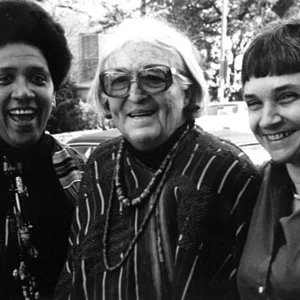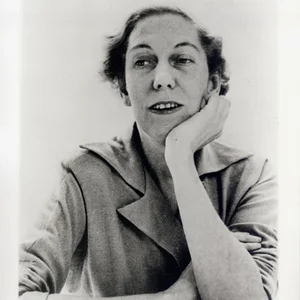

Eudora Welty (1909-2001) was an American novelist and short story writer, a major figure in the literature of the American South. Her work depicts daily life in Mississippi with great subtlety. She received the Pulitzer Prize in 1973.
Eudora Welty(1909 — 2001)
Eudora Welty
États-Unis
6 min read
Frequently asked questions
Famous Quotes
« A good snapshot keeps a moment from running away.»
« The events in our lives happen in a sequence in time, but in their significance to ourselves, they find their own order.»
Key Facts
- Born on April 13, 1909, in Jackson, Mississippi
- Photographer for the Works Progress Administration during the Great Depression in the 1930s
- Published her first short story collection, A Curtain of Green, in 1941
- Received the Pulitzer Prize for Fiction in 1973 for The Optimist's Daughter
- Died on July 23, 2001, in Jackson
Works & Achievements
Her first published short story, which reveals her talent for brief narratives rooted in the rural South.
First short story collection, containing famous tales such as “A Worn Path” and “Why I Live at the P.O.”
Short novel blending fairy tale and Mississippi folklore, poised halfway between reality and legend.
A novel depicting a large planter family during a wedding in the Mississippi Delta.
A sequence of linked stories set in an imaginary town, considered one of her most accomplished works.
A novel about grief and memory that earned her the Pulitzer Prize for Fiction in 1973.
A memoir about her vocation as a writer, born from lectures at Harvard and turned into a bestseller.
Anecdotes
During the Great Depression, in the 1930s, Eudora Welty was hired as a publicity agent for the WPA, an agency created by President Roosevelt. She traveled across all 82 counties of Mississippi and photographed ordinary people: farmers, children, country markets. These photographs, gathered much later into a book, became precious records of poverty in the South.
Her very first short story, *Death of a Traveling Salesman*, appeared in 1936 in a small literary magazine. She was 27 at the time and completely unknown: it was the beginning of a long career that would lead her all the way to the Pulitzer Prize.
In June 1963, the civil rights activist **Medgar Evers** was assassinated in his hometown of Jackson. Deeply shaken, Welty wrote the short story *Where Is the Voice Coming From?* during the night, told from the murderer's point of view. The New Yorker published it a few days later, after changing certain details for legal reasons.
Eudora Welty lived almost her entire life in the family home in Jackson, at 1119 Pinehurst Street, where she often wrote near a window overlooking her mother's garden. That house is now a museum, preserved almost exactly as she left it, with her books and her typewriter.
Her memoir *One Writer's Beginnings* (1984) grew out of three lectures she gave at Harvard University. Against all expectations, this small book became a bestseller and stayed for months on the best-seller lists in the United States.
Primary Sources
In our house on North Congress Street in Jackson, Mississippi, where I was born, the oldest of three children, in 1909, we grew up to the striking of clocks.
Long before I wrote stories, I listened for stories. Listening for them is something more acute than listening to them.
A sheltered life can be a daring life as well. For all serious daring starts from within.
Fiction depends for its life on place. Location is the crossroads of circumstance, the proving ground of “What happened? Who's here? Who's coming?”
Key Places
Welty's hometown and the place where she lived and died. The capital of Mississippi, it lies at the heart of nearly all her work.
The family home where she wrote most of her books, now turned into a museum. It is preserved almost exactly as she left it.
Welty earned her degree in literature here in 1929. These years far from the South broadened her literary horizons.
She took advertising courses at the business school here in the early 1930s. New York introduced her to another America.
A vast farming region she traveled through as a photographer, which serves as the setting for her novel Delta Wedding. A land of plantations and cotton.
Typical Objects

With this camera, Welty photographed the people of Mississippi in the 1930s. Photography shaped her eye as a writer, attentive to faces and to ordinary moments.

The novelist's everyday working tool, on which she typed her short stories and novels. Hers is preserved in her house-museum in Jackson.

Welty is best known for her short stories, brief narratives gathered into collections such as A Curtain of Green. The short form was at the heart of her art.

Passionate about her mother's garden, Welty tended camellias and roses around her house. The garden often appears in the background of her writing.

Welty jotted down fragments of overheard conversations and observations that became the raw material of her stories. Listening to the voices of the South was her starting point.

The most prestigious American literary award, which she received in 1973 for The Optimist's Daughter. It crowned an entire career devoted to the literature of the South.
School Curriculum
Vocabulary & Tags
Key Vocabulary
Tags
Daily Life
Morning
Welty worked mainly in the morning, settled at her typewriter near an upstairs window overlooking the garden. She wrote and rewrote her short stories, cutting up and rearranging her pages with pins.
Afternoon
The afternoon might be devoted to the garden she had inherited from her mother and loved to tend, or to reading. She also welcomed her writer friends and kept up an abundant correspondence.
Evening
In the evening, she read a great deal and listened to the conversations and stories that people told one another, a constant source of inspiration. She led a quiet life, faithful to her hometown of Jackson.
Food
She shared the traditional cuisine of the American South: cornbread, vegetables from the garden, tomatoes, and sweet iced tea. Meals with family and neighbors gave rhythm to social life.
Clothing
Welty wore the plain, classic clothes of a twentieth-century Southern woman: simple dresses, cardigans, and comfortable shoes, with no taste for luxury.
Housing
She spent most of her life in the family's Tudor-style house in Jackson, surrounded by books and a garden. This home, where she wrote, is today a national museum.
Historical Timeline
Period Vocabulary
Liens externes & ressources
Références
Œuvres
Death of a Traveling Salesman (nouvelle)
1936
A Curtain of Green and Other Stories
1941
The Robber Bridegroom
1942
Delta Wedding
1946
The Golden Apples
1949
The Optimist's Daughter
1972
One Writer's Beginnings
1984