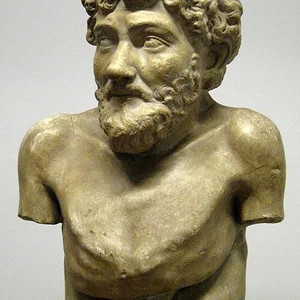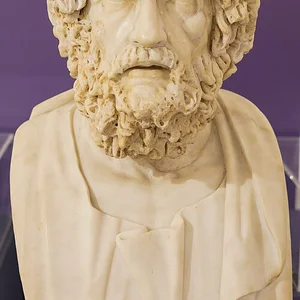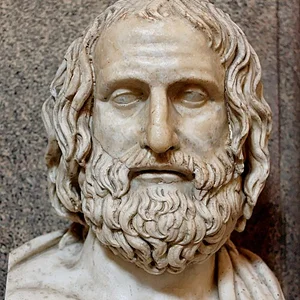

Euripides (480–406 BC) is one of the three great tragic playwrights of ancient Athens, alongside Aeschylus and Sophocles. Author of more than 90 plays, he stands out for his innovative approach to tragedy, portraying more human and psychologically complex characters, especially women.
Euripides(480 av. J.-C. — 406 av. J.-C.)
Euripides
Athènes
7 min read
Frequently asked questions
Famous Quotes
« Death is nothing; but to live defeated and without glory is to die every day.»
« Many women have gone to war for the sake of one.»
Key Facts
- Won his first prize at the dramatic festival in Athens in 441 BC.
- Created Medea in 431 BC, a revolutionary tragedy centering the drama on a woman's passion.
- Composed The Trojan Women in 415 BC, an implicit critique of the brutality of the Peloponnesian War.
- Died in exile in Macedonia around 406 BC, after leaving Athens.
- Left a body of work of approximately 18–19 complete plays preserved out of more than 90 written.
Works & Achievements
Tragedy recounting the terrible revenge of Medea, the wife repudiated by Jason. A masterpiece of feminine psychology, this play remains one of the most performed in the world.
Tragedy exploring the destructive passion of Phaedra for her stepson Hippolytus. One of the rare plays that earned Euripides first prize at the Dionysia.
A poignant denunciation of the horrors of war through the fate of the women of Troy after the fall of the city. Considered one of the earliest pacifist works in literature.
A retelling of the Atreid myth in which Euripides humanizes his characters and questions the legitimacy of vengeance. The play contrasts with the versions by Aeschylus and Sophocles.
Euripides' last great tragedy, performed after his death. It portrays the sacrifice of Iphigenia by her father Agamemnon and questions the price of military glory.
Euripides' final work, on the cult of Dionysus and the destructive madness of King Pentheus. A masterpiece on the conflict between reason and irrational forces.
A play in which the wife Alcestis agrees to die in place of her husband Admetus. Blending tragic and comic elements, it illustrates Euripides' originality in handling genres.
Tragedy depicting the transformation of Queen Hecuba from a grieving mother into a figure of vengeance after the fall of Troy. A powerful reflection on suffering and dehumanization.
Anecdotes
Euripides was known for his solitary nature. According to tradition, he would retreat to a cave on the island of Salamis to write his plays, far from the turmoil of Athens. This cave, facing the sea, is said to have served as his study for many years.
Euripides won only four victories at the dramatic contests of the Great Dionysia during his lifetime, far fewer than Sophocles who won eighteen. A fifth victory was awarded to him posthumously, for the trilogy including The Bacchae, performed by his son after his death.
Aristophanes, the famous comic playwright, regularly mocked Euripides in his comedies. In The Frogs, performed in 405 BC, Aristophanes stages a contest between Aeschylus and Euripides in the Underworld to determine the greatest tragedian. Aeschylus wins, yet the play paradoxically attests to Euripides' immense renown.
Toward the end of his life, Euripides left Athens to settle at the court of King Archelaus of Macedon, in Pella. According to an ancient legend, he died torn apart by the king's hunting dogs, but this story is most likely fabricated. He died in 406 BC in Macedon, a few months before Sophocles.
Euripides' mother, Clito, was said to have been a vegetable seller according to Aristophanes, who used this detail to ridicule him. However, this claim is most likely a comic invention, as other sources indicate that Euripides came from a relatively prosperous family from Salamis.
Primary Sources
"Of all things which are living and can form a judgment we women are the most unfortunate creatures. Firstly, to an excessive price, we must buy a husband and take a master for our body."
"The god, son of Zeus, delights in banquets, and he loves Peace, giver of wealth, goddess who nurtures the young. He grants alike to the poor and to the rich the painless joy of wine."
"Among mortals, no one is free. One is a slave to money, another to fate; sometimes the crowd, sometimes the written laws prevent one from living according to one's own will."
"I made tragedy democratic: I gave voice to women, slaves, masters, young girls and old women." Aristophanes puts these words in Euripides' mouth to summarize his theatrical revolution.
Key Places
Large open-air theatre at the foot of the Acropolis, capable of holding approximately 17,000 spectators. It is here that Euripides presented the vast majority of his tragedies during the contests of the Great Dionysia.
Island in the Saronic Gulf where Euripides is said to have been born. Tradition holds that he would retreat to a cave facing the sea to compose his works, away from the bustle of the city.
Central hub of Athenian political and intellectual life. Euripides mingled there with philosophers, notably Socrates and Anaxagoras, whose ideas profoundly influenced his theatre.
Capital of the Kingdom of Macedonia where Euripides went into exile at the end of his life, welcomed by King Archelaus. It is there that he composed his final plays, including The Bacchae, and where he died in 406 BC.
Temple dedicated to Dionysus, adjacent to the theatre, where the religious ceremonies preceding the dramatic performances in which Euripides took part were held.
Typical Objects

A mask made of stiffened linen or wood, covering the entire face, with an open mouth serving as a megaphone. Euripides used varied masks for his many female characters and fallen heroes.

The writing medium on which Euripides composed his tragedies. His personal library, one of the first known in Athens, was famous in Antiquity.

A mechanical lifting device used to make gods appear above the stage. Euripides made such frequent use of it that it gave rise to the expression "deus ex machina".

High boots with thick soles worn by tragic actors to appear taller. They contributed to the imposing stature of characters on the theatre stage.

Common writing instruments used for drafts and notes. Euripides could sketch out dialogues on them before transcribing them onto papyrus.

A stringed instrument accompanying the choral songs of tragedies. Euripides was renowned for his musical innovations, incorporating more complex and expressive melodies.
📷 CC BY-SA 4.0 · Wikimedia Commons ↗School Curriculum
Vocabulary & Tags
Key Vocabulary
Daily Life
Morning
Euripides rose at dawn, like most Athenians. After a quick wash and a frugal breakfast of barley bread soaked in diluted wine and a few figs, he would likely withdraw to write, taking advantage of the morning light. His mornings were devoted to composition and reading.
Afternoon
The afternoon could be spent on rehearsals with the actors and chorus when a competition was approaching, or on philosophical discussions. Euripides frequented the intellectual circles of Athens, notably the sophists Protagoras and Prodicus, as well as the philosopher Anaxagoras and Socrates, with whom he debated moral questions.
Evening
In the evening, Euripides sometimes took part in symposia (banquets), but his reputation as a solitary figure suggests he preferred the quiet of his home. The evening meal, the deipnon, was the most substantial of the day. He likely continued to work by the light of an oil lamp.
Food
Euripides' diet was typical of a prosperous Athenian citizen: barley or wheat bread, olives, figs, goat's cheese, grilled fish, vegetables and legumes. Meat was reserved for days of sacrifice. Wine, always diluted with water, accompanied meals and discussions.
Clothing
Euripides wore the chiton, a linen or wool tunic fastened at the shoulders with fibulae, and the himation, a large cloak draped over it. As an Athenian citizen, he generally went barefoot or wore leather sandals. His beard, according to ancient depictions, was full.
Housing
Euripides lived in a typical Athenian house built of mud brick on stone foundations, organised around an interior courtyard with a domestic altar. The rooms were modest and sparsely furnished: beds, chests, stools. He owned a personal library that was remarkable for the time, filled with papyrus scrolls.
Historical Timeline
Period Vocabulary
Visual Style
Style visuel inspiré de l'esthétique athénienne classique du Ve siècle av. J.-C., évoquant la céramique attique à figures rouges, l'architecture du théâtre de Dionysos et la lumière dorée de la Méditerranée.
Sound Ambience
L'ambiance sonore du théâtre de Dionysos lors d'une représentation tragique : voix déclamées et chants choraux accompagnés de l'aulos, mêlés aux bruits lointains de la cité athénienne et au vent méditerranéen.
Liens externes & ressources
Références
Œuvres
Médée
431 av. J.-C.
Hippolyte porte-couronne
428 av. J.-C.
Les Troyennes
415 av. J.-C.
Électre
vers 413 av. J.-C.
Iphigénie à Aulis
405 av. J.-C. (posthume)
Les Bacchantes
405 av. J.-C. (posthume)
Alceste
438 av. J.-C.