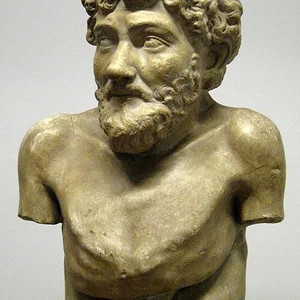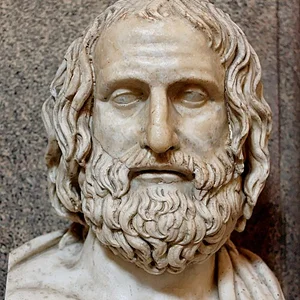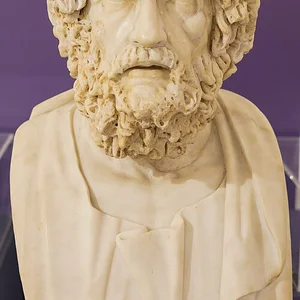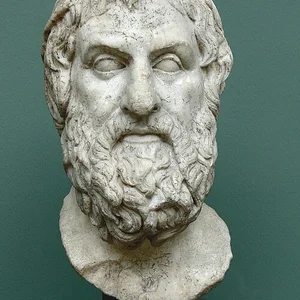

Sophocles (495–405 BC) was a major Athenian playwright of ancient Greece. Author of tragedies such as Antigone and Oedipus Rex, he profoundly shaped the development of Western theatre by exploring moral dilemmas and human fate.
Sophocles(495 av. J.-C. — 405 av. J.-C.)
Sophocles
Athènes
7 min read
Frequently asked questions
Key Facts
- Born around 496 BC in Colonus, in Attica
- Won the dramatic competition at the City Dionysia multiple times, beginning in 468 BC
- Wrote around 120 plays, of which only 7 have survived complete
- Created Antigone (around 442 BC), a masterpiece exploring the conflict between divine law and human law
- Died in Athens around 406 BC at the age of 90
Works & Achievements
A tragedy exploring the conflict between divine law and human law through the story of Antigone, who defies the edict of King Creon. The play examines moral dilemmas and individual responsibility in the face of authority.
A masterpiece of Greek tragedy depicting Oedipus's gradual discovery of his own tragic fate. Considered one of the greatest works in Western theatre, it illustrates the themes of inescapable destiny and recognition.
A tragedy recounting the revenge of Electra and Orestes against their mother Clytemnestra. The play explores themes of justice, vengeance, and family loyalty.
A tragedy telling of the death of Heracles, poisoned by his wife Deianira. The play deals with themes of love, jealousy, and inescapable human suffering.
A tragedy staging the moral conflict between political expediency and personal ethics in the retrieval of Philoctetes for the Trojan War. It examines manipulation, betrayal, and redemption.
A tragedy portraying the warrior Ajax after the Trojan War, exploring his downfall and suicide in the face of dishonor. The play deals with honor, shame, and human dignity.
Sophocles's final tragedy, recounting the last days of Oedipus in exile. The play offers a meditation on forgiveness, redemption, and the wisdom gained through suffering.
Anecdotes
Sophocles won the dramatic competition at the Dionysia festival in Athens at least 20 times during his lifetime, making him one of the most celebrated figures in ancient Greek theatre. This victory was a tremendous honor, reflecting the playwright's recognized genius among his peers and the Athenian public.
According to ancient tradition, Sophocles wrote approximately 123 plays over the course of his long life, yet only 7 have survived to the present day. Among them are his masterpieces Oedipus Rex and Antigone, which remain landmarks of world literature.
Sophocles took an active role in Athenian political life, serving as a strategos (general) during the wars against Persia — proof that he was not merely an artist but also a committed citizen. He served alongside great figures such as Pericles during Athens' golden age.
Past the age of 80, Sophocles wrote The Women of Trachis, a play that demonstrates his undiminished creativity until the very end of his life. He continued to push the boundaries of dramatic art by introducing a third actor to the stage, a innovation that revolutionized Greek theatrical stagecraft.
Sophocles lived through virtually the entire 5th century BCE, witnessing the greatest events in Athenian history: the Persian Wars, the height of Athenian democracy under Pericles, and the devastating Peloponnesian War. He died in Athens at the age of 90, revered as one of the greatest citizens his city had ever produced.
Primary Sources
I did not think your edicts, Creon, had power enough to override the unwritten and unfailing laws of the gods, binding upon all mortals.
O fate! Why was I born? Alas! Without knowing it, I have fulfilled the crimes you had destined for me.
It is easy to counsel others in misfortune; but one who suffers finds little comfort in words.
Nothing is more wondrous than man. He crosses the seas beneath the winter gale, and the earth, greatest of the goddesses, he wearies her, wearing her down ceaselessly with his labors.
Key Places
Sophocles' birthplace and the city where he spent most of his life. The center of his dramatic career and the setting where his major tragedies were performed at the Theatre of Dionysus.
The principal Athenian theatre where Sophocles' plays were performed during dramatic competitions. The venue where Antigone and Oedipus Rex were staged before Athenian audiences.
A suburb of Athens where Sophocles was born. The village that inspired the setting of his final tragedy, Oedipus at Colonus, written near the end of his life.
The legendary city of Greece that serves as the backdrop for several of his major tragedies, notably Antigone and Oedipus Rex, exploring the myths of the Theban cycle.
A symbol of Athens' cultural brilliance in the 5th century BC, the era in which Sophocles achieved his greatest success. It represents the height of Athenian democracy during his lifetime.
The region surrounding Athens where Sophocles carried out his civic and military responsibilities. The geographical and cultural setting of his life and creative output.
Typical Objects

A linen and plaster mask covering the entire face, worn by actors in Sophocles' plays. These masks conveyed the emotions of tragic characters such as Antigone and Oedipus, allowing audiences in the amphitheater to instantly identify roles and their emotional states.

The writing surface on which Sophocles composed his tragedies. The playwright used papyrus to write and preserve his works — around 123 are documented, though only 7 have survived in their entirety.

A symbol of victory and honor awarded to Sophocles at Athenian dramatic competitions. He won approximately 24 victories at the Dionysia, Athens' premier theatrical festival, a testament to his extraordinary prestige.

The monumental theater in Athens where Sophocles' plays were performed before audiences of several thousand. This architectural landmark embodies the civic and democratic context in which dramatic art flourished.

Typical Greek garments worn by Sophocles and his contemporaries: a tunic (chiton) and a cloak (himation). These clothes reflect the elegance and high social standing of a cultured man in classical Athens.

A commemorative monument honoring Sophocles after his death in 405 BCE. The Athenians granted him a dignified burial in recognition of his immense contribution to Greek dramatic culture.

A musical instrument associated with Greek tragedy, used to accompany the choruses and songs in Sophocles' plays. The lyre symbolizes the harmony between music and spoken word in ancient theater.
📷 CC BY-SA 4.0 · Wikimedia Commons ↗
A portable writing surface used by Greeks of the classical period for notes and drafts. Sophocles may well have used tablets of this kind to compose and revise his dramatic dialogues.
School Curriculum
Vocabulary & Tags
Key Vocabulary
Daily Life
Morning
Sophocles wakes at dawn in his Athenian home. After a quick wash, he has a light breakfast of bread and olives, then prepares to head to the agora or to rehearsals at the theater.
Afternoon
The afternoon is devoted to his public activities: discussions with fellow citizens at the agora, participation in Athenian political assemblies, or intensive work on his theatrical compositions. He may also oversee rehearsals with actors and the chorus.
Evening
As the day winds down, Sophocles attends banquets (symposia) reserved for high-status citizens, where philosophy and literature are debated over diluted wine. He may also spend time composing or revising his plays.
Food
Sophocles follows the typical Mediterranean diet of a wealthy citizen: bread, fish, poultry, vegetables (lentils, chickpeas), cheese, and fruits (figs, grapes). Wine is diluted with water according to Greek custom.
Clothing
He wears the traditional Greek himation draped over one shoulder and fastened with a fibula. As a respected citizen of comfortable means, his garments are of good quality — wool or linen, generally white or undyed.
Housing
Sophocles lives in a modest but comfortable Athenian house (oikos), likely situated on the higher slopes of Athens. The dwelling features rooms arranged around a central courtyard, with few windows and sparse furnishings typical of the era.
Historical Timeline
Period Vocabulary
Visual Style
Un style inspiré de l'art grec classique du Ve siècle av. J.-C., mêlant la céramique aux figures rouges, le théâtre antique et l'architecture grecque. L'ambiance privilégie un éclairage dramatique mettant en valeur les dilemmes moraux, avec une palette terracotta et indigo évoquant les tragédies intemporelles de Sophocle.
Sound Ambience
Une ambiance théâtrale immersive du Ve siècle av. J.-C., capturant l'essence d'une représentation tragique grecque dans un amphithéâtre antique, mêlant voix dramatiques, instruments anciens et l'énergie palpable du public athénien.
Liens externes & ressources
Références
Œuvres
Antigone
442 av. J.-C.
Œdipe roi
429 av. J.-C.
Électre
410 av. J.-C.
Les Trachiniennes
455 av. J.-C.
Philoctète
409 av. J.-C.
Ajax
450 av. J.-C.
Œdipe à Colone
406 av. J.-C.