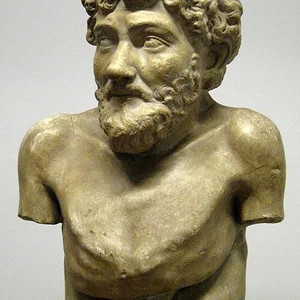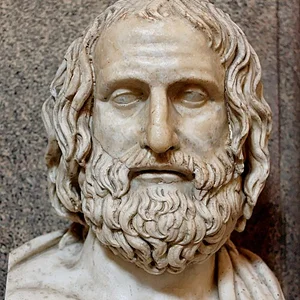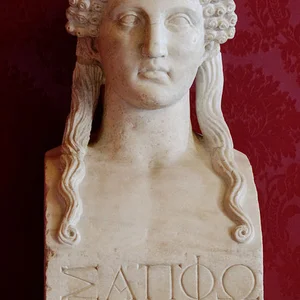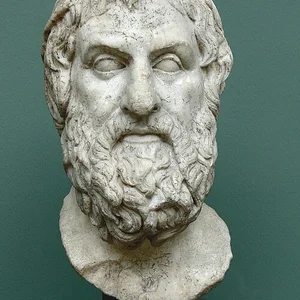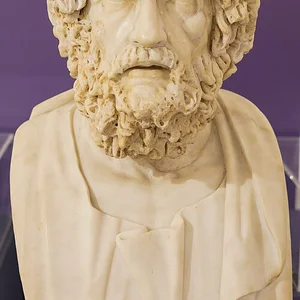

Homer is an ancient Greek epic poet, traditionally dated to the 9th–8th century BC, recognized as the author of two major epics: the Iliad and the Odyssey. These two founding works of Western literature recount the Trojan War and the return of Odysseus, shaping ancient Greek culture and influencing world literature.
Homer(900 av. J.-C. — 800 av. J.-C.)
Homer
Confédération ionienne
8 min read
Frequently asked questions
Key Facts
- Composition of the Iliad (8th century BC), an epic narrating the Trojan War and the deeds of Achilles
- Composition of the Odyssey (8th century BC), an epic describing Odysseus's journey home after the fall of Troy
- Oral transmission in the archaic period: the Homeric poems first circulated as recitations before being written down
- Major influence on Greek paideia (education): his works formed the core of young Greeks' upbringing
- Foundation of the Western epic tradition: his poems served as a model for writers in the centuries that followed
Works & Achievements
Epic poem in 24 books and 15,693 verses recounting 51 days of the Trojan War, centered on the wrath of Achilles. Considered the first monument of Western literature, it defined the canons of heroic epic poetry for two millennia.
Epic poem in 24 books and 12,110 verses tracing Odysseus's return to Ithaca after the fall of Troy, through ten years of adventures and trials. It founded the genre of the 'adventure novel' and the literary motif of the initiatory journey.
A collection of 33 hymns in hexameters dedicated to the Greek gods, attributed to Homer in Antiquity but composed by anonymous bards in his tradition. They constitute a precious source for archaic Greek mythology and religion.
A short parodic epic recounting the war between the frogs and the mice, imitating the Homeric style for comic purposes. Attributed to Homer in Antiquity, it is today considered a late parody.
Anecdotes
The Homeric question has fascinated scholars since Antiquity: did Homer truly exist, or does his name designate a collective tradition of poets? As early as Antiquity, seven Greek cities — including Chios and Smyrna — competed for the honor of being his birthplace. This rivalry testifies to the immense prestige attached to his name.
Ancient tradition portrays Homer as an old blind poet wandering from city to city to recite his verses. Paradoxically, his name in ancient Greek may mean 'one who does not see' or 'one who is guided'. Some scholars see this as a symbol: the blind man who, deprived of sight of the external world, possesses a superior inner vision.
In the 8th century BC, Homer's poems did not exist in written form: they were memorized and sung by aoidoi, poet-singers who accompanied themselves on the lyre. These artists improvised variations at each performance, keeping the epic alive as a living organism before writing fixed it permanently.
A legendary 'Agôn' (contest) is said to have pitted Homer against the poet Hesiod before King Panedes at Chalcis in Euboea. According to the late account of the Certamen, Hesiod would have won the prize by singing of peace and agriculture, deemed superior to tales of war. This tale illustrates the rivalry between two great poetic traditions of Greek Antiquity.
The Homeric poems played a central role in ancient Greek education. Young Greeks learned to read and write by copying the Iliad and the Odyssey. Alexander the Great always carried a copy of the Iliad annotated by his teacher Aristotle, and compared himself to Achilles, his favorite hero.
Primary Sources
"Sing, goddess, the anger of Achilles, son of Peleus, that ruinous anger which brought countless sufferings upon the Achaeans, hurled many mighty souls of heroes down to Hades, and made their bodies prey for dogs and all manner of birds."
"Tell me, Muse, of that ingenious man who wandered so long after he had sacked the sacred citadel of Troy, who saw the cities of many peoples and came to know their ways of thinking, and who suffered many sorrows at sea in his heart."
"Hector stretched out his arms toward his son, but the child shrank back crying against the breast of his fair-girdled nurse, frightened by the sight of his father, terrified by the bronze and the horsehair crest swaying dreadfully atop the helmet."
"Remember me in time to come, if any mortal stranger who has suffered many hardships comes here and asks you: Who is, O young maidens, the sweetest of the bards who come here, and in whom do you take the greatest pleasure?"
"Cyclops, you ask my famous name — I will tell it to you; but give me the guest-gift you promised me. My name is Nobody; Nobody is what my mother, my father, and all my companions call me."
Key Places
Aegean island that most strongly claims to be the birthplace of Homer. A guild of poets claiming descent from him, the 'Homeridae', was established there in Antiquity.
Ionian city of Asia Minor, the other main contender for the title of Homer's birthplace. Its geographical position between the Greek and Oriental worlds fits well with the cultural context of the epics.
Archaeological site in present-day Turkey identified in the 19th century by Heinrich Schliemann as Homeric Troy. Excavations revealed a city destroyed around 1200 BC, partially confirming the historical basis of the Iliad.
Small Cycladic island where ancient tradition placed the tomb of Homer. According to certain ancient accounts, the poet died there of grief after failing to solve a riddle posed by fishermen.
Panhellenic sanctuary of Apollo, patron god of the arts and poetry. Bards invoked the Muse, associated with Apollo, before each recitation, and the sanctuary of Delphi represented the spiritual center of this poetic tradition.
Typical Objects

A stringed instrument used by bards to accompany themselves during the recitation of epics. In the Iliad, Achilles himself plays the phorminx in his tent to sing of the heroes' exploits.

A staff or scepter held by the poet-singer during his recitations, a mark of his authority and particular status in archaic Greek society. The staff symbolized the link between the poet, inspired by the Muses, and his audience.

The medium on which the Homeric epics were gradually transcribed from the 8th–7th century BC onward. Athenian scribes used these scrolls to permanently fix texts that had circulated orally for centuries.

These ceramic vases, typical of the Greek archaic period, frequently depicted scenes from the Iliad and the Odyssey, attesting to the omnipresence of Homeric narratives in Greek material culture.

At aristocratic banquets (symposia), bards recited Homeric passages while guests drank from these cups. Such gatherings constitute the primary social context for the transmission of epic poetry.

A wax-coated tablet on which one could write and erase, used to note down passages or memorize epic formulas. A working tool of the scribes and rhapsodes who learned the epics by heart.
School Curriculum
Vocabulary & Tags
Key Vocabulary
Daily Life
Morning
The aoidos would rise at dawn, an hour devoted to invoking the Muses and memorizing new sequences of verses. He practiced aloud, repeating the fixed epic formulas ('rosy-fingered Dawn', 'swift-footed Achilles') that structured oral composition. The morning was also the time to tend his lyre and tune its strings.
Afternoon
In the afternoon, the aoidos traveled from city to city, often on foot or by sea, seeking the hospitality (xenia) of aristocrats and kings. He observed landscapes, markets, and artisan trades, feeding his metaphors and epic similes with these observations of the real world.
Evening
The evening was the high point of the day: invited to the banquet (symposion) of the local chief, the aoidos took the place of honor, tuned his phorminx, and sang his verses for hours. The audience participated actively, calling for favorite episodes — a sign that these tales were already widely known to all.
Food
His diet followed the archaic Mediterranean regime: barley or wheat bread, olives and olive oil, goat cheese, pulses (lentils, chickpeas), figs, and grapes. At banquets, the aoidos had access to richer fare: roasted mutton, fish, and wine mixed with water and scented with resin.
Clothing
The aoidos wore a chiton (a wool or linen tunic) fastened at the shoulders with fibulae, covered by a himation (a large rectangular cloak) for travel or cool evenings. His sandals with tanned leather soles were reinforced for long walks. A walking staff completed this modest yet dignified attire.
Housing
The itinerant aoidos had no fixed dwelling, depending on the hospitality (xenia) of the aristocrats and cities he passed through. This sacred institution obliged every Greek to welcome the stranger, offering shelter, food, and protection. When he settled, he lived in a modest house with a tiled roof and a central courtyard, surrounded by his own people.
Historical Timeline
Period Vocabulary
Visual Style
Esthétique de la céramique grecque archaïque à figures noires, avec ses fonds ocre-terracotta, ses silhouettes stylisées de guerriers et de navires, ses motifs géométriques et la lumière vive de la Méditerranée orientale.
Sound Ambience
Ambiance sonore d'une soirée de banquet aristocratique grec au VIIIe siècle av. J.-C., où un aède accompagné de sa lyre récite les exploits des héros devant un auditoire attentif, avec en toile de fond la mer Égée et la nature méditerranéenne.
Liens externes & ressources
Références
Œuvres
L'Iliade
VIIIe siècle av. J.-C. (tradition orale), fixée par écrit vers 550 av. J.-C.
L'Odyssée
VIIIe siècle av. J.-C. (tradition orale), fixée par écrit vers 550 av. J.-C.
Les Hymnes homériques
VIIe-VIe siècle av. J.-C.
La Batrachomyomachie (attribuée)
Ve-IVe siècle av. J.-C.