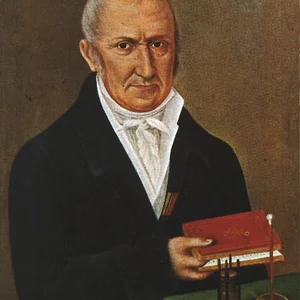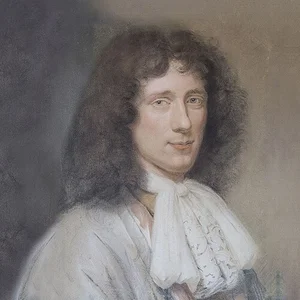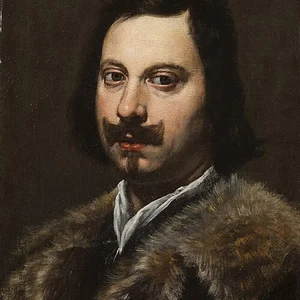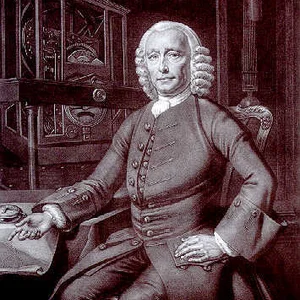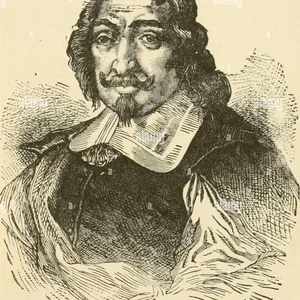

French mathematician and physicist (1602–1675), professor at the Collège Royal de France. He is renowned for inventing the balance scale that bears his name, and for his pioneering work in geometry and mechanics.
Roberval(1602 — 1675)
Roberval
Brésil
9 min read
Frequently asked questions
Key Facts
- Born in 1602 in Roberval (Oise), died in 1675 in Paris
- Professor of mathematics at the Collège Royal de France (later the Collège de France) from 1634
- Invented the two-pan suspended balance known as the 'Roberval balance' (c. 1669)
- Developed precursor methods to infinitesimal calculus for computing areas and tangents
- Founding member of the Académie royale des sciences in 1666
Works & Achievements
A weighing mechanism with parallel platforms based on an articulated parallelogram, still manufactured and used today. This invention illustrates Roberval's genius for connecting pure mathematics with everyday applied mechanics.
Roberval proved that the area beneath one arch of a cycloid equals three times the area of the generating circle — a foundational result in the geometry of curves, obtained using the method of indivisibles.
An original vector-based method for drawing tangents to curves, built on the composition of two simultaneous velocities. This approach foreshadows the differential calculus of Newton and Leibniz, and remains one of Roberval's most original contributions.
A posthumous work in which Roberval sets out his method for computing areas and volumes by summing infinitely small elements, revealing the full scope of his work on what would become integral calculus.
An edition and commentary on a treatise attributed to Aristarchus of Samos, in which Roberval develops his own mechanical arguments in favour of the Copernican heliocentric system, contributing to the great cosmological debate of the century.
A body of letters forming a major primary source on the intellectual life of the 17th century, in which Roberval discusses the cycloid, probability, and methods of integration with the greatest European mathematicians of his time.
Anecdotes
To keep his mathematics chair at the Collège Royal, Roberval had to win a renewal competition every three years. Cunning by nature, he almost never published his most powerful methods, keeping them secret to maintain his edge over competitors. This strategy allowed him to hold his chair for more than forty years, until his death in 1675.
Roberval was one of the first to calculate exactly the area under one arch of a cycloid — the mysterious curve traced by a point on a rolling circle. He discovered that this area equals exactly three times the area of the generating circle, a result that astonished his contemporaries. A heated dispute with Descartes and Torricelli over priority for this discovery tormented him for years.
In 1669, Roberval invented a beam balance based on an ingenious articulated parallelogram mechanism. Unlike ordinary scales, the pans always remained perfectly horizontal regardless of their position, which made it immediately popular in markets and workshops. The “Roberval balance” still bears his name today and is used in kitchens and laboratories around the world.
The son of a Picard peasant, Gilles Personne adopted the name of his birth village — Roberval, in Oise — as a noble surname during his rise in Parisian scholarly circles. This change of name illustrates the remarkable social mobility that mathematics offered in the 17th century: a humble country boy could, through intellectual merit alone, become a royal professor and correspondent of the greatest minds in Europe.
Roberval developed an original method for drawing tangents to curves, based on the composition of movements. He imagined the point tracing the curve as being driven by two simultaneous velocities, with the tangent as the geometric resultant of these two vectors. This approach, very close to differential calculus, foreshadowed the ideas that Newton and Leibniz would formalize a few decades later.
Primary Sources
Roberval sets out his method for calculating areas and volumes by dividing figures into an infinite number of small elements called 'indivisibles', drawing on Cavalieri while developing his own proofs on the cycloid and the parabola.
Roberval publishes and comments on this treatise attributed to Aristarchus of Samos, defending the heliocentric system with his own mechanical and mathematical arguments, contributing to the great cosmological debate of his century.
In these preserved letters, Roberval presents his results on the cycloid, the quadrature of curves, and his methods for finding tangents, debating with Fermat, Pascal, and Descartes through this unique scholarly network across Europe.
A manuscript held at the Bibliothèque nationale in which Roberval sets out his fundamental geometric methods, in particular his theory of tangents through the composition of motions and his reflections on the equilibrium of forces.
Key Places
A small village in Picardy where Gilles Personne was born in 1602 into a peasant family. He adopted its name as his surname upon his rise in the learned world, a common practice among intellectuals of modest origins wishing to set themselves apart.
Roberval held the Ramus chair in mathematics here from 1634 until his death in 1675 — a span of over forty years. He gave free public lectures there, in keeping with the mission of this institution founded by Francis I, known today as the Collège de France.
The residence of Father Marin Mersenne, a true hub of seventeenth-century Parisian science. Roberval visited regularly to take part in informal scholarly gatherings where the latest discoveries of Galileo, Descartes, and Kepler were debated.
Founded in 1666 by Colbert, Roberval was one of its founding members. He presented his work on the beam balance there and took part in the early sessions of this institution, which shaped French science for centuries to come.
Roberval lived and died in Paris on 27 October 1675. The capital was then the intellectual center of Europe under Louis XIV, drawing scholars, philosophers, and artists into an unprecedented ferment of culture and science.
Liens externes & ressources
Références
Œuvres
Invention de la balance à fléaux (balance de Roberval)
1669
Quadrature de la cycloïde
vers 1634-1640
Méthode des mouvements composés pour les tangentes
vers 1636
Traité des indivisibles
rédigé vers 1640, publié en 1693
Aristarchi Samii De mundi systemate
1644
Correspondance scientifique (Mersenne, Fermat, Pascal)
1635-1660