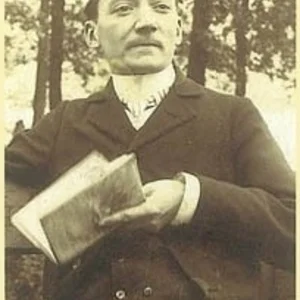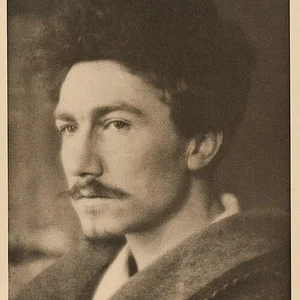

Ezra Pound (1885-1972) was an American poet and critic, a major figure of English-language literary modernism. A driving force behind Imagism, he influenced an entire generation of writers and left behind a monumental, unfinished work, the Cantos.
Ezra Pound(1885 — 1972)
Ezra Pound
États-Unis
6 min read
Frequently asked questions
Famous Quotes
« Make it new.»
Key Facts
- Born in 1885 in Hailey, Idaho, he settled in Europe from 1908 onward (London, Paris, then Italy).
- Founder of the Imagist movement around 1912, advocating concision and precision in the poetic image.
- Mentor and editor to T.S. Eliot: he revised and abridged The Waste Land (1922).
- Author of the Cantos, a vast, unfinished epic poem written from 1915 until the end of his life.
- A supporter of Italian fascism, he was arrested in 1945, confined to St. Elizabeths psychiatric hospital until 1958, and then died in Venice in 1972.
Works & Achievements
His very first collection of poems, self-published in Venice, revealing an ambitious young poet.
A collection that heralds Imagism and the pursuit of clear, concentrated poetry.
Adaptations of classical Chinese poems that opened English-language poetry to new forms.
A long, ironic poem offering a disenchanted assessment of European civilization after the Great War.
A monumental, unfinished work, regarded as one of the great poems of the 20th century.
An essay in which Pound sets out his way of reading and teaching literature, with his motto “Make it new.”
A section of the Cantos written while detained near Pisa, award-winning and highly controversial.
Anecdotes
For his most famous poem, “In a Station of the Metro,” Ezra Pound spent months transforming a thirty-line text into just two lines. The idea had come to him when he saw faces emerge from the crowd in a Paris metro station. It became the perfect example of Imagism: saying a great deal in very few words.
In 1922, Pound reread the long poem by his friend T.S. Eliot, “The Waste Land,” and cut it down by nearly half with his pencil. Grateful, Eliot dedicated the poem to him, calling him “il miglior fabbro,” meaning “the better craftsman.” Pound was nicknamed the “midwife” of other people's masterpieces.
At the end of the Second World War, Pound was arrested by the American army for treason, because of his radio broadcasts supporting Mussolini's fascist regime. He was locked up for several weeks in an open-air wire cage, in a military camp near Pisa. It was there, in very harsh conditions, that he wrote the “Pisan Cantos.”
Declared unfit to stand trial, Pound spent twelve years (1946-1958) in a psychiatric hospital near Washington, St. Elizabeths Hospital. Great writers such as Ernest Hemingway and Robert Frost rallied to get him released. Once free, he immediately went back to live in Italy.
Fascinated by China, Pound published “Cathay” in 1915, a collection of adaptations of classical Chinese poems. Yet he could not really read Chinese: he worked from notes left by the Orientalist Ernest Fenollosa. The result nonetheless thrilled the poets of his time.
Primary Sources
The apparition of these faces in the crowd; / Petals on a wet, black bough.
An “Image” is that which presents an intellectual and emotional complex in an instant of time.
What thou lovest well remains, / the rest is dross.
Literature is news that STAYS news.
Key Places
A small town in the American West where Ezra Pound was born in 1885.
Pound settled here in 1909 and became a central figure of literary life, launching imagism and vorticism.
In the early 1920s, he immersed himself in the vibrant Parisian art scene and mingled with many expatriate writers.
A seaside resort on the Italian Riviera where Pound lived from 1924 until the war and worked on his Cantos.
Pound was detained here in 1945, for a time in an open-air cage; it was there that he composed the “Pisan Cantos.”
Pound died in Venice in 1972 and was buried on the cemetery island of San Michele.
Typical Objects

Pound endlessly typed and reworked his poems and his correspondence, which he exchanged with the greatest writers of his time.

The pages of his great unfinished poem, covered with crossings-out, notes, and even Chinese ideograms. A work begun in 1917 and never truly completed.

An avant-garde magazine founded in 1914, with a provocative typography, that launched the Vorticist movement. Pound published his manifestos and poems in it.

During the war, Pound used Italian radio to broadcast his political speeches. This object symbolizes the commitment that would lead him to prison.

Pound drew inspiration from the notes of the Orientalist Ernest Fenollosa to adapt classical Chinese poetry. The ideograms fascinated him as concentrated images.

An everyday tool of the poet and critic, with which he also annotated and corrected the texts of other writers, such as those of T.S. Eliot.
School Curriculum
Vocabulary & Tags
Key Vocabulary
Tags
Daily Life
Morning
In the morning, Pound wrote and tirelessly reworked his verse, crossing out words and tightening every one of them. He also devoted a great deal of time to reading and studying other languages, from Provençal to Chinese.
Afternoon
In the afternoon, he read the manuscripts of young authors and offered them advice and criticism. A tireless promoter, he wrote dozens of letters to get his protégés like Joyce or Eliot into print.
Evening
In the evening, he met up with writers, painters, and musicians in cafés and salons. These gatherings fed the magazines and manifestos of the avant-garde movements he championed.
Food
In Rapallo, on the Italian coast, his daily life revolved around Mediterranean cooking: pasta, fish, vegetables, and local wine. Pound loved the simplicity of Southern meals.
Clothing
Pound cultivated the look of a bohemian artist: a wide-brimmed hat, loose jackets, a pointed beard, and sometimes a cape. This eccentric style was part of his public persona.
Housing
He lived in modest apartments and houses as his travels took him from London to Paris and then Rapallo. His Italian house, facing the sea, served for a long time as his writing studio.
Historical Timeline
Period Vocabulary
Liens externes & ressources
Références
Œuvres
A Lume Spento
1908
Ripostes
1912
Hugh Selwyn Mauberley
1920
The Cantos
1917-1969
ABC of Reading
1934
The Pisan Cantos
1948