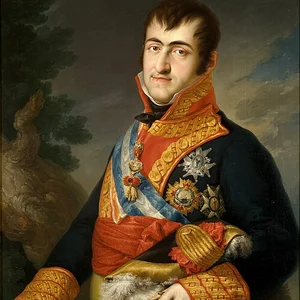

King of Spain in 1808 and from 1814 to 1833, Ferdinand VII reigned under Napoleonic occupation and then after the Restoration. His absolutist rule and the loss of Spain's American colonies left a profound mark on Spanish history.
Ferdinand VII(1784 — 1833)
Ferdinand VII of Spain
Espagne
9 min read
Frequently asked questions
Key Facts
- King of Spain briefly in March 1808, then forced to abdicate in favor of Napoleon
- Imprisoned at Valençay (France) from 1808 to 1814 during the Peninsular War
- Restored to the throne in 1814, abolished the Constitution of Cádiz of 1812
- His reign witnessed the independence of nearly all Spanish colonies in the Americas (1810–1825)
- The question of his succession triggered the Carlist Wars after his death in 1833
Works & Achievements
The first major act of his return to Spain, this decree annulled the liberal work of the Cádiz Cortes and restored absolute monarchy. It inaugurated a reactionary policy that would define his entire reign.
Ferdinand VII restored the Spanish Inquisition, which had been abolished under Joseph Bonaparte, as a symbol of his commitment to the traditional religious and social order. The institution would be permanently abolished in 1834, after his death.
One of the few lasting and positive acts of his reign, Ferdinand VII inaugurated the Royal Museum of Painting and Sculpture in Madrid, opening the collections of the Spanish Crown to the public. This institution is today one of the greatest museums in the world.
A legislative act restoring female succession in Spain, allowing his daughter Isabella to inherit the throne at the expense of his brother Carlos. This text was the origin of the Carlist Wars that tore Spain apart for decades.
During his reign, Spain lost nearly all of its continental colonies in the Americas, from Mexico to Argentina, as a result of the independence wars. His inflexible policy of reconquest, without adequate resources or negotiation, accelerated this irreversible loss of the colonial empire.
Anecdotes
Nicknamed "El Deseado
(the Desired One)
Ferdinand VII was welcomed as a hero upon his return from French captivity in 1814. Enthusiastic crowds unhitched the horses from his carriage to pull it themselves
convinced he would embody a renewed monarchy. But upon arriving in Madrid
he abolished the liberal Constitution of 1812 and restored absolutism
betraying the hopes placed in him.
At the Bayonne conferences in 1808, Napoleon summoned Ferdinand VII and his father Charles IV to settle their dynastic dispute. Napoleon managed to compel Ferdinand to return the crown to his father, who immediately ceded it to the Emperor. Ferdinand, humiliated and trapped, was placed under house arrest at the Château de Valençay in France, where he lived in relative comfort but under close watch, for nearly six years.
In 1820, Colonel Rafael del Riego mutinied at the head of troops intended to suppress colonial uprisings in the Americas. His revolt forced Ferdinand VII to solemnly swear to uphold the Constitution of 1812, which he had abolished. It is said that the king, forced to comply in public, privately declared that he was now a king in chains, shackled by the liberals.
The painter Francisco de Goya produced several official portraits of Ferdinand VII, of whom he was technically the court painter. Yet Goya, traumatized by the war and deeply liberal in his convictions, depicted the king with a coldness and stiffness that seem to betray his lack of admiration. Goya ultimately chose voluntary exile in Bordeaux in 1824, the very year of the great absolutist crackdown.
Ferdinand VII was married four times; his first two wives died without giving him a male heir. His fourth wife, Maria Christina of the Two Sicilies, gave him two daughters. To allow his daughter Isabella to succeed him, he restored female succession through the Pragmatic Sanction of 1830, abolishing the Salic law introduced by the Bourbons. This decision triggered the First Carlist War, as his brother Carlos refused to recognize the change.
Primary Sources
We declare null and void and of no effect or value the said Constitution and the decrees of the General and Extraordinary Cortes... as if such acts had never been passed and were abolished from time.
His Majesty Napoleon, Emperor of the French, recognizes Ferdinand VII as King of Spain and the Indies, and undertakes to restore to him, in full freedom, the château of Valençay.
Spaniards: your King comes to join you... I acknowledge the loyalty, the steadfastness, and the sacrifices with which you have defended my cause and the independence of the nation.
We order and command that the said Pragmatic Sanction be observed, upheld, and enforced as a fundamental law of the State, thereby restoring succession by order of primogeniture without distinction of sex.
I find myself deprived of my liberty, my crown, my family, without having committed any fault... I beseech the allied powers to take into consideration the situation of a prince who has never ceased to be the legitimate king.
Key Places
Born in this palace-monastery built by Philip II, Ferdinand VII spent part of his childhood in the sumptuous yet austere setting of the Spanish Bourbon court.
Ferdinand VII was held prisoner here by Napoleon from 1808 to 1813, in this château in Berry belonging to Talleyrand. Confined in supervised luxury, he spent six years with no real power.
Ferdinand VII's main residence during his years of rule, this neoclassical palace was the heart of Spanish absolutist power. It was here that he signed his most important decrees and where he died in 1833.
It was in this border town that Napoleon summoned Ferdinand VII and Charles IV in 1808 to obtain their successive abdications. The Abdications of Bayonne were one of the most humiliating acts in the history of the Spanish monarchy.
The city where the liberal Cortes drafted the Constitution of 1812, which Ferdinand VII hastened to abolish. Cádiz, the last major city not occupied by the French, symbolized both Spanish resistance and the nascent liberal movement.
Site of the popular uprising of March 1808 that forced Charles IV to abdicate in favor of Ferdinand. This movement marked the beginning of the dynastic turmoil that would deliver Spain into Napoleon's hands just weeks later.
Liens externes & ressources
Références
Œuvres
Décret de Valence abolissant la Constitution de 1812
4 mai 1814
Rétablissement du Tribunal du Saint-Office (Inquisition)
1814
Fondation du Musée royal de peinture (futur Prado)
19 novembre 1819
Pragmatique Sanction
29 mars 1830
Perte des colonies américaines continentales
1810-1824