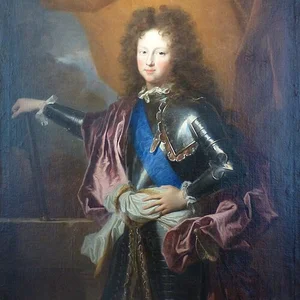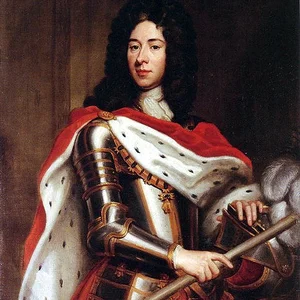

A prince of the House of Savoy who entered the service of the Habsburgs, Eugene of Savoy became one of the greatest military commanders of his time. As generalissimo of the imperial armies, he distinguished himself against the Ottomans and during the War of the Spanish Succession.
Eugene of Savoy(1663 — 1736)
Eugene of Savoy
duché de Savoie
6 min read
Frequently asked questions
Key Facts
- Born in 1663 in Paris and rejected by Louis XIV, he entered the service of Emperor Leopold I in 1683
- Together with Marlborough, won the Battle of Blenheim (Höchstädt) in 1704 during the War of the Spanish Succession
- Crushed the Ottomans at the Battle of Zenta in 1697, then captured Belgrade in 1717
- Victorious at Malplaquet (1709) and a negotiator of the Treaty of Rastatt (1714)
- Died in Vienna in 1736; patron who commissioned the Belvedere Palace
Works & Achievements
Annihilation of the Ottoman army crossing the Tisza; a founding victory that led to the Treaty of Karlowitz.
Triumph won alongside Marlborough against the Franco-Bavarian forces, which saved Vienna.
A strategic maneuver that drove the French out of Northern Italy during the War of the Spanish Succession.
Successes in the Spanish Netherlands that lastingly weakened the position of Louis XIV.
Conquest of the Ottoman fortress, the military peak of Eugene's career and a Habsburg expansion into the Balkans.
A masterpiece of Viennese Baroque architecture commissioned by Eugene, a patron of the arts.
Modernization of the organization and administration of the imperial armies under his presidency.
Anecdotes
Small, frail, and destined by his family for a career in the Church, the young Eugene asked Louis XIV for a military command. The king judged him to have no future and dismissively nicknamed him “the little abbot.” Stung, Eugene left France in 1683 and, it is said, swore to return only sword in hand — a promise he kept by fighting the French armies for thirty years.
At the Battle of Zenta in 1697, Eugene learned that the Ottoman army was in the middle of crossing the Tisza River. Although an order from the court forbade him to engage in combat, he attacked at once and crushed the sultan's army, which lost tens of thousands of men. The victory was so dazzling that the emperor forgave his disobedience.
During the War of the Spanish Succession, Eugene formed with the Duke of Marlborough, the English general, one of the most famous military duos in history. At Blenheim in 1704, their perfect coordination dealt the Franco-Bavarian army a resounding defeat that saved Vienna.
In 1706, the imperial army besieged in Turin seemed doomed. Eugene marched across all of northern Italy with his troops, outflanked the French lines, and launched an assault that relieved the city. Legend has it that he led the charge himself, sword in hand.
Having become immensely rich and powerful, Eugene had the splendid Belvedere Palace built in Vienna and assembled a library of more than 15,000 books and manuscripts. This warrior, known for being taciturn, was also a cultivated man, a patron of the arts and a correspondent of scholars such as Leibniz.
Primary Sources
The enemy has been utterly defeated and cut to pieces; the Grand Vizier's camp, artillery, and baggage have fallen into our hands.
The letters exchanged during the War of the Spanish Succession bear witness to the trust and coordination of the two generals in conducting their joint campaigns.
Official compilation of Eugene's military orders, reports, and dispatches, preserved in the Austrian war archives and published by the imperial general staff.
The summer palace built by Prince Eugene bears the mark of his military glory, blending martial emblems with the baroque splendor of the Viennese court.
Key Places
Eugene's birthplace, where he grew up at the court of Louis XIV before being rebuffed and leaving for Austria.
The Habsburg capital where Eugene built his career, led the Aulic War Council, and died in 1736.
A sumptuous Baroque palace that Eugene had built to house his art collections and library.
The site of his crushing victory of 1697 over the Ottoman army, which established his reputation as a great military commander.
A city besieged by the French in 1706 that Eugene relieved through a daring maneuver, freeing northern Italy.
An Ottoman fortress captured by Eugene in 1717, the high point of his campaigns against the Ottoman Empire.
Typical Objects

The supreme commander's ever-present weapon, both a fighting tool and a symbol of authority. Eugene is said to have personally brandished it during decisive charges, such as at Turin.

Insignia of supreme command over the imperial armies, handed over by the emperor. It marked the very top of the military hierarchy.

A firearm carried in a holster on the saddle bow by cavalry officers. Eugene often commanded on horseback, right in the thick of the fray.

A metal breastplate protecting the torso from sword blows and spent bullets. Senior officers wore one, often engraved.

Documents essential to strategy, showing rivers, fortresses and enemy positions. Eugene, a shrewd tactician, would study them at length before every manoeuvre.

A collection of more than 15,000 works assembled by Eugene, a sign of his learning and his patronage. It later joined the Imperial Library of Vienna.

A long powdered wig and embroidered coat worn by nobles at the court of Vienna. They signalled the rank and refinement expected of a prince.
School Curriculum
Vocabulary & Tags
Key Vocabulary
Daily Life
Morning
On campaign, Eugene rose early to inspect the troops, read scouts' reports and study his maps. In Vienna, his mornings combined military audiences with reading diplomatic correspondence.
Afternoon
The afternoon was devoted to councils of war, to maneuvers or, in peacetime, to administering the army from the Aulic War Council. He received officers and foreign envoys.
Evening
In the evening, far from the bustle of the court, Eugene liked to withdraw to his library, converse with scholars or admire his art collections and the gardens of the Belvedere.
Food
His princely table offered roasted meats, game, pâtés and wines, in keeping with the aristocratic customs of the Baroque era. On campaign, however, he often shared the rougher fare of his officers.
Clothing
At court, he wore the embroidered coat, the powdered wig and the ornaments of his princely rank. In battle, he donned the cuirass and the senior officer's uniform of the imperial armies.
Housing
In Vienna, Eugene owned the Winter Palace, in the city, and the great summer palace of the Belvedere, surrounded by gardens. On campaign, he lived under canvas, at the heart of the military camp.
Historical Timeline
Period Vocabulary
Liens externes & ressources
Références
Œuvres
Victoire de Zenta
1697
Bataille de Blenheim (Höchstädt)
1704
Déblocage de Turin
1706
Victoire d'Oudenarde et prise de Lille
1708
Prise de Belgrade
1717
Palais du Belvédère
1714-1723
Réforme du Conseil aulique de guerre (Hofkriegsrat)
1703-1736