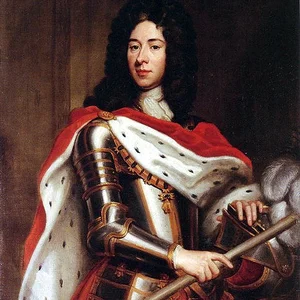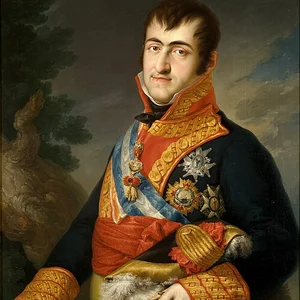

King of Prussia from 1713 to 1740, nicknamed the “Soldier King.” A rigorous and thrifty administrator, he reorganized the Prussian state and built a powerful army that turned Prussia into a major European military power.
Frederick William I of Prussia
Frederick William I of Hohenzollern, King of Prussia
5 min read
Frequently asked questions
Key Facts
- Becomes King of Prussia in 1713 upon the death of his father Frederick I
- Nicknamed the “Soldier King” for his obsession with the army and discipline
- Doubles the size of the Prussian army and creates a centralized, thrifty administration
- Gives the Amber Room to Tsar Peter the Great in 1716, sealing the Russo-Prussian alliance
- Dies in 1740, leaving his son Frederick II a solid state and a formidable army
Works & Achievements
A central administration unifying finances, war, and the management of royal domains, laying the foundations of the modern Prussian bureaucracy.
He expanded the army from about 40,000 to more than 80,000 men, making it one of the most disciplined in Europe despite the kingdom's modest size.
A territorial organization of military recruitment that gave Prussia a permanent pool of soldiers without ruining its agriculture.
One of the first measures in Europe to make school attendance compulsory, laying the groundwork for the Prussian education system.
The settlement of more than 15,000 Protestant refugees in East Prussia, repopulating and developing devastated lands.
Through rigorous economy, he left at his death a considerable war chest, a decisive asset for his successor Frederick II.
Anecdotes
Nicknamed the "Soldier King," Frederick William I was obsessed with his personal guard, the "Potsdam Giants": he recruited exceptionally tall soldiers from all over Europe, going so far as to buy them, kidnap them, or forcibly marry them to tall women in order to father giant sons.
Loathing the luxury of his father's court, he drastically cut palace spending as soon as he came to power in 1713, selling the royal silverware and jewels to replenish the state's coffers and fund the army.
He was so hot-tempered and authoritarian that he sometimes beat his subjects in the street with his cane when they were not working fast enough for his liking, shouting: "You must not fear me, you must love me!"
His relationship with his son, the future Frederick II, was violent: when the young prince tried to flee in 1730 with his friend Hans Hermann von Katte, the king had Katte executed before his son's eyes as a punishment.
A lover of tobacco and beer, he held a "Tabakskollegium" (tobacco college), an informal evening gathering where ministers, generals, and guests would smoke and discuss affairs of state in a rough, etiquette-free atmosphere.
Primary Sources
A strong army and a well-stocked treasury are the best guarantors of a state's peace and security; take care never to let them fall into decline.
My father reduced all things to military order and the strictest economy; he regarded spending as the greatest of evils.
Parents shall be required to send their children to school, so that none may remain in ignorance.
Key Places
Capital of the Kingdom of Prussia, where the king was born and ruled, reforming the state's administration and finances.
A residence and garrison town dear to the king, where his famous “Potsdam Giants” guard was stationed. He turned it into a military center of Prussia.
Historic capital of East Prussia, repopulated during his reign by the Protestants expelled from Salzburg. A symbolic seat of the Prussian monarchy.
A hunting lodge south of Berlin where the king liked to stay and hold his “Tabakskollegium” (Tobacco Council). The setting of his rustic daily life.
Fortress where Crown Prince Frederick was imprisoned after his attempted escape in 1730, and where Katte was executed.
Typical Objects

Rattan cane that the king carried at all times and used to physically correct his subjects and soldiers. It became the symbol of his brutal authoritarianism.

Blue military attire of the Prussian infantry that the king wore daily, fitting his nickname of the “Soldier King.” He made it the standard garment of the state.

Standard firearm of the Prussian infantry, whose handling was drilled to perfection. The Prussian rate of fire became a military benchmark across Europe.

Clay or wooden pipe used during the “Tabakskollegium,” the king's evening gathering. It symbolizes his taste for rustic simplicity and conviviality free of etiquette.

Chest in which the king methodically accumulated the state's financial reserves. At his death, he bequeathed a considerable treasure to his successor.

The king, hardly an artist, sometimes signed his orders or sketches “in tormentis” (“in torment”) because of his gout. His rare drawings reflect his direct, no-frills temperament.
School Curriculum
Vocabulary & Tags
Key Vocabulary
Daily Life
Morning
The king rose early, at daybreak, and devoted his morning to administrative work, personally reading and annotating reports and petitions. He demanded the same punctuality from his officials.
Afternoon
The afternoon was often dedicated to inspecting the troops, military drills, and tours of the kingdom to oversee the activity of his subjects. He also practiced hunting, his favorite pastime.
Evening
In the evening, he held his *Tabakskollegium*, a rustic gathering where the men smoked pipes and drank beer while freely discussing affairs of state, far from courtly etiquette.
Food
The king favored simple, hearty fare: meats, cabbage, game from his hunts, washed down with beer. He scorned the refinements of French-style dining.
Clothing
He almost always wore the blue military uniform of the Prussian infantry — plain and functional — refusing the luxury and ceremonial garments of his father.
Housing
He resided in palaces in Berlin and Potsdam, but preferred modest settings such as his hunting lodge at Wusterhausen, living without pomp despite his rank.
Historical Timeline
Period Vocabulary
Liens externes & ressources
Références
Œuvres
Création du Generaldirektorium
1723
Réforme de l'armée prussienne
1713-1740
Système des cantons (Kantonsystem)
1733
Édit d'instruction obligatoire
1717
Accueil des protestants de Salzbourg
1732
Assainissement des finances de l'État
1713-1740