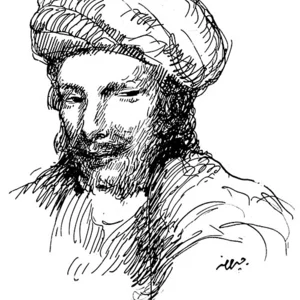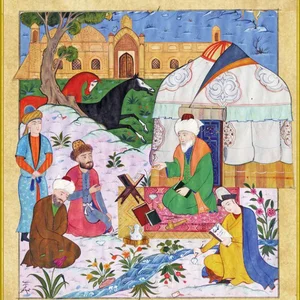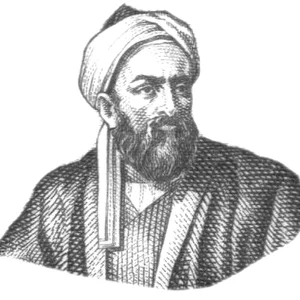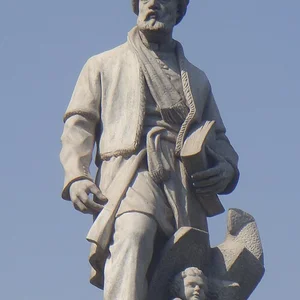

Ferdowsi (c. 940-1020) is the greatest epic poet of Persian literature. He is the author of the *Shâhnâmeh* ("Book of Kings"), an epic of 60,000 couplets recounting the mythical and legendary history of Persia.
Ferdowsi(940 — 1020)
Ferdowsi
Empire ghaznévide, empire samanide
7 min read
Frequently asked questions
Famous Quotes
« Knowledge is better than wealth: knowledge guards you, while you must guard wealth.»
Key Facts
- c. 940: birth in Tus, Khorasan (present-day Iran)
- 977-1010: composition of the *Shâhnâmeh* over more than thirty years
- 1010: presentation of the *Shâhnâmeh* to Sultan Mahmud of Ghazni
- The *Shâhnâmeh* contains about 60,000 couplets, making it one of the longest epics in world literature
- c. 1020: death in Tus; his work contributed to the revival and survival of the Persian language
Works & Achievements
A monumental epic of nearly 60,000 couplets recounting the mythical, legendary, and historical history of Persia from the creation of the world to the Arab conquest in the 7th century. An absolute masterpiece of Persian literature, it remains a foundational text of Iranian cultural identity.
A romantic poem inspired by the Quran, telling the story of Joseph and Potiphar's wife. Long attributed to Ferdowsi, its authenticity is now contested by scholars.
A short protest poem composed after the disappointment of the royal reward, in which Ferdowsi expresses his bitterness. It provides rare insight into the conflicted relationships between poets and patrons in the medieval Islamic world.
Anecdotes
Ferdowsi devoted more than thirty years of his life to writing the *Shâhnâmeh*, working tirelessly despite his family's growing poverty. According to tradition, he hoped that the reward from Sultan Mahmud of Ghazni would allow him to irrigate the lands of his native village of Tus.
When Mahmud of Ghazni finally sent him his reward — sixty thousand silver coins instead of the promised sixty thousand gold coins — Ferdowsi, deeply hurt, distributed the sum to a baker and a public bath before fleeing the court. He is said to have composed a scathing satire against the sultan before his escape.
The *Shâhnâmeh* contains nearly 60,000 couplets (120,000 verses), making it one of the longest poetic epics in world history, surpassing the *Iliad* and the *Odyssey* combined. Ferdowsi is said to have written it almost entirely alone, drawing on Middle Persian sources and oral chronicles.
Legend has it that Sultan Mahmud, seized by belated remorse, finally sent a caravan laden with gold to Ferdowsi — but that the convoy arrived in Tus precisely as the poet's coffin was leaving through one of the city gates. His daughter, proud, is said to have refused the gold.
Ferdowsi deliberately introduced a minimum of Arabic words into his work, claiming he wanted to preserve the pure Persian language. This literary and identity-driven decision made the *Shâhnâmeh* a monument of cultural resistance against the gradual Arabization of the Iranian world after the Islamic conquest.
Primary Sources
"I have suffered much in these thirty years, but I have revived Persia through the Persian language." (prologue, approximate translation)
"Ferdowsi was a man of great intelligence and vast knowledge; he had studied the books of ancient kings and knew the traditions of Persian heroes."
Anonymous chronicle that mentions Ferdowsi among the great scholars of eastern Iran and recounts the composition of the Shâhnâmeh under the initial patronage of the Samanids.
"If the king had had a noble father, he would have placed a golden crown upon my head." Poem of protest composed after the disappointment of the royal reward.
Key Places
Ferdowsi's birthplace in eastern Khorasan. It was here that he was born, worked most of his life, and died. His mausoleum, rebuilt in the 20th century, still stands there.
Capital of the Ghaznavid sultanate and court of Sultan Mahmud, to whom Ferdowsi dedicated the *Shâhnâmeh*. It was in this city that the poet suffered the humiliation of an inadequate reward.
Major intellectual and commercial metropolis of Khorasan, a center of medieval Persian culture. Ferdowsi is said to have stayed there and mingled with other scholars of his time.
Capital of the Samanid dynasty, the first cradle of the revival of Persian poetry. It was in this Samanid cultural context that the project of the *Shâhnâmeh* originated.
A waypoint on the caravan routes of eastern Khorasan, Herat was an important cultural center. Ferdowsi is said to have taken refuge there after his falling out with Mahmud.
Typical Objects

A fundamental writing instrument of the medieval Islamic world, the reed pen cut from cane was used to inscribe verses on paper or parchment. Ferdowsi used it to compose the tens of thousands of couplets of the *Shâhnâmeh*.

Luxury copies of the *Shâhnâmeh* were adorned with miniatures depicting epic heroes. These illuminated manuscripts on paper or vellum were prestige objects presented to princes and rulers.

The metal inkwell, often finely engraved, was an essential accessory for the Persian scholar. It held carbon or soot ink used for calligraphic writing.

In the palaces and homes of Khorasan's scholars, woven carpets decorated floors and walls. They appear in descriptions of the lifestyle of noble characters mentioned in the *Shâhnâmeh*.

Candle or oil lamp lighting was essential for a poet's nighttime work. Ferdowsi is said to have composed much of his work by night, in the glow of a flame.

A lost Middle Persian source that Ferdowsi and his predecessors used to reconstruct the epic traditions of Sassanid Iran. It symbolizes the transmission of pre-Islamic Iranian cultural heritage.
School Curriculum
Vocabulary & Tags
Key Vocabulary
Daily Life
Morning
Ferdowsi rose before dawn for the fajr prayer, then settled at his desk at first light. He reread the verses composed the previous day, correcting them in natural light while reciting softly to test their rhythm and musicality.
Afternoon
Afternoons were devoted to research in the Middle Persian manuscripts and chronicles available to him, or to receiving oral storytellers who transmitted heroic tales. He sometimes discussed episodes of the *Shāhnāmeh* with scholars or local patrons.
Evening
In the evening, by the light of an oil lamp, Ferdowsi composed his verses with the utmost care, ensuring he used only words of Iranian origin. He recited his couplets aloud to verify their prosody before committing them definitively to paper.
Food
The diet of a scholar in medieval Khorasan was based on wheat bread, rice, legumes, dates, and dried fruits from the oases. Roasted lamb and stewed dishes with aromatic herbs (coriander, mint, saffron) were festive meals, accompanied by rose-scented water.
Clothing
Ferdowsi wore the white turban and long tunic (qaba) made of cotton or fine wool, common among educated men of Khorasan. In cold weather, he donned a fur-lined cloak; his soft leather shoes were typical of affluent city dwellers of his time.
Housing
Ferdowsi owned a modest home in Tus, featuring an inner courtyard with a pool, rooms tiled with faience, and a library. His land income allowed him to work without practicing another profession, but the enrichment he hoped for from the *Shāhnāmeh* never came.
Historical Timeline
Period Vocabulary
Visual Style
Miniature persane aux teintes lapis-lazuli, safran et or, représentant un poète lettré dans un pavillon de jardin de l'Iran médiéval, dans le style des enluminures timurides.
Sound Ambience
Atmosphère sonore d'un scriptorium persan médiéval à Tus : grattement du calame, appel à la prière, vent du Khorasan et mélopée des vers récités à voix basse.
Liens externes & ressources
Références
Œuvres
Shâhnâmeh (Livre des Rois)
vers 977-1010
Yusuf et Zuleikha (attribution débattue)
vers 1010
Satire contre le sultan Mahmoud (qasida)
vers 1010