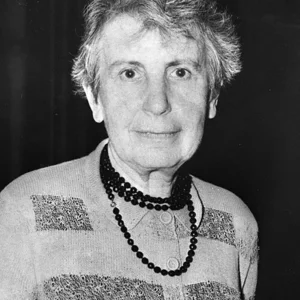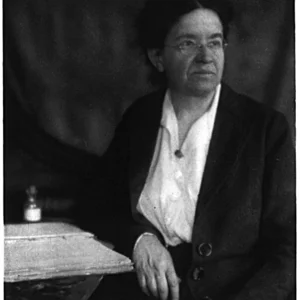

Florence Sabin (1871-1953) was an American physician and anatomist, a pioneer of medical research. She was the first woman to become a full professor at the Johns Hopkins Medical School and the first woman elected to the National Academy of Sciences of the United States.
Florence Sabin
Florence Rena Sabin
4 min read
Frequently asked questions
Key Facts
- Born in 1871 in Central City (Colorado, United States)
- In 1917, became the first woman to be a full professor at the Johns Hopkins Medical School
- In 1925, the first woman elected as a full member of the National Academy of Sciences of the United States
- Conducted fundamental research on the lymphatic system and blood vessels
- After retiring, led a public health reform in Colorado (the Sabin Laws, 1947)
Works & Achievements
A landmark teaching tool used to teach neuroanatomy for decades.
A major demonstration establishing that lymphatic vessels bud off from veins.
Pioneering work in embryology and hematology on the formation of blood.
Research into the body's immune reactions against the tuberculosis bacillus.
A set of public health reforms that sharply reduced tuberculosis mortality in the state.
Anecdotes
As a little girl, Florence Sabin lost her mother at the age of seven. Raised in part by her physician grandfather, she discovered the world of medicine very early and decided to make it her profession, at a time when almost no woman practiced it in the United States.
To finance her studies at Johns Hopkins Medical School, one of the first schools to admit women, Florence taught classes and worked hard. Brilliant, she built there a three-dimensional model of a newborn's brainstem, still used to teach anatomy for decades afterward.
Her research under the microscope overturned accepted ideas: she demonstrated that lymphatic vessels develop by budding out from the veins, and not separately as had been believed. This discovery earned her international recognition.
In 1925, she became the first woman elected as a full member of the United States National Academy of Sciences, after having been the first woman to hold a full professorship at Johns Hopkins. Doors long closed to women opened thanks to her determination.
At 73, when she could have enjoyed her retirement, Florence Sabin agreed to lead a public health campaign in her native Colorado. Her reforms sharply reduced deaths from tuberculosis: science directly serving people.
Primary Sources
A model and atlas of the brainstem produced by Florence Sabin, which became a reference tool for teaching anatomy.
Sabin demonstrates that the lymphatic vessels arise by budding from the venous system.
A health reform program championed by Florence Sabin to fight tuberculosis and improve public hygiene.
Key Places
Mining town where Florence Sabin was born in 1871.
Women's college where she earned her first degree before studying medicine.
Here she studied, taught, and became the institution's first woman to hold a full professorship.
Research center where she studied the immune system and tuberculosis from 1925 onward.
City where she led her public health campaign and where she died in 1953.
Typical Objects
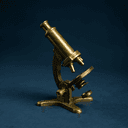
An essential instrument in her research, it allows her to observe blood vessels, lymphatic vessels and blood cells.
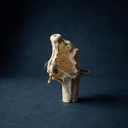
A three-dimensional reconstruction of a newborn's medulla and midbrain, used to teach neuroanatomy.
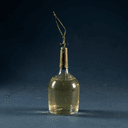
Tissue preparations stained and fixed onto glass slides, used to study cells under the microscope.
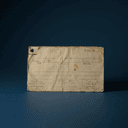
A notebook in which she meticulously records her observations, sketches and experimental results.
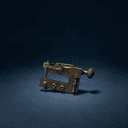
A device used to cut extremely thin tissue sections for observation under the microscope.
School Curriculum
Vocabulary & Tags
Key Vocabulary
Daily Life
Morning
Early in the morning, Florence Sabin heads to the laboratory at Johns Hopkins. She prepares her slides, adjusts her microscope and begins her observations while the university's hallways are still quiet.
Afternoon
Her afternoons are split between teaching medical students and pursuing her research. She draws precisely what she sees under the microscope and discusses the results with her colleagues.
Evening
In the evening, she reads scientific journals, writes her articles and prepares her lectures. Unmarried and passionate about her work, she devotes a great deal of her time to science.
Food
Her diet is that of an urban American woman in the first half of the 20th century: simple, regular meals of bread, meat, vegetables and coffee. Very busy, she often eats quickly between two experiments.
Clothing
She wears the understated outfits of the professional women of her time: long dresses or skirts and buttoned blouses, covered by a white lab coat while working.
Housing
She lives in modest lodgings near her workplaces, in Baltimore and then New York, before moving back to Colorado to settle near her sister at the end of her life.
Historical Timeline
Period Vocabulary
Liens externes & ressources
Références
Œuvres
Atlas et modèle du tronc cérébral du nouveau-né
1901
Théorie de l'origine veineuse du système lymphatique
1902
Recherches sur l'origine des cellules sanguines et des vaisseaux
1917
Études sur la tuberculose au Rockefeller Institute
1926
Sabin Health Laws (Colorado)
1947