
Forseti is the Norse god of justice and reconciliation in Scandinavian mythology. Son of Baldr and Nanna, he presides over the divine tribunal Glitnir, whose golden walls and silver roof symbolize the brilliance of justice. He is considered the greatest judge among gods and men.
Forseti
Forseti
8 min read
Frequently asked questions
Key Facts
- Forseti is mentioned in the Prose Edda by Snorri Sturluson (c. 1220)
- He resides in Glitnir, a hall with golden walls and a silver roof, a symbol of justice
- He is the son of Baldr (god of light) and Nanna
- His name means 'presiding one' or 'president' in Old Norse
- He belongs to the Aesir, the principal gods of the Norse pantheon
Works & Achievements
Forseti established Glitnir as the seat of supreme justice in Asgard. This mythological achievement represents the very institution of divine law in Norse cosmology, a precedent for all human justice.
Forseti is said to have exercised his power of reconciliation during the great crises of Asgard, particularly in the tensions that followed the death of his father Baldr — an event foreshadowing Ragnarök.
Snorri Sturluson devotes a passage of the Gylfaginning to Forseti, placing him among the twelve great Aesir gods. This source remains the most complete reference text on the Norse god of justice.
The Poetic Edda mentions Glitnir and its judicial role, confirming that the myth of Forseti predates the prose tradition alone and attesting to his place in ancient skaldic poetry.
A cult dedicated to the god Fosite existed on the island of Helgoland before the Christianization of Frisia. This cult testifies to the spread of Norse mythology as far as the shores of the North Sea.
Anecdotes
Forseti dwells in Glitnir, the most beautiful hall in Asgard: its walls are made of pure gold and its roof of gleaming silver. Any god or man who comes there with a dispute leaves with a fair judgment. This resplendent hall symbolizes the idea that justice must be radiant and visible to all.
Son of Baldr, the most beloved of the Aesir, and of Nanna, goddess of tenderness, Forseti inherits his father's goodness and his mother's gentleness. In Norse mythology, this lineage places him at the heart of the most noble divine values: beauty, innocence, and fairness.
Snorri Sturluson, in the Prose Edda around 1220, states that Forseti is the finest judge among gods and men. No one left Glitnir without having received a just ruling, which made him the supreme arbiter invoked during major disputes between Viking clans.
A medieval Frisian tradition links Forseti to the island of Helgoland, then known as Fositesland. The monk Alcuin records around 796 that Saint Willibrord landed on this sacred island dedicated to a god named Fosite, whom modern scholars often identify with Forseti. Slaughtering animals or drawing water from the sacred well there was forbidden on pain of death.
Unlike Tyr, the other Norse god associated with justice, Forseti is never depicted as a warrior. His role is that of mediator and reconciler: where Tyr decides by the force of law, Forseti seeks agreement between the parties — a remarkable distinction in Indo-European pantheons, where justice is so often bound up with war.
Primary Sources
The twelfth is Forseti, son of Baldr and Nanna Nepsdóttir. He owns in Asgard the hall called Glitnir. Its walls and pillars are of red gold, its roof of silver. He is the best judge among gods and men.
Glitnir is the tenth; its walls are of gold and its roof of silver; there Forseti dwells for most of his days and settles all disputes.
He landed on an island lying between the Franks and the Saxons, in the northern ocean, which the inhabitants of that country call Fositesland, after a god they worship there.
Among the names that can be given to Forseti: the god of Glitnir, the son of Baldr, the judge of the gods, the settler of disputes.
Key Places
Forseti's golden hall in Asgard, with walls of gold and a roof of silver. This is where the god delivers his divine judgments and reconciles feuding gods and mortals — the most radiant place in Asgard according to the Eddas.
A North Sea island formerly known as Fositesland, a Frisian cult site dedicated to the god Fosite, identified with Forseti. Saint Willibrord landed there around 716 and broke a religious taboo, attesting to the importance of this sanctuary.
Site of the Althing, the world's oldest parliamentary assembly, founded in 930, which reflects in historical reality the ideals of justice and deliberation embodied by Forseti in Norse mythology.
A major pre-Christian Norse religious center with a great temple dedicated to the Aesir gods. Uppsala was one of the principal places where the memory of Norse deities, including Forseti, was kept alive by priests and skalds.
Home to the Codex Regius, the manuscript of the Poetic Edda that mentions Glitnir and Forseti. This site symbolizes the transmission and survival of Norse mythology down to the present day.
Typical Objects

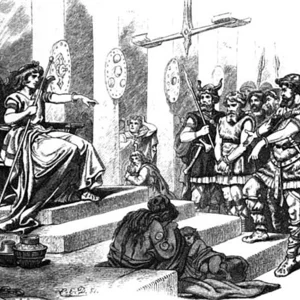
Forseti presides over judgments seated on a golden chair in his resplendent hall. This throne symbolizes the supreme authority of the divine judge, beyond the reach of corruption or partiality.

In Norse tradition, the most solemn oaths were sworn on a sacred ring kept in temples. Forseti, as the god of justice, was invoked during these oaths to guarantee their divine validity.

According to Alcuin, the island of Fositesland had a well whose water could only be drawn in complete silence. This well symbolized the purity of judgments rendered under Forseti's aegis and the sacred nature of truth.

Viking assemblies made use of collections of oral and later written laws. Forseti, god of justice and law, was associated with the preservation and transmission of these sacred legal codes across generations.

A symbol of judicial authority in Norse cultures, the axe was raised during assemblies to mark the beginning and end of deliberations. Some symbolic representations of Forseti associate him with this instrument of solemn decision.

A symbolic staff wielded by the reciter of laws during Viking assemblies to signify his authority. An earthly emblem of the judicial power that Forseti exercises at the divine level in Glitnir.
School Curriculum
Vocabulary & Tags
Key Vocabulary
Daily Life
Morning
Each morning, Forseti takes his place on his golden throne in Glitnir, whose walls gleam in the light of the rising sun. Gods and spirits bearing disputes come before him at dawn, for no quarrel is allowed to linger under his reign.
Afternoon
In the afternoon, Forseti deliberates with infinite patience, hearing each party without interruption. Unlike the battles or feasts of Odin's Valhalla, Glitnir resounds with measured words — the god passes judgment without ever being swayed by anger or partiality.
Evening
In the evening, Forseti pronounces his final rulings, which no god may contest once he has spoken. He then joins the banquet of the Aesir in Asgard, respected by all for his impartial wisdom and his ability to reconcile even the most opposing spirits.
Food
Like all Norse gods, Forseti takes part in the divine feasts of Asgard, where mead and boar meat are plentiful. Yet the texts emphasize his intellectual sobriety — a judge who drowns himself in mead risks losing the impartiality that is the source of his greatness.
Clothing
Forseti is associated with radiant garments, sometimes golden in reference to Glitnir. Unlike Thor with his warrior attributes, he rarely wears armor: his dignity is that of a sovereign magistrate, not a fighter, and his authority is expressed through words rather than force.
Housing
Glitnir, his dwelling in Asgard, is described as the most beautiful of all divine halls: walls of red gold and a roof of polished silver that scatters light in every direction. This splendor is not ostentatious but symbolic — justice must be luminous, transparent, and visible to all, with no shadows or dark corners.
Historical Timeline
Period Vocabulary
Liens externes & ressources
Références
Œuvres
Institution du tribunal de Glitnir
temps mythiques
Rôle de médiateur lors des crises divines
temps mythiques
Edda en prose — Description de Forseti par Snorri Sturluson
vers 1220
Grímnismál — Mention de Glitnir (Edda poétique)
XIIe-XIIIe siècle
Culte de Fosite à Fositesland (Frise)
avant 716