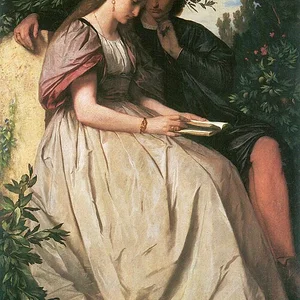

A 13th-century Italian noblewoman, Francesca da Polenta was married to Giovanni Malatesta and then murdered alongside her brother-in-law Paolo, with whom she was in love. Her tragic story was immortalized by Dante in the Divine Comedy.
Francesca da Rimini(1259 — 1285)
Francesca da Rimini
8 min read
Frequently asked questions
Key Facts
- Born around 1255 in Ravenna, daughter of Guido da Polenta
- Married to Giovanni Malatesta (known as 'lo Sciancato') to seal a political alliance
- Murdered around 1285 by her husband along with her brother-in-law Paolo Malatesta
- Immortalized by Dante Alighieri in Canto V of the Inferno (Divine Comedy, c. 1307–1321)
- Become one of the most iconic figures of tragic courtly love in Western literature
Works & Achievements
The first and most celebrated literary account of Francesca. Dante places her in the second circle of Hell alongside Paolo, among the lustful, yet grants her a long and moving speech that has resonated through the centuries.
Boccaccio's public commentary on the Divine Comedy, in which he expands on Francesca's biography and passes down the legend of the ruse used during the betrothal — the principal source for later tradition.
A Italian Romantic tragedy that reignited interest in Francesca in the nineteenth century and helped establish her as a symbol of sacrificed love and political oppression in Risorgimento Italy.
A major verismo opera inspired by D'Annunzio's tragedy (1901), representing the dramatic and musical culmination of the Francesca legend. It is still regularly performed in major opera houses.
An orchestral work inspired by Canto V of Dante's Inferno, musically depicting the infernal storm and the passion of Francesca and Paolo. One of the best-known orchestral pieces of the nineteenth century.
Anecdotes
According to the tradition reported by Boccaccio
Francesca was allegedly deceived at the time of her betrothal: her future husband Giovanni Malatesta
nicknamed Gianciotto (
the lame one
)
supposedly sent his brother Paolo — younger and more handsome — to meet her in his place. Francesca is said to have believed she was marrying Paolo
only discovering the substitution at the moment of the ceremony. According to contemporaries
this story explains how her love for Paolo came to be.
In Canto V of the Inferno, Dante has Francesca recount the decisive moment of her passion: while reading with Paolo the romance of Lancelot and Guinevere, they were consumed by desire at the passage where Lancelot kisses the queen. "A Galeotto was the book and he who wrote it
says Francesca — comparing the book to the go-between Gallehault from the Arthurian romance. This scene is one of the most celebrated in all of medieval literature.
Giovanni Malatesta discovered the two lovers and killed them both on the spot, around 1283–1285. Under medieval Italian law, a deceived husband had the right to kill his adulterous wife and her accomplice caught in the act: Giovanni was never prosecuted for the double murder. He continued to wield political power in Rimini until his death.
Dante knew the Malatesta family personally and was himself received in Ravenna, at the home of Francesca's family's heirs, in the final years of his life (1318–1321). It was in this city that he completed the Divine Comedy and died in 1321. The fact that he places Francesca in Hell, yet with profound compassion, remains one of the most moving and most debated passages in the entire work.
Francesca's marriage to Giovanni Malatesta was above all a political alliance: her father, Guido da Polenta, lord of Ravenna, was seeking military support against his Guelph and Ghibelline enemies. The Malatesta family, rising to prominence in Rimini, also found it in their interest. Francesca had no say in the matter, as was customary for noble daughters in the thirteenth century.
Primary Sources
«Amor, ch'al cor gentil ratto s'apprende, / prese costui de la bella persona / che mi fu tolta; e 'l modo ancor m'offende. / Amor, ch'a nullo amato amar perdona, / mi prese del costui piacer sì forte, / che, come vedi, ancor non m'abbandona.»
«Fu adunque questa Francesca figliuola di messer Guido Vecchio da Polenta... e fu data per moglie a messer Giovanni figliuolo di messer Malatesta da Verucchio... La qual cosa avvedutasi Francesca, e già avendo preso amore con Paolo...»
«Malatesta de Verucchio dominus Arimini genuit filios... Iohannes qui claudus vocatur occidit uxorem suam et Paulum fratrem propter adulterium.»
«Francisca fuit nobilis domina de Polenta de Ravenna, filia Guidonis Senioris... quae nupsit Joanni Malatestae claudo, et postea tractavit amores cum Paulo fratre suo...»
Key Places
Birthplace of Francesca, daughter of Guido da Polenta, lord of Ravenna. It was from this city that her father arranged her political marriage into the Malatesta family of Rimini.
City of the Malatesta, Francesca's husband's family. It was at the palace of Rimini — or, according to some sources, at the castle of Gradara — that the tragedy unfolded: the discovery of the affair and the double murder.
A medieval fortress on the border of the Marche and Romagna regions, long identified by local tradition as the precise location where Francesca and Paolo were murdered by Giovanni Malatesta.
Birthplace of Dante, who immortalized Francesca in the *Divine Comedy*. The literary culture of the *Dolce Stil Novo* in Florence, of which Dante was the foremost representative, celebrated precisely the courtly love that Francesca lived out so tragically.
Typical Objects

It was while reading this Arthurian romance together that Francesca and Paolo surrendered to their passion, according to Dante. Manuscripts of courtly romances circulated among the noble courts of 13th-century Italy, often adorned with miniature paintings.

A legal document sealing the alliance between the Polenta and Malatesta families, setting out Francesca's dowry. For 13th-century nobles, this contract was the cornerstone of an arranged marriage made for political ends.

Italian noblewomen of the 13th century wore linen or silk veils covering their hair, a mark of respectability and social standing. Francesca, as a lady-in-waiting and a lord's wife, wore one every day.

The reading of the Lancelot romance took place by the flickering light of a wax candle or an olive-oil lamp. Artificial lighting, precious and costly, was reserved for the interiors of noble households.

Noblewomen spent part of their days embroidering wall hangings, liturgical garments, or accessories. This activity, both practical and decorative, gave structure to the domestic hours of high-ranking women.

Daily religious observance — masses, the canonical hours — was an integral part of medieval noble life. Francesca, like every Christian noblewoman, owned a personal breviary for prayers and attended services in the castle chapel.
School Curriculum
Vocabulary & Tags
Key Vocabulary
Daily Life
Morning
Francesca rose at dawn, as required by the rule of the Christian canonical hours. After morning prayers in the castle's private chapel, she would oversee the needlework and domestic tasks of the noble household alongside her ladies-in-waiting.
Afternoon
The afternoon was devoted to courtly activities: receiving visitors, managing the castle's domestic affairs, and — a cherished moment — the reading aloud of courtly romances. It was during these shared readings that, according to Dante, the passion between Francesca and Paolo was born.
Evening
In the evening, the household gathered for the main meal, served in the castle's great hall. After supper, musicians or jesters would sometimes enliven the evening gathering, before final prayers and bedtime at dusk.
Food
The diet of a 13th-century noblewoman in Romagna included wheat bread, legumes, garden vegetables, meat (pork, poultry, and game) on permitted days, and fish on fast days. Local Romagna wine was served at the table, diluted with water.
Clothing
Francesca wore long gowns of dyed wool (red, blue) or imported silk, cinched at the waist with an embroidered belt. Her head was covered with a white linen veil held in place by a headband, a mark of her rank as a married noblewoman. In winter, she wrapped herself in fur-lined cloaks.
Housing
Francesca lived in a fortified seigneurial residence: the Malatesta palace in Rimini, or the castle of Gradara according to tradition. These dwellings combined defensive towers, an inner courtyard, a great common hall, and private chambers furnished with chests, tapestries, and four-poster beds.
Historical Timeline
Period Vocabulary
Liens externes & ressources
Références
Œuvres
Divine Comédie — Enfer, Chant V (Dante Alighieri)
vers 1307-1321
Esposizioni sopra la Comedia (Giovanni Boccaccio)
1373-1374
Francesca da Rimini (tragédie de Silvio Pellico)
1815
Francesca da Rimini (poème symphonique de Tchaïkovski, op. 32)
1876