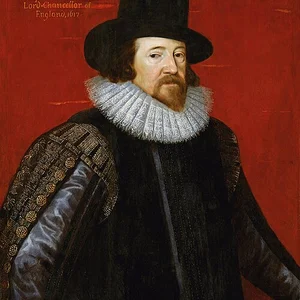

English philosopher and statesman (1561–1626), Francis Bacon is the founder of the modern experimental method. Lord Chancellor of England under James I, he championed the idea that science must be based on observation and induction rather than authority.
Francis Bacon(1561 — 1626)
Francis Bacon
royaume d'Angleterre
7 min read
Frequently asked questions
Famous Quotes
« Knowledge is power.»
« Nature, to be commanded, must be obeyed.»
Key Facts
- Born on 22 January 1561 in London, died on 9 April 1626.
- Appointed Lord Chancellor of England in 1618 under the reign of James I.
- Published Novum Organum in 1620, a foundational work on inductive method.
- Convicted of corruption in 1621, he was removed from office and devoted himself entirely to philosophy.
- His unfinished work New Atlantis (1627) describes an ideal society built on science.
Works & Achievements
A collection of 58 essays on moral, political, and practical subjects. Considered one of the founding works of the essay genre in English, it showcases Bacon's pragmatic and clear-eyed thinking on human affairs.
Bacon's first major manifesto for the reform of knowledge. In it, he offers a critical assessment of human learning and calls for a rebuilding of science on the foundations of observation and experience.
Bacon's philosophical masterpiece, in which he presents his inductive method as an alternative to Aristotelian logic. He also describes the four 'idols' — cognitive biases that distort human judgment.
A utopian tale describing an ideal society governed by science. The 'House of Solomon' he imagines within it directly inspired the founding of the Royal Society of London in 1660.
An expanded Latin version of The Advancement of Learning, aimed at Europe's scholarly readership. In it, Bacon develops his encyclopedic classification of the sciences, which had a lasting influence on Enlightenment philosophers.
Anecdotes
Francis Bacon died in 1626 from pneumonia contracted during a scientific experiment: he had wanted to test the effects of cold on food preservation by stuffing a chicken with snow on a bitter winter's day. This ironically experimental death perfectly illustrates his lifelong devotion to the scientific method he had championed.
Despite his immense intellect, Bacon was convicted of corruption in 1621: he had accepted bribes from litigants while serving as Lord Chancellor. He admitted the charges without attempting to defend himself, declaring that he was 'the most corrupt judge since many years.' He was briefly imprisoned in the Tower of London before being pardoned by King James I.
Bacon wrote his works in both Latin and English, but he harbored a strange fear: he believed his English writings would be forgotten because the language seemed too unstable to him. He therefore asked his friends to translate his essays into Latin, which he regarded as the eternal language of scholarship. Paradoxically, his Essays in English are today among the founding texts of modern English prose.
In his utopian fiction New Atlantis (1627), Bacon imagined an institution he called 'Solomon's House' — a kind of ideal scientific academy dedicated to experimental research. This prophetic vision directly inspired the founding of the Royal Society of London in 1660, more than thirty years after his death, proving the lasting influence of his thought on the organization of modern science.
Primary Sources
Man, being the servant and interpreter of Nature, can do and understand so much and so much only as he has observed in fact or in thought about the order of Nature: beyond this he neither knows anything nor can do anything.
Reading maketh a full man; conference a ready man; and writing an exact man. And therefore, if a man write little, he had need have a great memory; if he confer little, he had need have a present wit; and if he read little, he had need have much cunning.
We are much beholden to Machiavel and others, that write what men do, and not what they ought to do. For it is not possible to join serpentine wisdom with the columbine innocency, except men know exactly all the conditions of the serpent.
I have taken all knowledge to be my province; and if I could purge it of two sorts of rovers, whereof the one with frivolous disputations, confutations, and verbosities, the other with blind experiments and auricular traditions and impostures, hath committed so many spoils, I hope I should bring in industrious observations.
Key Places
The family residence where Francis Bacon was born in 1561. His father Nicholas Bacon served there as Lord Keeper of the Great Seal, introducing young Francis early to the realities of English power and politics.
Bacon began his studies here in 1573, at the age of just 12. It was here that he developed his first criticisms of Aristotelian philosophy, which he considered too abstract and of little use to genuine knowledge of the world.
Bacon was admitted here in 1576 to study law and resided there for much of his life. He conceived and wrote several of his major works within its gardens, which he himself helped design.
A country estate inherited from his father, to which Bacon retreated following his disgrace in 1621. It was here that he devoted his final years to writing and scientific experimentation.
The seat of Parliament and the courts of justice, where Bacon pursued his political career over several decades — first as a Member of Parliament, then as Lord Chancellor from 1618 to 1621.
Typical Objects

Bacon wrote his essays and philosophical treatises with a quill, sometimes dictating to secretaries. He produced a considerable body of work in both English and Latin, reflecting an intense and methodical writing practice.

A symbol of worldly knowledge during the Age of Exploration, the globe appears on the title page of the Novum Organum, accompanied by the motto 'Multi pertransibunt et augebitur scientia' (Many will pass through and knowledge will grow).

Bacon championed the direct observation of nature and experimentation as the foundations of knowledge. He collected natural specimens and took a keen interest in the practices of craftsmen and physicians.

At the height of his career, Bacon wore the insignia of England's highest judicial office. These magnificent robes symbolised his dual status as statesman and thinker — a fusion of political and intellectual power.

Bacon had a thorough mastery of Aristotle, whom he sought precisely to surpass. His library combined jurisprudence, natural philosophy, and classical texts, reflecting his encyclopaedic education.

A modest yet highly symbolic object: Bacon died after exposing a chicken to snow in order to test the effects of cold on food preservation — a concrete illustration of his faith in direct experimentation.
School Curriculum
Vocabulary & Tags
Key Vocabulary
Tags
Daily Life
Morning
Bacon rose early and began his day with a walk through the gardens of Gray's Inn or Gorhambury, meditating on his philosophical ideas. He would then dictate his thoughts to his secretaries, as he preferred to compose orally before correcting the manuscripts himself.
Afternoon
His afternoons were devoted to judicial and political affairs when he held office: hearings, drafting judgments, meetings in Parliament or at Court. Even in disgrace, he continued writing treatises and maintaining an extensive correspondence with scholars and statesmen.
Evening
Bacon's evenings often brought together men of letters, lawyers, and philosophers for lengthy conversations. He was fond of music — which he considered beneficial to concentration — and would have classical texts or his own writings read aloud so he could refine them.
Food
Bacon's table reflected the status of a great Elizabethan nobleman: roasted meats, game, fish, spiced pastries, and wines from France or Spain. He took an interest in dietetics as he did in every scientific subject, noting the effects of food on health and longevity.
Clothing
Bacon wore the dark and sumptuous attire of senior dignitaries at the Jacobean court: black velvet robes, a large white lace ruff, and the insignia of his successive offices. In private, he preferred simpler clothing, though always of fine quality, reflecting his taste for refined comfort.
Housing
Bacon lived in several prestigious residences: York House on the Thames, his chambers at Gray's Inn in London, and Gorhambury House in the countryside. He personally designed the gardens of his homes, conceiving them as places for reflection and botanical experimentation — a living extension of his natural philosophy.
Historical Timeline
Period Vocabulary
Visual Style
Portraits solennels de la cour jacobéenne, intérieurs sombres et richement meublés, lumière dorée des chandelles sur les robes noires et les fraises blanches, atmosphère austère et savante.
Sound Ambience
L'univers sonore de Bacon mêle le silence studieux du cabinet de travail, le bruit sourd des institutions politiques londoniennes et les ambiances feutrées d'une grande demeure élisabéthaine.
Liens externes & ressources
Références
Œuvres
Essays or Counsels, Civil and Moral
1597 (1re éd.), 1625 (éd. définitive)
The Advancement of Learning (Du progrès des connaissances)
1605
Novum Organum Scientiarum
1620
New Atlantis (La Nouvelle Atlantide)
1627 (posthume)
De Dignitate et Augmentis Scientiarum
1623