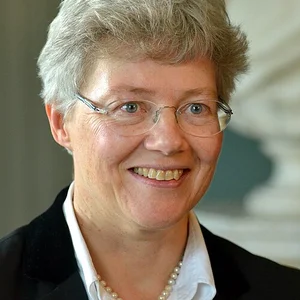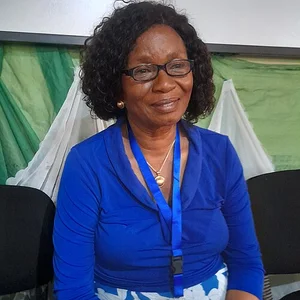

Francisca Nneka Okeke is a Nigerian physicist and professor at the University of Nigeria, Nsukka. A specialist in geophysics, she studies the electric currents of the ionosphere (the equatorial electrojet) and their link to the climate. In 2013, she received the L'Oréal-UNESCO Award for Women in Science.
Francisca Nneka Okeke(1968 — ?)
Francisca Okeke
Nigeria
6 min read
Frequently asked questions
Key Facts
- Born in 1956 in Nigeria
- First woman to earn a doctorate in physics at the University of Nigeria, Nsukka, where she later became a professor and head of the physics department
- Her research focuses on variations in the Earth's magnetic field and ionospheric currents (the equatorial electrojet), with applications to climate change
- In 2013, she received the L'Oréal-UNESCO Award for Women in Science, representing Africa and the Arab States
- A recognized advocate for African girls' access to scientific studies
Works & Achievements
In-depth studies of the electric currents in the ionosphere along the magnetic equator, based on geomagnetic data. This work represents Okeke's major scientific contribution.
Okeke became one of the first women to reach the rank of professor of physics at her university, paving the way for other female researchers.
She led her university department, taking on responsibilities in teaching, research, and mentoring young scientists.
Scientific papers linking variations in upper-atmosphere currents to the understanding of climate change. They contributed to her international recognition.
A global distinction awarded to five researchers each year; Okeke was the laureate for Africa and the Arab States. It honored the whole body of her work in geophysics.
A steadfast commitment to encouraging young African girls to study science and to supporting them in their careers as researchers.
Anecdotes
In 2013, Francisca Okeke received the L'Oréal-UNESCO "For Women in Science" award in Paris, one of the highest international honors for women researchers. She was chosen as the laureate representing Africa and the Arab States, recognized for her work on the electric currents of the upper atmosphere.
Her research subject resembles an invisible river: the equatorial electrojet, a powerful electric current that flows more than 100 km above the ground, along the magnetic equator. To study it, Okeke spent years analyzing measurements of Earth's magnetic field recorded by African observatories.
Okeke explained that better understanding these upper-atmosphere currents could help scientists better grasp climate change. It was this link between geophysics and climate that especially impressed the jury for her award.
Having become one of the first women physics professors at her university, she uses her prominence to encourage young African girls to take up the sciences, a field where they are still few in number. She says she wants to show by example that physics is not reserved for men.
Primary Sources
For her significant contribution to the understanding of daily variations in the ionic currents of the upper atmosphere, which may advance our understanding of climate change.
A professor at the University of Nigeria, Nsukka, Francisca Okeke has devoted her research to the study of electric currents in the ionosphere, in particular the equatorial electrojet, using geomagnetic data.
She says she wants to use this distinction to inspire young women, particularly in Africa, and to show them that science is also meant for them.
Key Places
University where Francisca Okeke pursued her advanced studies, then became a professor and headed the department of physics and astronomy. It is the heart of her scientific career.
Region in southeastern Nigeria where Nsukka is located and where Okeke lives and works. It lies in a tropical zone, not far from the magnetic equator she studies.
Emblematic site of the “For Women in Science” programme. It was in Paris that Okeke received her international award in 2013.
West African country where Francisca Okeke was born in 1968 and where she carried out her entire career. Nigeria is the most populous country on the African continent.
Typical Objects

An instrument that measures the strength and direction of Earth's magnetic field. It is the basic tool for detecting the variations caused by the equatorial electrojet.
A device that sends radio waves up toward the sky and analyzes their echo to probe the ionosphere. It allows scientists to study this electrically charged layer of the upper atmosphere.

An essential tool for storing and analyzing long series of magnetic measurements. Okeke uses it to turn raw numbers into curves and models.

Publications in which researchers present their findings so they can be verified and used by others. It is through them that Okeke shares her discoveries about the equatorial electrojet.

Measurements of Earth's magnetic field collected from space by satellites such as Ørsted or CHAMP. They complement ground-based observatories in the study of the upper atmosphere.

A symbolic object presented to the laureates of the “For Women in Science” program. It represents the international recognition of an outstanding scientific career.
School Curriculum
Vocabulary & Tags
Key Vocabulary
Daily Life
Morning
Like many academics, Francisca Okeke starts her day early and heads to the Nsukka campus. Her mornings are often devoted to physics lectures and laboratory sessions with students.
Afternoon
Afternoons are dedicated to research: analyzing magnetic data, reading papers, supervising doctoral students, and departmental meetings. It is also the time for writing up scientific publications.
Evening
In the evening, family life takes over, between shared meals and moments of rest. A researcher often uses this time to prepare the next day's lessons or to make quiet progress on her work.
Food
The diet follows Nigerian cuisine, rich and spicy: jollof rice, yam, plantain, and soups such as egusi (made from melon seeds) or okra. Fish, chicken, and beans hold an important place in it.
Clothing
The attire blends Western academic clothing with traditional Nigerian garments in colorful fabrics (wax or ankara wrappers). During ceremonies, embroidered outfits and traditional headdresses take center stage.
Housing
A professor generally lives in modern housing in the city or in university accommodation near the campus. The tropical climate of southeastern Nigeria, hot and humid, sets the rhythm of daily life.
Historical Timeline
Period Vocabulary
Liens externes & ressources
Références
Œuvres
Recherches sur l'électrojet équatorial
années 1990-2010
Première femme professeure de physique de l'Université du Nigéria, Nsukka
années 2000
Direction du Département de physique et d'astronomie (UNN)
années 2010
Publications sur les courants ionosphériques et le climat
années 2000-2010
Prix L'Oréal-UNESCO Pour les femmes et la science
2013
Action en faveur des femmes dans les sciences
années 2010