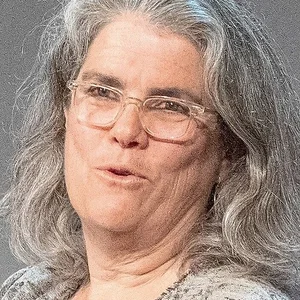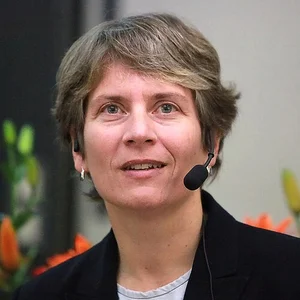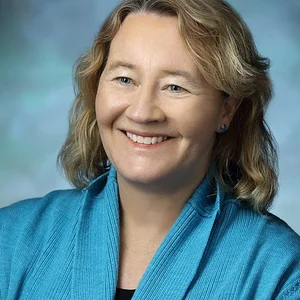

Carol Greider is an American molecular biologist born in 1961. In 1984 she discovered telomerase, the enzyme that protects the ends of chromosomes, which earned her the Nobel Prize in Physiology or Medicine in 2009.
Carol Greider(1961 — ?)
Carol Greider
États-Unis
5 min read
Frequently asked questions
Key Facts
- Born on April 15, 1961, in San Diego, California
- Discovered telomerase in 1984 with her thesis advisor Elizabeth Blackburn
- Awarded the Nobel Prize in Physiology or Medicine in 2009, shared with Elizabeth Blackburn and Jack Szostak
- Her work sheds light on the mechanisms of cellular aging and of certain cancers
- Professor of molecular biology and genetics (Johns Hopkins University, then the University of California, Santa Cruz)
Works & Achievements
First experimental demonstration of the enzyme that lengthens the ends of chromosomes, carried out in extracts of Tetrahymena.
Official publication of the discovery with Elizabeth Blackburn, introducing telomerase to the scientific community.
Greider shows that the enzyme carries its own RNA molecule serving as a template, explaining how it builds the telomeric repeats.
Her research establishes the link between telomere shortening, cellular aging, and the proliferation of cancer cells.
One of the highest American honors in medicine, recognizing her discoveries about telomeres.
Shared with Elizabeth Blackburn and Jack Szostak for understanding how chromosomes are protected by telomeres and telomerase.
Anecdotes
On December 25, 1984, Carol Greider, then a 23-year-old student in Elizabeth Blackburn's laboratory, developed an autoradiography plate and discovered the “ladder” pattern proving the existence of telomerase. She recounted that she put on music and danced in the empty laboratory that Christmas Day, sensing the importance of what she had just seen.
Carol Greider is dyslexic. She has often explained that her difficulties with spelling and standardized tests led to her being rejected by several universities, but that learning to compensate in other ways may have helped her think about science in an original way.
On the morning of October 5, 2009, the phone call from Stockholm informing her that she was receiving the Nobel Prize caught her in the middle of a household chore: a single mother of two children, she was folding laundry before school. She shares the prize with her thesis advisor Elizabeth Blackburn and with Jack Szostak.
Her discovery did not remain a laboratory curiosity: telomerase is today at the heart of research on cellular aging and on cancer, because cancer cells reactivate it to become “immortal”.
Primary Sources
The authors describe a new enzymatic activity capable of adding repeated telomeric sequences to the ends of chromosomes — the first demonstration of what would become telomerase.
The article shows that telomerase contains an RNA molecule that serves as an internal template for building the telomeric repeats, revealing the enzyme's molecular mechanism.
The prize honors Elizabeth Blackburn, Carol Greider and Jack Szostak “for the discovery of how chromosomes are protected by telomeres and the enzyme telomerase.”
Greider looks back on her path, the dyslexia she overcame, and Christmas Day 1984, when the decisive experiment revealed telomerase activity.
Key Places
City in southern California where Carol Greider was born in 1961.
California campus where Greider earned her bachelor's degree in 1983 and trained in biology.
Site of her doctorate in Elizabeth Blackburn's laboratory; this is where she discovered telomerase in 1984.
Renowned research center where Greider led her own laboratory starting in 1988 and deepened the study of telomeres.
Medical school where Greider became a professor and led research on telomeres, cancer, and aging starting in 1997.
Swedish capital where she received the Nobel Prize in Physiology or Medicine in December 2009.
Typical Objects
Instrument used to draw up and transfer tiny volumes of liquid, on the order of a microliter. A basic tool for every molecular biologist.

The gel separates DNA fragments by size; autoradiography reveals their position as a series of bands. It was on such a plate that Greider “saw” telomerase.

A notebook in which the researcher records every protocol, observation, and result, dated day by day. It ensures the traceability and reproducibility of experiments.

Small plastic tubes with snap caps, holding one to two milliliters, used to store and mix biological samples.

A device that spins tubes at high speed to separate the components of a mixture according to their density, for example to isolate DNA or proteins.
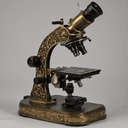
A magnifying instrument used to observe cells and model organisms such as Tetrahymena, employed to grow and examine the living material under study.
School Curriculum
Vocabulary & Tags
Key Vocabulary
Tags
Daily Life
Morning
In the morning, Carol Greider arrives early at the laboratory after dropping her children off at school. She checks her emails, reads the latest scientific papers, and plans the day's experiments with her team.
Afternoon
The afternoon is devoted to bench work and mentoring: preparing DNA samples, reading gels, and discussing results with her doctoral students. She also attends seminars and research meetings.
Evening
In the evening, she goes home to look after her children, then writes papers, revises grant applications, or prepares her lectures. The line between family life and research often remains blurred.
Food
Like many researchers with a demanding schedule, she eats simple, quick meals: coffee in the morning, lunch on campus, a family dinner in the evening. Her diet follows the contemporary American way of life.
Clothing
She wears practical everyday clothes, covered in the laboratory by a white coat, gloves, and sometimes safety goggles, required by biological handling.
Housing
She lives in an American suburban house close to her workplace, in Cold Spring Harbor and later in Baltimore, organized to balance single-parent family life with long days of research.
Historical Timeline
Period Vocabulary
Liens externes & ressources
Références
Œuvres
Découverte de l'activité de la télomérase
1984
Article fondateur dans la revue Cell
1985
Identification de l'ARN matrice de la télomérase (revue Nature)
1989
Travaux sur télomères, cancer et vieillissement
1990-2010
Prix Albert-Lasker de recherche médicale fondamentale
2006
Prix Nobel de physiologie ou médecine
2009