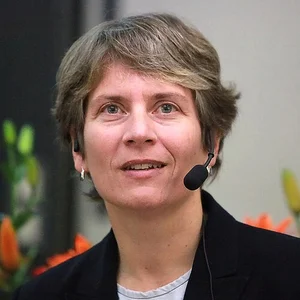

Anne L'Huillier is a French-Swedish physicist born in 1958, a pioneer of attosecond physics. She received the 2023 Nobel Prize in Physics for her work on generating ultra-short pulses of light that make it possible to observe the motion of electrons.
Anne L'Huillier(1958 — ?)
Anne L'Huillier
Suède, France
7 min read
Frequently asked questions
Key Facts
- Born on August 16, 1958, in Paris
- Discovered high-order harmonic generation in noble gases in 1987, the foundation of attosecond physics
- Professor at Lund University (Sweden) from 1997 onward
- Received the Nobel Prize in Physics in 2023, shared with Pierre Agostini and Ferenc Krausz
- Only the fifth woman to receive the Nobel Prize in Physics
Works & Achievements
Observation at the CEA in Saclay of the phenomenon that transforms an infrared laser into a series of high harmonics. It is the cornerstone of attosecond physics.
A foundational scientific publication (with her colleagues at the CEA) that describes the phenomenon in detail and remains one of the major references in the field.
Her group in Lund produces one of the shortest light pulses ever created, opening up the possibility of observing the motion of electrons.
A major institutional recognition: she joins the academy that awards the Nobel Prizes in Physics and Chemistry.
One of the most prestigious scientific awards, honouring her entire body of work on ultra-short pulses.
Awarded jointly with Pierre Agostini and Ferenc Krausz for the experimental methods generating attosecond pulses and enabling the study of electron dynamics.
Anecdotes
On October 3, 2023, when the Nobel committee called to tell her she had won the prize, Anne L'Huillier was teaching a class to her students at Lund University. She saw her phone buzzing but could only answer during a break, then went back to finish her lesson. She later admitted that the last half hour of class had been hard to get through.
In 1987, at the CEA in Saclay, Anne L'Huillier sent an infrared laser beam through a noble gas such as argon. To her great surprise, the gas re-emitted a long series of colors (harmonics) far more numerous than expected: it was this unexpected phenomenon that would pave the way for the entire field of attosecond physics.
Anne L'Huillier is only the fifth woman to receive the Nobel Prize in Physics, after Marie Curie (1903), Maria Goeppert Mayer (1963), Donna Strickland (2018), and Andrea Ghez (2020). She has emphasized how rare this prize remains for women scientists.
An attosecond is a billionth of a billionth of a second (10⁻¹⁸ s). To convey the dizzying scale: there are roughly as many attoseconds in a single second as there have been seconds since the birth of the Universe. It is this minuscule duration that finally makes it possible to “photograph” the movement of electrons.
As a young woman, Anne L'Huillier wavered between mathematics and physics: she actually pursued a dual education in both disciplines before choosing experimental physics. This taste for mathematical abstraction helped her greatly in understanding the light phenomena she studied.
Primary Sources
The article describes how infrared laser radiation passing through rare gases (argon, krypton, xenon) produces a long series of high-order harmonics of comparable intensity—an observation that gave rise to attosecond physics.
The prize rewards experimental methods that make it possible to generate light pulses on the attosecond scale, in order to study the dynamics of electrons within matter.
She explains that she was teaching when the call came and could only answer during the break, and recalls that few women have received this prize, which makes it very special.
She traces the history of high-order harmonic generation and shows how these ultra-short pulses give access to the characteristic timescale of electron motion.
Key Places
Birthplace of Anne L'Huillier, born in 1958. She also completed her higher education in mathematics and physics there.
Parisian university where she prepared and defended her doctoral thesis in physics in the mid-1980s.
Major research center south of Paris where, in 1987, Anne L'Huillier observed high-order harmonic generation in noble gases for the first time.
University where she settled in 1995 and became a professor. It was there that her group set the record for the 170-attosecond pulse and where she learned of her Nobel Prize.
Swedish capital where the Nobel Prize award ceremony is held in December 2023, at the Konserthuset (concert hall).
Liens externes & ressources
Références
Œuvres
Découverte de la génération d'harmoniques d'ordre élevé
1987
Article « Multiple-harmonic conversion of 1064 nm radiation in rare gases »
1988
Impulsion lumineuse record de 170 attosecondes
2003
Élection à l'Académie royale des sciences de Suède
2004
Prix Wolf de physique
2022
Prix Nobel de physique
2023