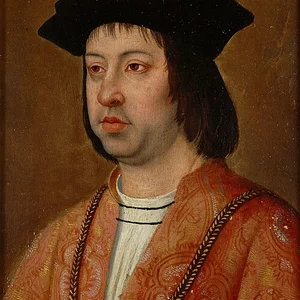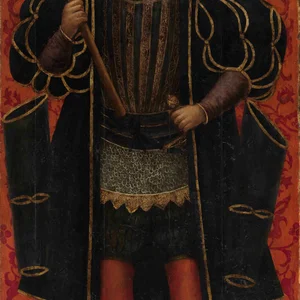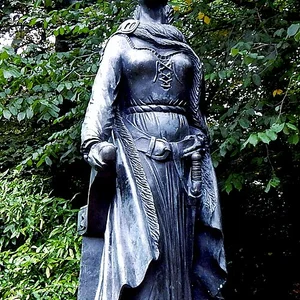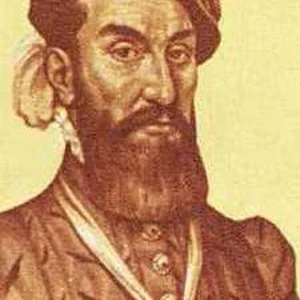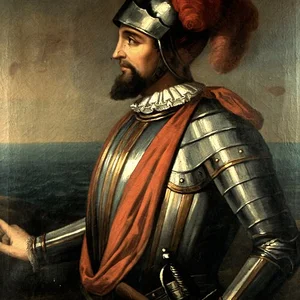

Spanish conquistador born around 1475, Balboa was the first European to see the Pacific Ocean from the New World in 1513. He crossed the Isthmus of Panama at the head of an expedition and claimed the “South Sea” in the name of the Spanish Crown.
Vasco Núñez de Balboa(1475 — 1519)
Vasco Núñez de Balboa
Espagne
10 min read
Frequently asked questions
Key Facts
- Around 1500: Balboa takes part in his first expeditions to the Caribbean and Colombia
- 1510: He settles in Darién (present-day Panama), the first stable European colony on the American continent
- September 25, 1513: First European to see the Pacific Ocean from the top of a hill on the Isthmus of Panama
- September 27, 1513: He wades into the Pacific in full armor and claims the “South Sea” in the name of the King of Spain
- 1519: Accused of treason by Governor Pedrarias Dávila, he is beheaded at Acla (Panama)
Works & Achievements
First permanent European settlement on the American continent. Balboa took charge of the colony, secured its survival through alliances with indigenous peoples, and made it the base of operations for all explorations of the isthmus.
A 25-day expedition through the jungle with 190 Spaniards and hundreds of indigenous allies, culminating in the first European sighting of the Pacific Ocean from the New World — a discovery that fundamentally transformed humanity's understanding of the globe.
A formal ceremony in which Balboa waded into the waves in full armor and claimed sovereignty over the Pacific and all lands it touched on behalf of the Spanish Crown — the founding legal act of Spain's presence in that ocean.
Official reports sent to the Spanish court describing the geography, peoples, and resources of Darién and the South Sea — the first detailed European documents on the Isthmus of Panama and the existence of the Pacific.
An undertaking to carry timber pieces through the jungle and assemble brigantines on the Pacific coast. Balboa was preparing a maritime exploration southward toward what would become Peru, but his arrest brought the project to an end before its completion.
Anecdotes
In 1510, Balboa is deep in debt in Hispaniola. To flee his creditors, he hides stealthily in a barrel — or in supply sacks according to some sources — aboard the ship of Martín Fernández de Enciso's expedition bound for Darién. Discovered at sea, he risks being abandoned on a deserted island, but his knowledge of the Caribbean territory convinces the captain to keep him on board.
On September 25, 1513, Balboa climbs alone to a ridge on the Isthmus of Panama and catches the first glimpse of a vast ocean unknown to Europeans. Two days later, on September 27, he wades into the waves in full armor, sword in hand and the Castilian banner raised, and takes possession of the “South Sea” in the name of the King of Spain — a theatrical gesture that seals one of the greatest geographical discoveries of the Renaissance.
To reach the Pacific coast, Balboa leads an expedition of approximately 190 Spaniards and several hundred indigenous allies through the jungle and swamps of the Isthmus of Panama over 25 days. One of Chief Comogre's sons had described to him this mysterious sea and a fabulous land to the south, rich in gold — what would become the Inca Peru. Without this crucial information, the discovery might have been delayed by years.
In 1515, Balboa undertakes a titanic project: building ships on the Pacific coast to explore the southern seas. The timber pieces are cut on the Atlantic coast and carried by hand through the jungle to the Pacific — a remarkable logistical feat. But his rival Pedrarias Dávila, jealous of his glory and suspicious of his ambitions, has him arrested before he can set sail.
Balboa is beheaded in January 1519 at Acla on the orders of Pedrarias Dávila, following a summary trial for treason. He was 44 years old and had never been able to sail the sea he had discovered. The irony of fate would have it that, just a few months later, Magellan began his circumnavigation of the globe by crossing that same Pacific — the ocean Balboa had been the first European to see from the New World.
Primary Sources
I most humbly beseech Your Highness to order that ships and men be sent to me, so that I may discover the great secrets and the very rich lands that God has created in this place; for I know from certain sources that there exist in the South Sea many islands very rich in gold, pearls, and precious stones.
I took possession of the said South Sea and of all the lands, coasts, islands, and ports therein and that might be found therein, both to the north and to the south, in the name of the most powerful and catholic king and queen of Castile, León, and Aragon, and of their heirs and successors.
Balboa, having climbed a high peak, caught sight with his own eyes of the South Sea. He immediately prostrated himself, raising his hands toward heaven and giving thanks to God and all the saints for having granted him this signal honor, reserved until then to no other Christian.
Vasco Núñez de Balboa was a man of fine bearing, skilled in arms and very courageous. He governed the colony of Darién with firmness, maintaining peace with the Indians through shrewd alliances and gifts; without these alliances, no crossing of the isthmus would have been possible.
Key Places
Balboa's birthplace, in the province of Badajoz. This impoverished region of Extremadura produced a remarkable number of conquistadors — Cortés, Pizarro, Balboa — drawn by the promise of wealth and glory in the New World.
The first island colonized by the Spanish, where Balboa arrived around 1500. He spent ten difficult years there as a debt-ridden settler, seeking to escape toward new adventures on the mainland.
The first permanent European settlement on the American mainland, founded in 1510. Balboa became its de facto governor and used it as his base for exploration, ensuring its survival through diplomatic alliances with indigenous peoples.
The summit from which Balboa caught his first glimpse of the Pacific Ocean on September 25, 1513. This moment stands as one of the greatest geographical discoveries of the European Renaissance.
The place where Balboa waded into the waters of the Pacific on September 27, 1513, in full armor, to claim the South Sea in the name of the Spanish Crown. This ceremonial act opened the era of Spanish presence in the Pacific.
The coastal village where Balboa was arrested, tried, and beheaded in January 1519 on the orders of Pedrarias Dávila. This place marks the tragic end of the explorer who never had the chance to sail the ocean he had discovered.
Typical Objects

The Spanish conquistador's primary weapon, forged from Toledo steel renowned for its flexibility and resilience. Balboa brandished it during his symbolic claim over the South Sea, wading into the surf in full armor, sword raised in the name of the King of Spain.

A combination of metal plates and chainmail that protected against arrows and indigenous weapons, yet crushingly heavy under the tropical heat of the isthmus. Balboa wore it during his celebrated entry into the Pacific — an iconic image of the Spanish conquest.

An indispensable navigation instrument for 16th-century explorers, used to find bearings at sea and in unknown territory. It was essential during the 25-day crossing through the dense jungle of the Isthmus of Panama.

A navigation chart depicting known coastlines and ports, the basic tool of every Renaissance explorer. The portolans of Balboa's era did not yet show the Pacific Ocean: his discovery would profoundly transform the cartography of the world.

The standard bearing the arms of the Spanish sovereigns that Balboa raised when claiming the South Sea on September 27, 1513. This legal and symbolic act — planting the banner in the waves — officially consecrated Spanish sovereignty over the Pacific Ocean.

A broad-bladed knife used to hack through the dense vegetation of the tropical jungle. Without this indispensable tool, crossing the Isthmus of Panama through impenetrable forests and swamps would have been impossible.

A ranged weapon widely favored by conquistadors, preferred over arquebuses in tropical conditions because it was far less sensitive to humidity. Balboa equipped a portion of his men with crossbows to repel indigenous attacks during expeditions.
School Curriculum
Vocabulary & Tags
Key Vocabulary
Daily Life
Morning
Balboa rose early in the governor's residence at Darién. The day began with Mass — an unavoidable Catholic practice for any sixteenth-century Spaniard — followed by an inspection of the fortifications and troops. He then received allied indigenous chiefs, negotiated food supplies, and organized reconnaissance expeditions into the surrounding jungle.
Afternoon
The afternoon was devoted to managing the colony: assigning tasks among the soldiers, settling disputes, and organizing barter with local populations (gold in exchange for knives, cloth, or glass beads). During forest expeditions, the afternoon meant an exhausting march through the dense, humid jungle of the isthmus, under torrid heat, with the constant risk of ambushes and disease.
Evening
In the evening, Balboa gathered his captains to plan the next day's operations and draft reports for the Spanish Crown. The men stood guard and tried to protect themselves from tropical diseases — malaria and dysentery cut down the Spaniards more reliably than combat did. As governor, he sometimes hosted indigenous dignitaries at his table to consolidate the political alliances essential to the colony's survival.
Food
The conquistadors' diet blended European provisions (hardtack, salt pork, sour wine) with local resources supplied by indigenous allies: cassava, maize, yams, fish, and tropical game. During jungle expeditions, food quickly ran scarce and the men suffered from hunger. Balboa systematically sought supplies from the villages they passed through, whether by trade or by requisition.
Clothing
At Darién, Balboa wore the dress of a Spanish *hidalgo*: a linen shirt, hose, doublet, and cloak. On expedition, he donned partial armor (morion, breastplate) or a lightened mail coat, better suited to the tropical heat. His entry into the Pacific in full armor was above all a ceremonial gesture intended to underscore the historical and legal significance of the event.
Housing
At Santa María la Antigua del Darién, Balboa lived in the governor's house — a timber-and-wattle construction with a palm-leaf roof, rudimentary by European standards but comfortable for the colony. The settlement had a church, storehouses, and houses clustered around a central square. On expedition, he slept under makeshift shelters or in the open air, shielded from tropical rain by giant palm fronds.
Historical Timeline
Period Vocabulary
Liens externes & ressources
Références
Œuvres
Fondation de Santa María la Antigua del Darién
1510
Traversée de l'isthme de Panamá
Septembre 1513
Prise de possession de la mer du Sud
27 septembre 1513
Lettres au roi Ferdinand II d'Aragon
1513
Projet de construction de navires sur le Pacifique
1515-1517