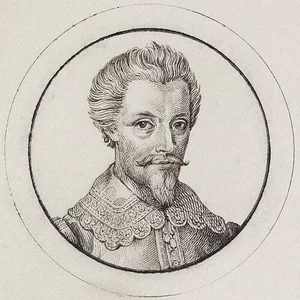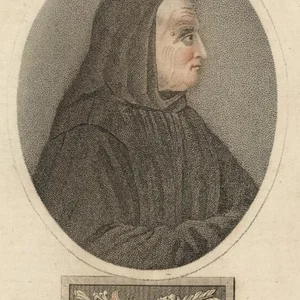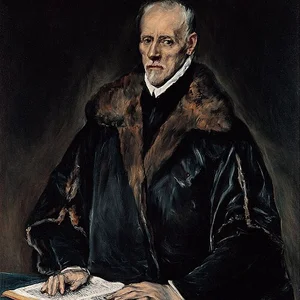

Francisco de Pisa (1534-1616) was a Spanish historian and writer, canon of Toledo Cathedral. He is the author of the “Descripción de la Imperial Ciudad de Toledo” (1605), a major reference work on the history of Toledo and the Spanish Church.
Francisco de Pisa(1534 — 1616)
Francisco de Pisa
Espagne
7 min read
Frequently asked questions
Key Facts
- Born in Toledo in 1534, he spent his entire life in service to the city's cathedral.
- As a canon of Toledo Cathedral, he pursued a career entirely dedicated to religious history.
- In 1605, he published the “Descripción de la Imperial Ciudad de Toledo,” a comprehensive historical and geographical account of Toledo.
- His work stands as an essential primary source for the history of the Catholic Church in Spain.
- He died in Toledo in 1616, the same year as Cervantes and Shakespeare.
Works & Achievements
A masterpiece by Francisco de Pisa, this monumental historical work describes the history, topography, monuments, Church, and illustrious figures of Toledo from Antiquity to the sixteenth century. It remains to this day an irreplaceable primary source for historians of early modern Spain.
Notes and materials gathered by de Pisa for a second part of his "Descripción" that he was unable to complete during his lifetime. This manuscript attests to the scope of his project and has been partially edited by later scholars.
As part of his research into the early history of Toledo, de Pisa turned his attention to the Visigoth rulers who made the city their capital between the fifth and eighth centuries. These preparatory studies fed directly into his major "Descripción."
Anecdotes
Francisco de Pisa was born in Toledo in 1534, in a city then at the height of its glory: Charles V had made it his unofficial capital, and its streets teemed with humanists, theologians, and artists from across Europe. It was in this exceptional intellectual atmosphere that young Francisco developed his vocation as a historian.
Appointed canon of the Primatial Cathedral of Toledo, Francisco de Pisa gained access to the most precious archives in Spain. He spent decades deciphering medieval parchments, Latin chronicles, and ecclesiastical records to reconstruct the complete history of the imperial city — a titanic undertaking that culminated in his great work in 1605.
The “Descripción de la Imperial Ciudad de Toledo” appeared in 1605, the same year as the first part of Cervantes's Don Quixote. While Cervantes was revolutionizing world literature, de Pisa was gifting posterity an irreplaceable historical compendium on Toledo: its monuments, institutions, bishops, and illustrious figures.
Francisco de Pisa lived to the remarkable age of 82, spanning the reigns of Charles V, Philip II, and Philip III. He thus witnessed the great moments of the Spanish Empire — the victory at Lepanto, the annexation of Portugal — but also its first setbacks, such as the defeat of the Spanish Armada in 1588.
His work was so exhaustive that it remains to this day an essential reference for historians specializing in the history of Toledo and the Spanish Church. Generations of scholars have consulted his “Descripción” to understand the social, religious, and urban organization of sixteenth-century Toledo.
Primary Sources
La imperial ciudad de Toledo, cabeça de los reinos de España, assiento de los reyes della, silla metropolitana y primada de las Españas, ha tenido desde sus principios singulares excelencias y prerrogativas sobre las demás ciudades...
Unfinished manuscript gathering the notes and materials compiled by de Pisa for the continuation of his work, bearing witness to the scope of his historiographical project on the Church and Toledan society.
Record of Canon Francisco de Pisa among the members of the chapter of the holy primatial Church, attesting to his liturgical duties and his role in the administration of chapter properties.
Key Places
Birthplace and home of Francisco de Pisa, Toledo was the primatial city of Spain and former imperial capital. It is the central subject of his historical work, described in its entirety — monuments, history, institutions, and illustrious figures.
As a canon, Francisco de Pisa performed his liturgical duties there and conducted his research in the chapter archives. This masterpiece of Hispanic Gothic architecture lies at the heart of his entire historical work.
Housed within the cathedral precinct, these archives contained centuries of ecclesiastical and civil documents. De Pisa drew the bulk of his documentation from them to write his "Descripción".
The official capital of Spain under Philip II, Madrid was the center of royal power and Castilian intellectual life. De Pisa, a recognized scholar, was connected to the learned circles revolving around the court.
The great Castilian university where Spanish clerics and humanists of the 16th century received their training. De Pisa, like many educated ecclesiastics of his time, was connected to the intellectual networks that emerged from Salamanca.
Typical Objects

The essential tool of the canon-historian, the quill allowed him to copy archival documents and draft his voluminous *Descripción*. Thousands of pages were written by hand over decades of patient research.

Francisco de Pisa had access to the archives of the Primatial Cathedral of Toledo, rich in documents dating back to the early Middle Ages. It was by combing through these registers that he was able to trace the ecclesiastical and civil history of the city.

An indispensable liturgical book for any canon, the breviary structured de Pisa's days around the canonical hours (Matins, Lauds, Vespers, Compline). Prayer and scholarship were thus interwoven throughout his daily life.

To document Toledo's landmarks with precision in his *Descripción*, de Pisa relied on maps and cartographic representations of the city. Toledo, perched on its rock encircled by the Tagus River, presented a complex and fascinating geography.

As a canon, de Pisa wore a distinctive liturgical habit during services — a white rochet and a violet *cappa magna* — which reflected his rank in the ecclesiastical hierarchy of one of the most powerful cathedrals in Europe.

To reconstruct the ancient history of Toledo from the Visigothic period onward, de Pisa consulted Latin chronicles from preceding centuries. Mastery of Latin was indispensable for any scholar of his era seeking access to primary sources.
School Curriculum
Vocabulary & Tags
Key Vocabulary
Daily Life
Morning
Francisco de Pisa rose at dawn to attend the first canonical hours sung at the cathedral — Matins and Lauds. A canon's life was entirely structured around the liturgical offices, which organized the day from the earliest light. Toledo Cathedral, with its many altars and large chapter, was a place of intense prayer and daily solemnity.
Afternoon
The afternoon was devoted to research in the archives of the cathedral chapter. De Pisa deciphered medieval parchments, copied epigraphic inscriptions, and took notes on the history of Toledo's parishes and institutions. This patient scholarly work, carried out by candlelight or near a narrow window, occupied him for several decades.
Evening
In the evening, after Vespers and Compline, de Pisa wrote and organized his notes in his personal library. He might receive other canons or scholars — among whom El Greco was living at the time — with whom he discussed history and theology. Toledo's intellectual life was particularly vibrant at the close of the sixteenth century.
Food
Like any canon of a great Spanish cathedral, de Pisa enjoyed a sufficient prebend to live comfortably. His diet followed the liturgical calendar, with days of fasting and abstinence (Fridays, Lent). He ate bread, legumes, and fish during Lent, and meat — mutton, pork — on ordinary days.
Clothing
Francisco de Pisa wore the canon's everyday ecclesiastical dress: a black cassock, a white surplice during services, and a cappa magna on days of solemn ceremony. When working in the archives, he wore his ordinary clerical attire — plain and black, suited to Toledo's sometimes harsh continental climate.
Housing
As a canon of the primatial cathedral, de Pisa lived in one of the canonical houses located immediately adjacent to the cathedral, in Toledo's ecclesiastical quarter. These dwellings, though modest in outward appearance, were equipped with a library — a vital space for a scholar of his stature.
Historical Timeline
Period Vocabulary
Liens externes & ressources
Références
Œuvres
Descripción de la Imperial Ciudad de Toledo
1605
Apuntamientos para la segunda parte de la Descripción de Toledo
posthume, XVIIe siècle
Traités et mémoires sur les rois wisigoths de Tolède
vers 1595-1605