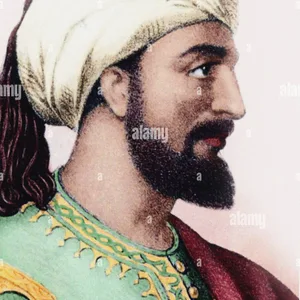

Chronicler, scholar, and secretary from Timbuktu, author of the Tarikh es-Sudan, one of the principal written sources on the Songhai Empire and the scholarly cities of the Western Sudan. His work recounts the succession of the Askias and the intellectual life of Timbuktu.
Abd al-Rahman al-Saadi
Abd al-Rahman ibn Abdallah al-Sa'di
6 min read
Frequently asked questions
Key Facts
- Born in 1594 in Timbuktu, at the heart of a great center of Islamic learning in West Africa
- Wrote the Tarikh es-Sudan, a chronicle completed around 1655 retracing the history of the empires of Ghana, Mali, and Songhai
- Details in it the genealogy and reigns of the Askias, including Askia Mohammed (r. 1493-1528), founder of the dynasty
- Served as secretary and negotiator for the authorities of the pashalik of Timbuktu after the Moroccan conquest of 1591
- Died around 1655-1656, leaving a major source for the history of the Western Sudan
Works & Achievements
A major chronicle of the history of the Mali and Songhai empires and of the scholarly life of Timbuktu; one of the principal written sources on the Western Sudan.
The central part of the Tarikh, retracing the succession of Songhai rulers, from Sonni Ali to the fall of the empire.
A detailed account of the Battle of Tondibi and the collapse of Songhai, invaluable for understanding this historical rupture.
Portraits of the city's ulama and jurists, which make the Tarikh a treasure trove of information on local intellectual life.
A history of the pashalik of Timbuktu after 1591, written by a witness close to power, on the government of the Arma.
Anecdotes
Born in Timbuktu in 1594, just three years after the Moroccan conquest of 1591, al-Saadi grew up in a scholarly city in full decline. He would devote his life to writing the history of that lost greatness, as if to rescue it from oblivion.
His major work, the Tarikh es-Sudan, recounts several centuries of the history of the empires of Mali and Songhai. Without this book, much of the memory of medieval West Africa would have vanished: it remains today one of the most precious written sources on these kingdoms.
Al-Saadi was not merely a scholar shut away with his books: he worked as a secretary and negotiator for the administration of the pashalik. He was even sent on a diplomatic mission to calm revolts along the Niger River.
He describes Timbuktu as a city where books were traded as much as salt and gold, and where some scholars owned libraries of hundreds of manuscripts. For him, knowledge was the true wealth of the city.
The manuscript of the Tarikh es-Sudan remained little known in Europe until the 19th century. It was the German explorer Heinrich Barth who rediscovered it, before it was translated and published, revealing to historians a treasure of African history.
Primary Sources
Timbuktu was a healthy, elegant, pure, pleasant, illustrious, and blessed city, where salt, gold, books, and slaves were traded, and where travelers and men of science flocked.
In those days, Timbuktu had no equal among the cities of the land of the Blacks, by the soundness of its institutions, its political liberties, the purity of its morals, and the great number of its scholars.
When the army of the Sultan of Morocco entered the country, order turned to disorder, security to fear, and prosperity to misery; calamities descended upon the people.
Key Places
Scholarly city of the Western Sudan where al-Saadi was born, famous for its mosques, its schools and its trade in manuscripts.
Merchant city on the inner delta of the Niger, where al-Saadi served as imam of the great mosque from 1627 onward.
Great center of learning in Timbuktu, regarded as one of the oldest universities in Africa, where many scholars distinguished themselves.
Former capital of the Songhai Empire on the Niger River, at the heart of the events recounted in the Tarikh es-Sudan.
Great lifeline of the Western Sudan, traveled by al-Saadi during his diplomatic missions for the pashalik.
Typical Objects

Handwritten chronicle recounting the history of the Mali and Songhai empires and the scholarly life of Timbuktu. It is al-Saadi's major work.

A cut reed used to write Arabic in ink. The everyday tool of the chronicler and the secretary.

A small vessel holding the black ink made from soot and gum arabic. Essential to the work of writing.

A handwritten copy of the holy book of Islam, sometimes adorned with geometric patterns. An object of study and devotion in Quranic schools.

A wooden board on which pupils copied verses of the Quran in chalk in order to memorize them.

A chest of wood or leather protecting precious manuscripts from dust and termites in private libraries.

A loose cotton tunic worn by the scholars and notables of the Western Sudan, a sign of religious dignity.
School Curriculum
Vocabulary & Tags
Key Vocabulary
Daily Life
Morning
Al-Saadi begins the day with the dawn prayer at the mosque. The morning is devoted to teaching, reading manuscripts, and copying religious or historical texts.
Afternoon
In the afternoon, as secretary of the pashalik, he writes official letters, deeds, and reports. He also takes part in scholarly discussions with other learned men of the city.
Evening
In the evening, after prayer, he continues writing his chronicle by the light of an oil lamp, consulting his notes and drawing on his memories of the history of Songhai.
Food
The diet is based on the grains of the Sahel: millet, sorghum, and rice from the Niger delta, served with dried fish, meat, and milk. Tea and dates round out the meals of the notables.
Clothing
He wears the loose cotton boubou and the turban of Muslim scholars, white or light-colored garments marking his dignity as an imam and a scholar.
Housing
He lives in a banco (mud-brick) house with a flat roof, typical of Timbuktu and Djenné, cool inside, with a courtyard and a room set aside for the precious manuscripts.
Historical Timeline
Period Vocabulary
Liens externes & ressources
Références
Œuvres
Tarikh es-Soudan
vers 1655
Récit de la dynastie des Askia
XVIIe siècle
Chronique de la conquête marocaine de 1591
XVIIe siècle
Notices biographiques des savants de Tombouctou
XVIIe siècle
Relation des pachas et de l'administration arma
XVIIe siècle