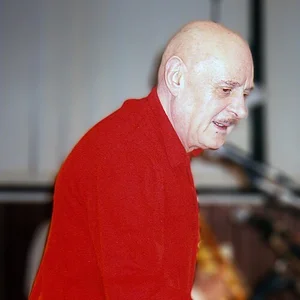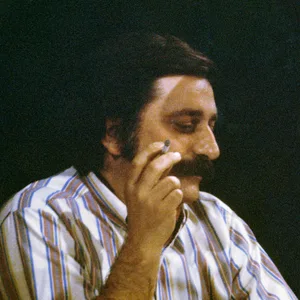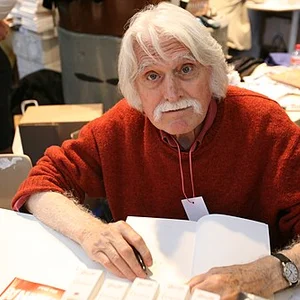

François Cavanna (1923-2014) was a French writer, journalist, and humorous cartoonist. Co-founder of the satirical newspapers Hara-Kiri and later Charlie Hebdo, he is also the author of famous autobiographical works such as “Les Ritals,” about his childhood as the son of an Italian immigrant.
François Cavanna(1923 — 2014)
François Cavanna
France
5 min read
Frequently asked questions
Famous Quotes
« Dumb and nasty.»
Key Facts
- Born on February 22, 1923, in Nogent-sur-Marne, the son of an Italian immigrant bricklayer
- Co-founded the satirical newspaper Hara-Kiri in 1960 with Professor Choron
- Took part in 1970 in the creation of Charlie Hebdo after the banning of Hara-Kiri Hebdo
- Published “Les Ritals” in 1978, an autobiographical account of his childhood
- Died on January 29, 2014, in Créteil, suffering from Parkinson's disease
Works & Achievements
Co-founding of the satirical monthly “dumb and nasty” that revolutionized humor in the French press.
After Hara-Kiri was banned, Cavanna co-founded the weekly that became a symbol of free speech and satire.
Autobiographical account of his childhood as the son of an Italian immigrant in Nogent; a huge popular success.
A novel about his experience of forced labor in Germany, awarded the Prix Interallié.
An account retracing the Hara-Kiri adventure and the birth of the modern satirical press.
An autobiographical sequel continuing the cycle begun with “Les Ritals.”
A lucid and funny testimony about his Parkinson's disease, written in his final years.
Anecdotes
The child of an Italian bricklayer from the Brianza region and a Frenchwoman, Cavanna grew up on rue Sainte-Anne in Nogent-sur-Marne, in a neighborhood of Italian immigrants that he made famous in *Les Ritals*. In it, he recounts how he juggled his father's Italian dialect and the French he spoke at school.
During the Second World War, Cavanna was conscripted in 1943 by the Compulsory Work Service (STO) and sent to Germany. He worked on construction sites near Berlin under the bombing raids, an experience he would later recount in *Les Russkoffs*, winner of the 1979 Prix Interallié.
In 1960, Cavanna, together with Georget Bernier (Professor Choron), founded the magazine Hara-Kiri, which proclaimed itself “dumb and nasty.” Banned on several occasions, the monthly became the laboratory for an insolent, provocative brand of humor never before seen in the French press.
In November 1970, the weekly Hara-Kiri was banned after a headline mocking the death of General de Gaulle: “Tragic ball at Colombey: one dead.” To get around the censorship, the team immediately created a new paper, which they named Charlie Hebdo.
Afflicted with Parkinson's disease in his final years, Cavanna drew from it a lucid, self-pity-free book, *Lune de miel* (2011), in which he describes with humor his fight against “la Parkinsonne,” whom he personifies as a burdensome companion.
Primary Sources
The rital is the Italian immigrant, the one people eye with suspicion, the one who works hard and talks with a sing-song accent. My father was a rital, a bricklayer, and proud of it in his own way.
They had crammed us into cattle cars, bound for Germany, for the STO forced labour service. We didn't know what awaited us, only that we were leaving everything behind.
Tragic ball at Colombey: one dead.
Parkinson's — I call it Miss Parkinson. She moved in with me without knocking, and she has no intention of leaving.
Key Places
Suburban town near Paris where Cavanna was born and grew up in an Italian immigrant neighborhood. Central setting of his novel *Les Ritals*.
Area where Cavanna was sent to forced labor during the STO between 1943 and 1945, under Allied bombing. An experience recounted in *Les Russkoffs*.
City where Cavanna built his career as a journalist and founded the editorial teams of Hara-Kiri and then Charlie Hebdo. The heart of the French satirical press.
Town in the Val-de-Marne where François Cavanna died in January 2014, at the age of 90.
Typical Objects

The everyday working tool of Cavanna, a prolific writer who penned dozens of novels and columns. The clatter of the keys accompanied his long days of writing.

Instruments of humorous drawing, the discipline through which Cavanna got his start before becoming director of satirical newspapers. He wielded the pen stroke as sharply as satire.

A “dumb and nasty” satirical monthly co-founded in 1960, printed on cheap paper and sold at newsstands. It shook up the taboos of the French press.

The tool of Cavanna's father, an Italian immigrant mason, a symbol of the working-class world of his childhood in Nogent. Cavanna evoked it tenderly in “Les Ritals.”

The administrative document that sent young French people to forced labor in Germany during the war. Cavanna made it the subject of his novel “Les Russkoffs.”

The tool of the editor-in-chief who reread, cut, and reworked his team's texts. Cavanna was a demanding craftsman of language.
School Curriculum
Vocabulary & Tags
Key Vocabulary
Daily Life
Morning
Cavanna would rise early to write, the discipline of a tireless worker of the pen. His mornings were often devoted to writing his columns or novels, in peace and quiet.
Afternoon
The afternoon found him at the newspaper's offices, proofreading texts, discussing front pages and coordinating cartoonists and writers. He loved the buzz of press deadlines.
Evening
In the evening, the discussions carried on among colleagues over a drink, blending provocation, jokes and political debate. The “dumb and nasty” spirit was forged in these exchanges.
Food
The son of Italian immigrants, Cavanna grew up with the hearty, working-class cooking of his mother and his bricklayer father: pasta, polenta, simple dishes. He kept a lasting fondness for that modest, warm table.
Clothing
A man of the working world and of the press, Cavanna dressed plainly, far from bourgeois conventions. His figure and his moustache became familiar to his readers.
Housing
From the modest apartment in Nogent to the Parisian lodgings of his life as a newspaperman, Cavanna stayed true to his working-class roots. His domestic world remained free of ostentation.
Historical Timeline
Period Vocabulary
Liens externes & ressources
Références
Œuvres
Fondation d'Hara-Kiri
1960
Création de Charlie Hebdo
1970
Les Ritals
1978
Les Russkoffs
1979
Bête et méchant
1981
Les Yeux plus grands que le ventre
1983
Lune de miel
2011