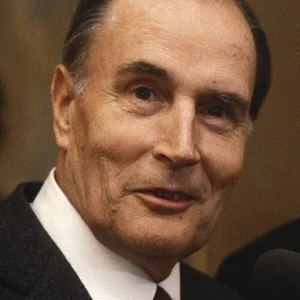

A French statesman, François Mitterrand served as President of the Republic from 1981 to 1995, becoming the first socialist elected under the Fifth Republic. His two consecutive seven-year terms remain the longest in the history of the French presidency.
François Mitterrand(1916 — 1996)
François Mitterrand
France
6 min read
Frequently asked questions
Famous Quotes
« I believe in the powers of the spirit, and I will not leave you.»
« The Permanent Coup d'État.»
Key Facts
- Elected President of the Republic on 10 May 1981, the first change of power in the Fifth Republic in favor of the left
- Re-elected for a second seven-year term in 1988, totaling 14 years in power (1981-1995)
- Abolition of the death penalty in 1981, championed by his Minister of Justice Robert Badinter
- Experienced two periods of cohabitation (1986-1988 with Chirac, 1993-1995 with Balladur)
- Signatory and promoter of the Maastricht Treaty (1992), ratified by referendum in France
Works & Achievements
An emblematic reform from the start of his term, championed by **Robert Badinter**, which abolished the guillotine in France.
A scathing political essay against the personal power of General **de Gaulle** and the institutions of the Fifth Republic.
A government platform signed with the communists, which sealed the union of the left and paved the way for the victory of **1981**.
A transfer of powers from the State to the regions and departments, one of the major structural reforms of his seven-year term.
A vast architectural programme including the **Louvre Pyramid**, the **Opéra Bastille**, the **Grande Arche de la Défense** and the **Bibliothèque nationale de France**.
The founding European agreement of the **European Union**, defended by **Mitterrand** and narrowly ratified by referendum.
A striking image of reconciliation at **Verdun**, where the two leaders held hands in tribute to the dead of both world wars.
A collection of chronicles and reflections expressing **Mitterrand**'s taste for literature and political meditation.
Anecdotes
On 21 May 1981, the day of his inauguration, François Mitterrand went alone to the Panthéon, a rose in hand, and laid flowers on the tombs of Jean Jaurès, Jean Moulin and Victor Schœlcher. This carefully staged gesture, filmed by television networks around the world, sought to place his election within a long republican and socialist history.
During the Occupation, Mitterrand led a surprising double life: he worked for the Vichy regime, which awarded him the Francisque medal, while also joining the Resistance under the codename “Morland.” This youthful ambiguity caused a scandal when it was fully revealed near the end of his life, in 1994.
For years Mitterrand kept a secret family: his daughter Mazarine, born in 1974, was not revealed to the public until 1994 by a magazine. The Republic had protected the secret, and Mazarine appeared publicly at her father's funeral in 1996.
Nicknamed “the Sphinx” or “God” by those close to him because of his fondness for secrecy and political maneuvering, Mitterrand loved to stroll through Paris and rummage through the stalls of the bouquinistes along the Seine. A voracious reader, he could recite entire pages of Lamartine or Chateaubriand from memory.
Stricken with prostate cancer as early as 1981, shortly after his election, Mitterrand hid his illness from the French people for eleven years by issuing false health bulletins. The truth only came out in 1992, raising a lasting question about transparency regarding the health of presidents.
Primary Sources
On this day when I take up the highest office, I think of those millions upon millions of women and men, the lifeblood of our people, who, in fervor and hope, have awaited change.
What is the Fifth Republic if not a dictatorship? […] I will not accept that France be confused with one man, however illustrious he may be.
To vote yes to Maastricht is to want a strong Europe, it is to want peace through the union of peoples who tore one another apart for so long.
I believe in the forces of the spirit, and I will not leave you.
I would not have undertaken a constitutional reform had I not believed it would serve the interest of the country.
Key Places
Small town in the Charente where François Mitterrand was born in 1916 and where he now rests in the family vault.
Residence and workplace of the President of the Republic in Paris, where Mitterrand held power from 1981 to 1995.
Monument where Mitterrand went alone, a rose in hand, on the day of his inauguration in 1981, to honor the great figures of the Republic.
Town of which Mitterrand was mayor and his electoral stronghold in the Nièvre, the cradle of his roots in provincial politics.
A sheep farm in the Landes that was his private residence and refuge, where he liked to recharge far from Paris.
A rocky outcrop that Mitterrand climbed every year at Pentecost, in a pilgrimage that became a political and media ritual.
Typical Objects

The emblem of the Socialist Party since the Épinay congress, the rose held in a fist became the symbol of the 1981 victory. Mitterrand laid one at the Panthéon on the day of his inauguration.

The insignia of the presidential office worn during official ceremonies. It embodies the authority of the State.

A familiar silhouette to the French, Mitterrand would stroll through Paris wearing a hat, often with a long scarf around his neck. This look became a true trademark.

A document signed in 1992 establishing the European Union and paving the way for the single currency. Mitterrand made it one of the great battles of the end of his term.

A great man of letters, Mitterrand collected books and frequented the booksellers along the banks of the Seine. Literature nourished his speeches and his thinking.

Mitterrand launched vast architectural projects in Paris, including the glass pyramid of the Louvre designed by Ieoh Ming Pei. These “Grands Travaux” were meant to leave his mark on the capital.
School Curriculum
Vocabulary & Tags
Key Vocabulary
Daily Life
Morning
An early riser, Mitterrand often began his day by reading the press and working through files. When his schedule allowed, he enjoyed walking through Paris in the early morning and browsing the bookshops.
Afternoon
His afternoons at the Élysée were filled with one council, audience, and reception of heads of state after another. A patient tactician, he took his time before deciding, listening intently and rarely letting anyone guess his thoughts.
Evening
In the evening, he gladly gathered with those close to him over dinners where the conversation turned to history, literature, and the arts. He would prolong these moments with reading, faithful to his passion for books.
Food
A lover of fine food and the cuisine of the Southwest, he relished the products of his native Charente and the Landes. A famous anecdote holds that he savored ortolans during his last meal, shortly before his death.
Clothing
He was recognizable by his felt hat, his long dark overcoat, and his scarf. This understated, bourgeois look helped forge the image of a distinguished and secretive president.
Housing
In Paris, he lived and worked at the Élysée Palace, but he kept a deep attachment to his sheepfold at Latche, in the Landes, a retreat where he renewed himself amid nature.
Historical Timeline
Period Vocabulary
Liens externes & ressources
Références
Œuvres
Abolition de la peine de mort
1981
Le Coup d'État permanent
1964
Programme commun de la gauche
1972
Lois de décentralisation (lois Defferre)
1982
Traité de Maastricht
1992
Couple franco-allemand avec Helmut Kohl
1984