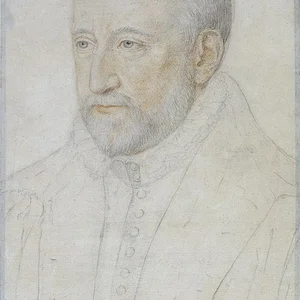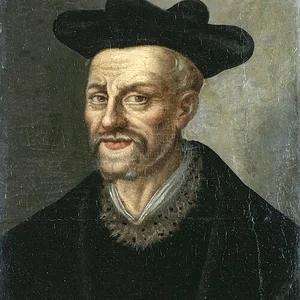

A French humanist writer of the 16th century, Rabelais is the author of Gargantua and Pantagruel, novels about giants blending satire, fantasy, and social criticism. A monk, physician, and scholar, he embodies the spirit of the Renaissance through his innovative approach to literature and his celebration of ancient culture.
François Rabelais(1500 — 1553)
François Rabelais
royaume de France
6 min read
Frequently asked questions
Famous Quotes
« Do what thou wilt»
« Science without conscience is but the ruin of the soul»
Key Facts
- Around 1500: born in Chinon, Touraine
- 1532: publication of Pantagruel, his first literary success
- 1534: publication of Gargantua, deepening his humanist project
- 1546: publication of The Third Book, consolidating his major work
- 1553: death in Paris
Works & Achievements
Rabelais's first published novel, recounting the adventures of the giant Pantagruel, son of Gargantua. The work blends humanist erudition, grotesque comedy, and satire of scholasticism.
The story of the life of the giant Gargantua, father of Pantagruel, his humanist education, and the Picrocholine Wars. The novel contains the famous description of the Abbey of Thélème.
The third installment of Pantagruel's adventures, centered on the question of Panurge's marriage. It is the first book signed under Rabelais's real name, and was censored by the Sorbonne.
An account of the sea voyage of Pantagruel and his companions toward the oracle of the Divine Bottle. The work multiplies satirical allegories against religious intolerance.
An annotated Latin edition of the Greek medical text by Hippocrates, published in Lyon. This scholarly work attests to Rabelais's dual activity as physician and philologist.
Published after Rabelais's death, this book concludes the voyage toward the oracle of the Divine Bottle. Its authenticity is debated: it may contain drafts by Rabelais completed by others.
Anecdotes
Rabelais was first a Franciscan monk at the convent of Fontenay-le-Comte, but his superiors confiscated his Greek books, which they deemed suspicious. He then obtained papal authorization to transfer to the Benedictines, an order more tolerant of humanist studies.
In 1532, Rabelais published Pantagruel under the pseudonym Alcofribas Nasier, a perfect anagram of François Rabelais. This stratagem allowed him to protect himself from the censorship of the Sorbonne, which swiftly condemned the work as obscene.
Rabelais was a renowned physician at the Hôtel-Dieu in Lyon. There he performed public anatomical dissections, which were still very rare and controversial at the time. His medical knowledge permeates his entire literary work.
Rabelais accompanied Bishop Jean du Bellay to Rome twice as his personal physician. He took the opportunity to study botany and brought back to France seeds of romaine lettuce, melons, and artichokes, contributing to the enrichment of French cuisine.
The Abbey of Thélème, described in Gargantua, is a utopian place whose sole rule is "Do what you will." This literary invention stood in point-by-point opposition to the real monasteries Rabelais had known, with their strict rules and austerity.
Primary Sources
Their whole life was governed not by laws, statutes, or rules, but according to their will and free choice. They rose from bed when it seemed good to them, drank, ate, worked, and slept whenever the desire came upon them.
Most illustrious and most chivalrous champions, gentlemen and others, who willingly devote yourselves to all noble and honorable pursuits, you have lately seen, read, and known the Great and Inestimable Chronicles of the enormous giant Gargantua.
Now all branches of learning are restored, and languages revived: Greek, without which it is shameful for a person to call themselves learned, Hebrew, Chaldean, Latin. I see that brigands, executioners, adventurers, and stable boys of today are more learned than the doctors and preachers of my time.
Most illustrious drinkers, and you most precious syphilitics, did you ever see Diogenes the Cynic philosopher? If you have seen him, you had not lost your sight.
Key Places
Rabelais's birthplace in Touraine, now a museum. This family wine estate inspired the landscapes of the Picrochole Wars in Gargantua.
Franciscan friary where Rabelais was a monk and discovered humanism alongside the jurist Pierre Amy. It was here that his Greek books were confiscated.
Major hospital where Rabelais practiced as a physician from 1532. It was in Lyon, a city of printers, that he published his first novels.
Rabelais obtained his medical degree here in 1530, after only a few weeks of study. He also gave lectures on the texts of Hippocrates.
Rabelais traveled there twice with Cardinal Jean du Bellay. He studied ancient architecture, botany, and obtained papal absolution for his apostasy.
Typical Objects

Rabelais was passionate about the Greek language and ancient texts. His Greek books were confiscated by the Franciscans, an event that left a lasting mark on his life.

As a physician at the Hôtel-Dieu in Lyon, Rabelais performed anatomical dissections. These tools reflect his scientific approach to the human body.

Essential writing instruments for a prolific author who composed his manuscripts by hand. Rabelais wrote in an exuberant style blending erudition with popular wit.

Rabelais brought back from his travels in Italy seeds of plants unknown in France. He took an interest in medicinal botany and the therapeutic properties of plants.

Rabelais edited and commented on the Aphorisms of Hippocrates in 1532. These ancient medical texts were at the foundation of his practice as a humanist physician.

Rabelais wore religious dress for a large part of his life, first among the Franciscans and then among the Benedictines. He later obtained the secularization of his vows.
School Curriculum
Vocabulary & Tags
Key Vocabulary
Tags
Époque
Mouvement
Daily Life
Morning
Rabelais rose early, as monastic rule and later medical habit demanded. He devoted his mornings to reading Greek and Latin texts, or to his medical consultations at the Hôtel-Dieu. Morning prayer long remained an integral part of his routine.
Afternoon
The afternoon could be given over to anatomical dissections, lectures at the faculty of medicine, or the drafting of his manuscripts. In Lyon, he frequented printers' workshops such as that of Sébastien Gryphe to oversee the publication of his works.
Evening
In the evening, Rabelais enjoyed company and learned conversation over a good meal. He moved in Lyonnais humanist circles and took part in scholarly discussions blending medicine, philosophy, and ancient literature.
Food
Rabelais celebrated fine food and the wines of Touraine in his works. The Renaissance table featured bread, roasted meats, soups, cheeses, and fruits. Wine was the daily drink, and Rabelais, the son of a winegrower, was particularly attached to it.
Clothing
Rabelais long wore the habit of the Franciscan and later Benedictine monks. After his secularisation, he dressed in the long robe of the physician and scholar, in dark cloth, with a doctoral cap. When travelling, he adopted the civilian dress of men of learning.
Housing
Rabelais lived in various monasteries during his monastic period, then in modest lodgings tied to his medical duties in Lyon. He also stayed in the residences of his patrons, the du Bellay family, and at the end of his life obtained the parish of Meudon, near Paris.
Historical Timeline
Period Vocabulary
Visual Style
Un style inspiré des gravures sur bois du XVIe siècle, mêlant l'architecture de la Renaissance française, les paysages viticoles de Touraine et l'univers foisonnant et excessif des géants rabelaisiens.
Sound Ambience
L'ambiance sonore mêle l'animation d'une ville de la Renaissance — tavernes bruyantes, presses d'imprimerie, cloches d'églises — au calme studieux des monastères et des bibliothèques humanistes.
Liens externes & ressources
Références
Œuvres
Le Tiers Livre
1546
Le Quart Livre
1552
Édition des Aphorismes d'Hippocrate
1532
Le Cinquième Livre (attribution discutée)
1564