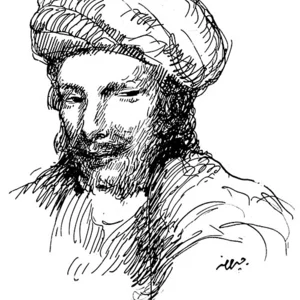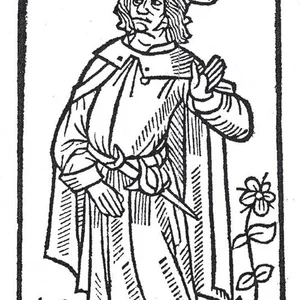

François Villon was a 15th-century French poet, regarded as the greatest poet of the late Middle Ages. A figure of the “accursed poet” (poète maudit), his life marked by poverty, brawls, and trouble with the law shines through in lyric poetry of rare intensity, dominated by the themes of death and the passing of time.
François Villon(1431 — 1463)
François Villon
Royaume de France
6 min read
Frequently asked questions
Famous Quotes
« But where are the snows of yesteryear?»
« Brother men who live on after us, harden not your hearts against us»
« In my own land I am in a far-off country»
« I know all things, save myself alone»
Key Facts
- Born in 1431 in Paris, he was raised by the chaplain Guillaume de Villon, whose name he took
- Master of Arts of the University of Paris in 1452
- In 1455, he killed a priest, Philippe Sermoise, in a brawl and had to flee Paris
- Composed Le Lais (around 1456) and then his masterpiece, Le Testament (1461-1462)
- Sentenced to hang in 1463, his sentence was commuted to ten years of banishment; all trace of him was then lost
Works & Achievements
Villon's first major poem: 320 octosyllables in which, in a mocking tone, he makes false bequests to his acquaintances before leaving Paris.
His masterpiece: nearly 2,000 lines blending huitains and ballades, a meditation on death, fleeting time and poverty, scattered with satirical bequests.
A ballade set within Le Testament, famous for its refrain “But where are the snows of yesteryear?”, an emblem of the passing of time.
A deeply moving poem written while awaiting the gallows, in which the executed beg the pity of the living: “Brother men who live on after us”.
A series of ballades written in jobelin, the coded slang of the Coquillards underworld, which long remained partly indecipherable.
A piece composed for Charles d'Orléans's poetry contest, built entirely on the device of antitheses (opposites).
Anecdotes
François Villon is probably not his real name: orphaned and raised in poverty, he was taken in by Guillaume de Villon, chaplain of the church of Saint-Benoît-le-Bétourné in Paris, whose name he adopted out of gratitude. In his verses he calls him “more than a father.”
In 1452, in his early twenties, Villon earned his master of arts degree from the University of Paris. He could have become a respectable cleric, but he chose the streets, the taverns, and bad company.
On the evening of the Feast of Corpus Christi in 1455, Villon killed the priest Philippe Sermoise with a dagger during a brawl near the cloister of Saint-Benoît. Wounded in the face himself, he fled Paris, then obtained a royal letter of remission pardoning him.
In late 1456, Villon took part in the burglary of the College of Navarre: the gang stole 500 gold écus from a chest. The poet then left Paris, and it was shortly afterward that he composed his first great poem, *Le Lais*.
In 1462-1463, after another fight, Villon was sentenced to be “hanged and strangled.” He appealed and wrote his famous *Ballade des pendus*. The Parlement commuted his sentence to ten years of banishment from Paris in January 1463 — after which all trace of him is lost for good.
Primary Sources
Tell me now in what hidden way is / Lady Flora the lovely Roman?... But where are the snows of yesteryear?
Brother men who live on after us, / Harden not your hearts against us, / For, if you take pity on us poor souls, / God will the sooner show you His mercy.
In that season I spoke of before, / Around Christmastime, the dead season, / When wolves must live upon the wind / And everyone keeps to his house...
Royal act of January 1456 pardoning “maistre François des Loges, autrement dit de Villon” for the death of the priest that occurred during a quarrel.
Key Places
The neighborhood around the church where Guillaume de Villon, the poet's guardian, lived, near the Sorbonne. It is the heart of Villon's Paris, where he grew up and where the 1455 brawl took place.
Great medieval university where Villon earned his bachelor's degree and then his master of arts degree in 1452.
Wealthy college on the Sainte-Geneviève hill, burgled in late 1456 by Villon's gang, who stole 500 gold écus there.
Small town whose castle housed the prison of Bishop Thibault d'Aussigny, where Villon was locked in a dungeon in 1461 before being freed when Louis XI passed through.
Court of the poet-prince Charles d'Orléans, where Villon took part in a poetry contest on the theme “I die of thirst beside the fountain.”
Fortress housing the provostry and royal prison of Paris, where Villon was detained and interrogated on several occasions.
Typical Objects

Cut with a penknife, the goose quill dipped in oak-gall ink was used to set down ballades and huitains on paper or parchment.

A short weapon carried by students and people of the streets; it was with a dagger blow that Villon mortally wounded the priest Sermoise in 1455.

A long dark robe and hood marked out the clerics of the University of Paris; Villon wore the garb after earning his Master of Arts degree.

A wooden structure where the condemned were hanged, like the gibbet of Montfaucon at the gates of Paris; it haunts the Ballade des pendus, written while awaiting execution.

Small bone cubes thrown in taverns to gamble; gambling, losing money, and debts come up often in Villon's world.

An earthenware or pewter vessel filled from the pitcher in the Parisian taverns frequented by the poet and his companions in debauchery.

Small coins of base alloy, the humblest of medieval currency; Villon, forever penniless, makes them the symbol of his poverty.
School Curriculum
Vocabulary & Tags
Key Vocabulary
Daily Life
Morning
Waking in a cold room or a prison cell, the schoolboy turned vagrant first looked for something to eat. On good days, he joined the benches of the University or copied out texts; on bad days, he wandered the muddy streets of **Paris**.
Afternoon
Afternoons were spent studying grammar and logic in Latin, or else loitering with his disreputable companions. **Villon** also frequented princely courts, such as that of **Blois**, where he presented his ballades.
Evening
Evening drew him into the taverns of the Latin Quarter, around a jug of wine, games of dice, and songs. These nights sometimes ended in bloody brawls, like the one that cost the life of the priest **Sermoise**.
Food
The poor man's daily fare consisted of dark bread, soup, broad beans, and a few herrings; meat remained scarce. Wine, cheap and watered down, accompanied nearly every meal.
Clothing
As a cleric, **Villon** wore the long dark robe and hood of the University's scholars. But his clothes, often worn and patched, betrayed his poverty far more than his title of Master of Arts.
Housing
He first lodged with his guardian near **Saint-Benoît**, then wherever his flights took him: rented rooms, barns, prison cells at **Meung** or the **Châtelet**. Post-war **Paris** offered narrow alleys, timber-framed houses, and many squalid dwellings.
Historical Timeline
Period Vocabulary
Liens externes & ressources
Références
Œuvres
Le Lais (Le Petit Testament)
1456
Le Testament (Le Grand Testament)
1461
Ballade des dames du temps jadis
1461
Ballade des pendus (L'Épitaphe Villon)
vers 1463
Ballades en jargon
vers 1455-1463
Ballade du concours de Blois (« Je meurs de soif auprès de la fontaine »)
vers 1457