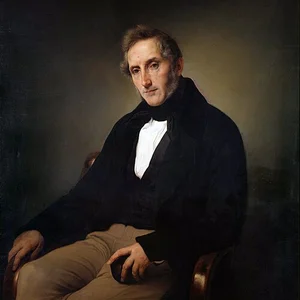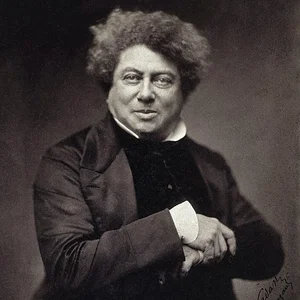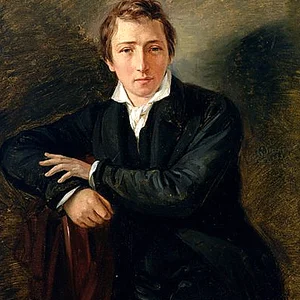

Heinrich Heine (1797–1856) is one of the greatest German Romantic poets. Exiled to Paris in 1831, he became a bridge between French and German cultures. His work blends lyricism, irony, and political engagement.
Heinrich Heine(1797 — 1856)
Heinrich Heine
France, royaume de Prusse
8 min read
Frequently asked questions
Famous Quotes
« Where they burn books, they will ultimately burn people also.»
« God will pardon me, it is His trade.»
Key Facts
- Born in Düsseldorf in 1797 into a Jewish family
- Publication of the Book of Songs (Buch der Lieder) in 1827, a landmark poetry collection of German Romanticism
- Voluntary exile to Paris in 1831, fleeing Prussian censorship
- His works were banned in Germany as early as 1835 by the Frankfurt Diet
- He died in Paris in 1856 after eight years bedridden, a period he called his 'Matratzengruft' (mattress tomb)
Works & Achievements
Heine's first major poetry collection, blending romantic lyricism with sharp irony. It was set to music by Schubert, Schumann, and Brahms, becoming one of the founding texts of the German Lied.
A series of prose travel narratives mixing humor, social criticism, and political observation. This new hybrid genre, somewhere between essay and poetry, was an immediate success in Germany.
A major essay introducing French readers to German philosophy, from Luther to Hegel. In it, Heine anticipates with remarkable clarity the dangers of German nationalism.
A long satirical poem recounting an imaginary yet real journey through Germany. A masterpiece of political poetry, it denounces reactionary politics and nationalism with wit and depth.
A satirical poem following the adventures of a dancing bear. Heine uses it to mock the excesses of romantic nationalism and the mediocrity of the political poetry of his day.
A collection of poems written from his sickbed, blending tragedy with irony. It represents the peak of his poetic maturity and his meditation on death, illness, and exile.
A collection of his journalistic dispatches from Paris, published in the German press. An exceptional record of the political, social, and cultural life of the July Monarchy.
Anecdotes
Heinrich Heine suffered throughout his life from a mysterious illness that gradually paralyzed him from 1848 onward. He called his Parisian bed his 'mattress grave' (Matratzengruft), yet from it he continued to write poems of remarkable lucidity and biting irony until his death in 1856.
In 1817, Heine published his first poems under a pseudonym. Later, he wrote in his poem 'Almansor' (1821) the prophetic line: 'Where they burn books, they will ultimately burn people also.' More than a century later, the Nazis burned his works during the book burnings of 1933, tragically illustrating this premonition.
Heine had a turbulent relationship with his cousin Karl Marx in Paris. The two men spent time together and debated politics and philosophy, but their temperaments clashed: Heine, an ironic poet, was wary of Marx's revolutionary dogmatism. He once told him: 'I pity you, gentlemen the future revolutionaries — you will never know the joy of doubt.'
Having converted to Protestantism in 1825 in order to gain the right to practice law in Prussia, Heine himself described the baptism as a 'ticket of admission into European civilization.' He never concealed the purely opportunistic nature of this conversion and continued to regard himself as deeply Jewish in his cultural and intellectual identity.
In Paris, Heine became a close friend of Frédéric Chopin, Franz Liszt, and Hector Berlioz. He attended the premieres of numerous operas and wrote brilliant musical chronicles for German newspapers, helping to bring Parisian artistic life to audiences across the Rhine.
Primary Sources
Du bist wie eine Blume, so hold und schön und rein; ich schau dich an, und Wehmut schleicht mir ins Herz hinein. (You are just like a flower, so lovely, pure, and fair; I look at you and sadness steals into my heart.)
Christianity — and this is its greatest merit — has somewhat softened the brutal Germanic spirit, but it could not destroy it; one day, when the restraining cross collapses, the old savage violence will break loose again.
I want to sing a new song, a better song. Right here on earth we mean to build the kingdom of heaven. We want to be happy here below, and no longer hunger.
My soul is musical; often a sound, a melody awakens in me poetic images that might seem to come from another world, yet belong deeply to the most intimate reality.
I am now — God help me — a good Christian. Last evening I dined with Gans; he too has been baptized. I am sorry he did it. I would much rather he had stolen the Christians' silver than begged for their baptism.
Key Places
Heine's birthplace, then under Napoleonic rule. He grew up in the Jewish quarter and was deeply shaped by the passage of French troops and the influence of the ideals of the Revolution.
Heine studied law there with little enthusiasm, but discovered Hegel's philosophy in Berlin. These university years forged his critical thinking and literary friendships.
Heine settled in Paris in 1831 and lived there until his death. He resided at several addresses in the central districts, at the heart of the French capital's artistic and intellectual life.
Heine's burial place since 1856. His tomb, adorned with a bust, remains to this day a site of literary pilgrimage for admirers of the German poet.
The city where his uncle and patron Salomon Heine, a very wealthy banker, resided. Heine visited regularly, in a relationship marked by both gratitude and humiliation over his financial dependence.
Heine visited Goethe in Weimar in 1824, hoping for the great master's blessing. The meeting was brief and disappointing, yet it nonetheless enriched his thinking on German literature.
Typical Objects

Heine wrote his verses with a quill in notebooks he filled even from his sickbed. The pen remained his primary weapon against censorship and injustice.

Heine contributed regularly to this newspaper from Paris, sending dispatches on French politics and cultural life that shaped German opinion of France.

A great lover of opera and Parisian entertainment, Heine frequented the Paris Opera and musical salons, opera glasses in hand, to observe and comment on the artistic scene.

Heine held a deep admiration for Goethe, whose complete works he owned. Their relationship was complex: Goethe briefly received him in Weimar in 1824 and left a lasting impression on him.

In exile in Paris, Heine frequented the cafés along the grands boulevards, where intellectuals and German political exiles gathered over a cup of coffee.

After his works were banned in 1835, Heine could no longer return to Germany. His Prussian passport, effectively unusable, symbolized the permanent exile to which censorship had condemned him.
School Curriculum
Vocabulary & Tags
Key Vocabulary
Daily Life
Morning
Heine rose late, chronically suffering from migraines and nervous disorders. He carefully read French and German newspapers, annotated political news, then dictated or wrote his texts for the day — often from his bed, particularly after 1848.
Afternoon
Afternoons were devoted to visits and cultural outings — galleries, literary salons, rehearsals at the Opéra. He met friends and correspondents, among them Alexandre Dumas, George Sand, Théophile Gautier, and Karl Marx, in the cafés along the Boulevard des Italiens.
Evening
In the evenings, Heine frequently attended concerts or opera performances. He would then write his columns for the German press by candlelight, often late into the night, blending musical observations with sharp political commentary.
Food
Heine enjoyed French cuisine, particularly oysters, soups, and Bordeaux wines. He often ate a light lunch, preferring to dine with friends at Parisian restaurants. His illness forced him to adopt an increasingly frugal diet in the final years of his life.
Clothing
Heine dressed elegantly in the Parisian bourgeois fashion: a black or dark blue frock coat, a carefully tied lavallière cravat, and a top hat. He took great care with his appearance, a sign of his desire to belong fully to cultivated Parisian society.
Housing
Heine lived in several Parisian apartments with his wife Mathilde, notably on the Rue du Faubourg-Saint-Honoré and later on the Avenue Matignon. His homes were simply furnished but surrounded by books, newspapers, and musical scores. His sickroom gradually became the center of his intellectual life.
Historical Timeline
Period Vocabulary
Visual Style
Le style visuel de Heine oscille entre la mélancolie brumeuse du romantisme allemand — paysages rhénans et forêts sombres — et la lumière chaude et animée des intérieurs parisiens du XIXe siècle.
Sound Ambience
L'univers sonore de Heine mêle les bruits vivants du Paris romantique — cafés, opéras, pavés — au silence feutré de sa chambre de malade où il dicte ses derniers poèmes.