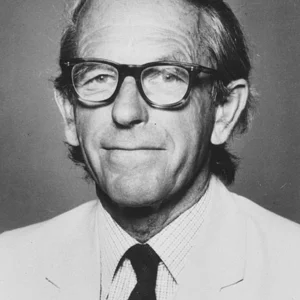

Frederick Sanger (1918-2013) was a British biochemist, one of the very few scientists to have received the Nobel Prize in Chemistry twice. He developed fundamental methods for determining the sequence of proteins and then of DNA.
Frederick Sanger(1918 — 2013)
Frederick Sanger
Royaume-Uni, Royaume-Uni de Grande-Bretagne et d'Irlande
6 min read
Frequently asked questions
Key Facts
- Born on 13 August 1918 in Rendcomb (England) and died on 19 November 2013
- 1958: Nobel Prize in Chemistry for determining the structure (amino acid sequence) of insulin
- 1977: development of the DNA sequencing method known as the “Sanger method” (dideoxy)
- 1980: second Nobel Prize in Chemistry, shared with Walter Gilbert and Paul Berg, for DNA sequencing methods
- One of only four laureates to have received two Nobel Prizes, and the only one to have received the Chemistry prize twice
Works & Achievements
The first determination of the amino acid sequence of a protein, proving that proteins have a precise and ordered structure. This work was crowned with the 1958 Nobel Prize.
The development of a chemical reagent for identifying the amino acid located at the end of a protein chain, a key tool throughout his analysis.
Sanger's first effective approach to reading the order of the bases in DNA, which paved the way for his definitive method.
A technique based on dideoxynucleotides that became the worldwide standard for DNA sequencing for more than thirty years. It earned him his second Nobel Prize.
The first genome of an organism to be sequenced in its entirety (5,386 bases), a spectacular demonstration of the power of his method.
The complete reading of the DNA in human mitochondria, showing that the method could be applied to the genome of our own species.
Anecdotes
Frederick Sanger is one of only four scientists in history to have won two Nobel Prizes, and the only one to have won the Chemistry prize twice: in 1958 for the sequencing of proteins, then in 1980 for that of DNA. Yet he described himself as “someone who tinkered in his laboratory,” not as a genius.
Raised in a Quaker family, Sanger refused to bear arms during the Second World War and was recognized as a conscientious objector. While others went off to the front, he completed his doctoral thesis at Cambridge on the metabolism of amino acids.
Determining the sequence of insulin took him about ten years of relentless work. He cut the protein into small fragments, stained them, separated them on blotting paper, then reassembled the order of the pieces like a gigantic puzzle. In doing so, he proved that a protein has a precise and reproducible sequence.
When he was offered a knighthood (“Sir Frederick Sanger”), he declined, explaining that he did not want to be called “Sir” and preferred to remain an ordinary man. He did, however, accept the Order of Merit in 1986, one of the highest British distinctions.
After retiring in 1983, Sanger gave up science entirely to devote himself to his garden and his boat. The famous genomics institute in Cambridge, the Wellcome Sanger Institute (which took part in sequencing the human genome), bears his name in tribute to his methods.
Primary Sources
It is the proteins, however, that are particularly characteristic of living matter and on which the specificity of living cells ultimately depends.
Of the various methods that we developed the most successful was the 'plus and minus' method... and more recently a method using specific chain-terminating inhibitors.
A new method for determining nucleotide sequences in DNA is described. It is similar to the 'plus and minus' method but makes use of the 2',3'-dideoxy analogues of the normal deoxynucleoside triphosphates.
Of the three main activities involved in scientific research, thinking, talking, and doing, I much prefer the last and am probably best at it.
Key Places
English village where Frederick Sanger was born in 1918 into a well-off family of Quaker tradition.
Where Sanger studied, earned his doctorate in 1943 and carried out his first research on proteins.
Medical Research Council laboratory that Sanger joined in 1962 and where he developed DNA sequencing.
Major genomics centre founded in 1992 near Cambridge and named in honour of Sanger; it took part in the sequencing of the human genome.
City where Sanger lived, retired and died in 2013 at the age of 95.
Typical Objects

Large sheets of blotting paper on which Sanger separated protein fragments according to their size and charge. This is the basic technique that allowed him to reconstruct the sequence of insulin.

1-fluoro-2,4-dinitrobenzene, a yellow chemical compound that attaches to the end of protein chains. Sanger used it to identify the first amino acid of a chain, which earned it the nickname “Sanger's reagent.”

A slab of gel through which DNA fragments migrate under the effect of an electric current, forming a ladder of bands. Reading these bands gave the sequence of the bases directly.

DNA building blocks made slightly radioactive (often with phosphorus-32) so they could be spotted on photographic film. They made it possible to visualize the fragments after separation.

Modified versions of DNA's building blocks that, once incorporated, abruptly halt the copying of the strand. This trick is the heart of the “Sanger method” of sequencing used for decades.

A notebook in which Sanger methodically recorded his experiments, his failures, and his sequences. A patient and stubborn worker, he preferred to “do” rather than theorize.
School Curriculum
Vocabulary & Tags
Key Vocabulary
Tags
Daily Life
Morning
Sanger arrived early at his Cambridge laboratory, far preferring the lab bench to the meeting room. He would put on his coat and pick up his experiments where he had left off, handling the pipettes and reagents himself.
Afternoon
His afternoons were spent cutting up proteins, running fragments across paper or gels, and patiently analysing the results. He could repeat the same experiment dozens of times until he obtained a reliable result.
Evening
In the evening, Sanger returned home to his wife Joan and his children, leading a quiet and unassuming family life. He avoided social occasions and honours as much as he could.
Food
A middle-class twentieth-century Briton, he ate simply and without pretension. Ordinary family meals were more than enough for him; he placed little value on luxury.
Clothing
At work, the white lab coat was his outfit of choice. Outside of it, he dressed soberly, in a suit or in practical gardening clothes, with no concern for elegance.
Housing
Sanger lived in a comfortable but modest house on the outskirts of Cambridge, with a large garden that he cherished. After his retirement, this garden and his boat became the centre of his life.
Historical Timeline
Period Vocabulary
Liens externes & ressources
Références
Œuvres
Séquençage complet de l'insuline
1951-1955
Réactif de Sanger (méthode au FDNB)
1945
Méthode 'plus et moins' de séquençage de l'ADN
1975
Méthode de séquençage par terminaison de chaîne (méthode Sanger)
1977
Séquençage du génome du bactériophage phi X 174
1977
Séquençage du génome mitochondrial humain
1981