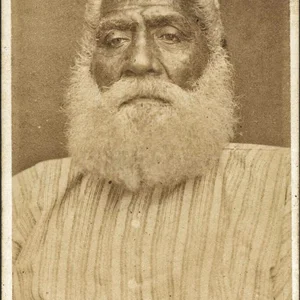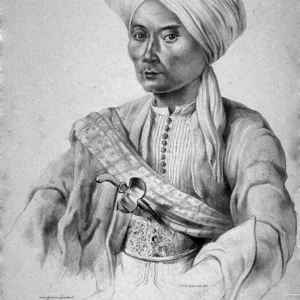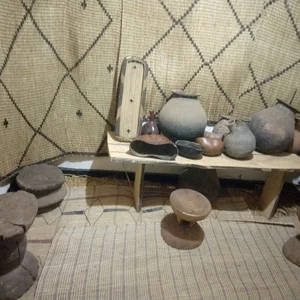

Queen of Ndorwa (a region straddling present-day Rwanda and Uganda), Nyabingi is, according to the oral traditions of the Kiga and Tutsi peoples, a ruler whose spirit became after her death a powerful symbol of resistance. Her name gave rise to the Nyabingi movement, which opposed European colonization into the 20th century.
Nyabingi
Nyabingi
8 min read
Frequently asked questions
Key Facts
- According to the oral traditions of the Kiga and Tutsi peoples, Nyabingi is said to have ruled the kingdom of Ndorwa during a pre-colonial period that is difficult to date precisely, most likely in the 19th century.
- After her death, her spirit was reportedly invoked by mediums (known as 'rugirwa') to guide and protect local communities — a practice documented in both oral tradition and British and German colonial sources.
- The Nyabingi movement, inspired by her spirit, was one of the most enduring anti-colonial resistance movements in the Great Lakes region, active from the late 19th century through the 1930s.
- British colonial authorities recognized the threat posed by the movement: the 'Nyabingi Ordinance' was enacted in 1912 in Uganda to criminalize practices associated with the cult.
- Her spiritual and political legacy influenced later movements, most notably Rastafari culture, which incorporated the term 'Nyahbinghi' into its ceremonies. (Source: oral traditions and colonial ethnographies.)
Works & Achievements
After the queen's death, her followers organized a system of mediums (bagirwa) capable of receiving her spirit and conveying her will. This structured cult became a major religious and political institution in the Great Lakes region.
Through successive mediums, the spirit of Nyabingi coordinated one of the most enduring anti-colonial resistance movements in East Africa, uniting populations divided by artificial colonial borders.
The stories, songs, and rituals connected to Nyabingi were passed down from generation to generation by griots and mediums, forming an exceptionally rich oral cultural heritage for the Kiga and Tutsi peoples.
The name Nyabingi was adopted by Jamaican Rastafarians to refer to their drumming and prayer ceremonies, making this African queen a globally recognized symbol of resistance and Black dignity.
Anecdotes
According to the oral traditions of the Kiga and Tutsi peoples, Nyabingi was a queen of Ndorwa whose wisdom and courage inspired profound devotion. Upon her death, her followers believed her spirit had not departed, but continued to act through chosen mediums called bagirwa. This belief gave rise to a powerful cult that endured across the centuries.
The Nyabingi movement resisted both German and British colonization in the Great Lakes region with remarkable force. The colonizers were so troubled by this movement that they produced official reports describing it as one of the most difficult forms of resistance to contain in East Africa. In 1919, the British even passed a special law — the Witchcraft Ordinance — to criminalize its practices.
Muhumusa, a powerful woman of the early twentieth century, claimed to be possessed by the spirit of Nyabingi and led armed resistance against the Germans and British around 1911. She rallied hundreds of fighters and refused all submission. Captured by the British in 1913, she was imprisoned — but her imprisonment did not end the movement.
The name Nyabingi literally means "she who possesses much" or "the great possessor" in Kinyarwanda. This name reflects the conception of power in these societies: a queen whose spirit remains active after death and continues to protect her people is regarded as the most powerful of beings, for she holds eternal vital force.
The Nyabingi tradition crossed the artificial colonial borders drawn by Europeans. As Uganda, Rwanda, and the Congo were divided among colonial powers, the cult of Nyabingi continued to unite the Kiga and Tutsi peoples on both sides of those borders — a testament to the resilience of African cultural identities in the face of colonial partition.
Primary Sources
The Kiga elders tell that Nyabingi was a woman of extraordinary power whose spirit, after her death, continued to speak through mediums. Whoever received her possession became an intermediary between the living and the invisible forces that govern fertility and war.
The Nyabingi movement constitutes one of the most persistent forms of resistance to European authority in the Great Lakes region. Its adherents believe in the spiritual power of a deceased queen whose spirit inhabits living mediums, granting them authority to lead the population against colonial rule.
The traditions of eastern Rwanda and Ndorwa describe Nyabingi as a sovereign whose legitimacy rested on her connection to spiritual forces. Her refusal to submit to foreign powers made her a model for the generations that followed, who resisted colonization.
O Nyabingi, you who hold strength and life, you whose spirit crosses mountains and rivers, hear our voices. Give us the strength to drive back those who would put us in chains. Your anger is our shield, your blessing our sword.
Key Places
A historical territory straddling present-day Rwanda and Uganda, where Nyabingi is said to have reigned as sovereign. This is the place of origin of the cult and movement that bears her name.
A mountainous area of Uganda that was the main stronghold of the Nyabingi movement in the early 20th century. It was here that Muhumusa and other leaders led their resistance against colonial powers.
A volcanic chain on the border of Rwanda, Uganda, and Congo, these mountains provided a natural refuge for fighters in the Nyabingi movement. Their rugged terrain made colonial suppression all the more difficult.
The main town of the Kigezi region, Kabale served as a British colonial administrative center from which operations against the Nyabingi movement were launched. Colonial archives relating to the movement are preserved there.
A lake dotted with numerous islands in the Kigezi region, it is associated in Kiga oral traditions with ancestral spirits. Ceremonies of the Nyabingi cult were sometimes held along its shores.
Typical Objects

The Nyabingi cult medium carried a carved staff as a sign of their spiritual authority and connection to the queen's spirit. This object allowed them to lead ceremonies and assert their legitimacy before the community.

Used during Nyabingi cult rituals to hold fermented drinks offered to the queen's spirit. The gourd served as a vessel of communication between the world of the living and that of the ancestors.

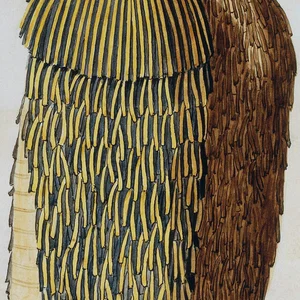
Nyabingi mediums wore leopard or cowhide during ceremonies, symbols of royal power and of the connection to the natural forces the queen was believed to command.

The drum was at the heart of Nyabingi movement ceremonies, used to summon the queen's spirit and unite the community. Its rhythm accompanied the ritual possession dances.

Nyabingi mediums used plants from the Great Lakes region to prepare remedies and magical protections. These preparations reinforced their authority as healers and protectors of the community.

Worn by mediums and followers during ceremonies, colorful bead ornaments marked one's belonging to the cult and their standing in the Nyabingi movement's hierarchy.
School Curriculum
Vocabulary & Tags
Key Vocabulary
Tags
Daily Life
Morning
Queen Nyabingi began her day with offerings to the ancestral spirits, guided by her spiritual advisors. Drums announced her awakening at the royal palace of Ndorwa, and griots recited her titles and the great deeds of her ancestors to start the day under favorable auspices.
Afternoon
The afternoon was devoted to royal audiences, where local chiefs and community representatives came to submit their disputes and seek counsel. Nyabingi administered justice and coordinated the management of the kingdom's resources, particularly the cattle herds that formed the region's primary source of wealth.
Evening
In the evenings, ritual ceremonies gathered the court around drums and songs. Mediums could enter trances to communicate with the ancestral spirits. Elders passed down to younger generations the stories of the kingdom's founding and the codes of conduct of Kiga and Tutsi society.
Food
The diet in Ndorwa was based on sorghum, millet, and beans grown on hillside terraces, supplemented by cow's milk and meat during major ceremonies. Fermented milk (ikivuguto) held a central place in Tutsi culture as a symbol of wealth and hospitality. Bananas served both as food and as the base for banana beer (urwagwa), consumed during rituals.
Clothing
Nyabingi wore royal garments made of carefully tanned animal hides — notably cow and leopard — symbols of royal power in the Great Lakes cultures. Ornaments of colored beads, coral, and shells adorned her neck, arms, and head. An elaborate hairstyle and raffia textiles completed her attire during official ceremonies.
Housing
The royal residence of Ndorwa consisted of several circular thatched-roof huts with conical rooftops, surrounded by a living fence of vegetation. The main hut, larger than the others, housed audiences and ritual ceremonies. The interior walls were decorated with geometric patterns in colored clay, a tradition still alive in the highlands of Rwanda and Uganda.
Historical Timeline
Period Vocabulary
Visual Style
Style visuel ancré dans les traditions artistiques des Grands Lacs africains, associant la puissance royale de Nyabingi à l'environnement mystique des hautes terres volcaniques et aux rituels de possession spirituelle.
Sound Ambience
Atmosphère sonore des hautes terres des Grands Lacs africains, mêlant les rythmes des cérémonies rituelles Nyabingi aux sons de la vie quotidienne des villages kiga et tutsi dans les montagnes brumeuses.
Liens externes & ressources
Références
Œuvres
Fondation du culte de l'esprit de Nyabingi
XVIIIe-XIXe siècle
Organisation de la résistance anticoloniale via le mouvement Nyabingi
1890-1928
Transmission de la tradition orale Nyabingi
XVIIIe-XXe siècle
Influence sur le mouvement rastafari mondial
XXe siècle