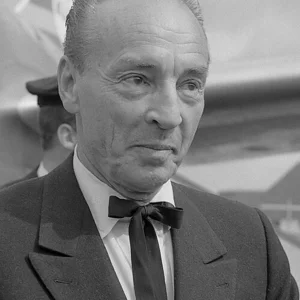

George Balanchine (1904-1983) was a Georgian-born dancer and choreographer, trained in Saint Petersburg before emigrating to the United States. A co-founder of the New York City Ballet, he is considered the father of American neoclassical ballet.
George Balanchine(1904 — 1983)
George Balanchine
États-Unis, France, Union soviétique, Empire russe
6 min read
Frequently asked questions
Famous Quotes
« But first, a society.»
Key Facts
- Born in 1904 in Saint Petersburg, trained at the Imperial Ballet School
- Joined Sergei Diaghilev's Ballets Russes in 1924 as a choreographer
- Emigrated to the United States in 1933 and founded the School of American Ballet in 1934
- Co-founded the New York City Ballet in 1948, which he directed until his death
- Major collaboration with Igor Stravinsky (Apollon musagète, Agon); died in 1983
Works & Achievements
Ballet set to music by Stravinsky, considered Balanchine's first neoclassical work and a turning point in the history of dance.
His first ballet created in the United States, set to music by Tchaikovsky; an iconic work conceived for his young American students.
A narrative ballet created for the Ballets Russes to music by Prokofiev, one of his rare ballets that tells a story.
An abstract ballet for twelve dancers set to music by Stravinsky, a pinnacle of modernity with a bare set and black-and-white leotards.
His version of Tchaikovsky's ballet became a Christmas tradition in the United States and remains one of the most frequently performed dance shows in the world.
Considered the first “abstract” full-length ballet in three acts, structured like a jewel case (Emeralds, Rubies, Diamonds).
Together with Lincoln Kirstein, he founded the company that would lastingly embody the American neoclassical style.
Anecdotes
Born Georgi Balanchivadze in Saint Petersburg, the young George had not chosen dance: his mother had taken him to audition at the Imperial Ballet School in 1913, and it was by chance that he was admitted while he had been dreaming instead of a military career. He stayed there for years, living through the Russian Revolution of 1917 and its famines.
In 1933, the young American patron Lincoln Kirstein, fascinated by his work, invited him to come and found a ballet school in the United States. Balanchine accepted on one famous condition: “But first, a school.” The School of American Ballet opened the very next year, in 1934.
Balanchine often repeated to his dancers the phrase “Don't think, dear, just do.” He wanted bodies that were precise, fast, and musical, and he liked to compare the choreographer to a cook or a gardener rather than to a great inspired artist.
Passionate about music, he had studied piano and composition at the Petrograd Conservatory. His collaboration with the composer Igor Stravinsky, himself a Russian exile, lasted for decades: their ballet *Apollon musagète* (1928) is considered the birth certificate of his neoclassical style.
Balanchine often stripped his ballets of sets, elaborate costumes, and stories. In works like *Agon* (1957), the dancers wear simple black-and-white leotards on a bare stage: what mattered, he said, was to “see the music and hear the dance.”
Primary Sources
But first, a school.
I am a cloud in trousers (a quote from Mayakovsky that he liked to repeat); the choreographer must serve the music, not the other way around.
There are no mothers-in-law in ballet. (A way of saying that he preferred pure dance to narrative plots.)
Don't think, dear, just do.
Key Places
Balanchine's birthplace and home of the Imperial Ballet School, where he was trained in the rigor of Russian classical ballet.
Here Balanchine joined Diaghilev's Ballets Russes in 1924 and created his first major choreographies, including *Apollon musagète*.
The school he founded in 1934 with Lincoln Kirstein, a training ground for dancers schooled in his neoclassical style.
The company he co-founded in 1948 and led until his death, based at Lincoln Center from 1964 onward.
The city where Balanchine spent most of his American career and where he died in 1983.
Typical Objects

Stiffened shoes that allow dancers to stand on the very tips of their toes. Balanchine demanded fast, sharp pointe work, a hallmark of his style.

A close-fitting garment worn by dancers during rehearsals and in his abstract ballets. It often replaced elaborate costumes to bring the body and movement to the forefront.

Trained as a musician, Balanchine worked directly from scores, notably those of Stravinsky. The musical structure entirely guided his choreography.

A horizontal rail fixed to the wall, used as support for daily warm-up exercises. A central teaching tool at the School of American Ballet.

The tulle skirt characteristic of classical ballet. Balanchine sometimes kept the short version (the “platter tutu”) but often simplified it to the extreme.

An instrument found in every studio, accompanying both exercises and new creations. Balanchine would play it himself to explain a musical passage.
School Curriculum
Vocabulary & Tags
Key Vocabulary
Tags
Daily Life
Morning
The day began at the studio with the daily class: exercises at the barre and then in the center, under Balanchine's exacting eye. He watched every dancer, correcting the line of an arm or the speed of a step.
Afternoon
The afternoon was devoted to rehearsals for the ballets being created or revived. Balanchine often demonstrated the movements himself and adjusted the choreography as he worked with the dancers.
Evening
On performance evenings, he stayed in the wings or watched from the auditorium. A cultured man, he also enjoyed cooking for those close to him and moved in New York's artistic circles.
Food
Balanchine was known as a fine cook, with a fondness for the Georgian and Russian cuisine of his childhood. He loved to entertain and prepare dishes for his dancers and friends.
Clothing
At the studio, he wore plain, practical clothes, often a shirt and sometimes a scarf knotted at the neck. Elegant but understated, he favored comfort for his work.
Housing
He lived in apartments in New York, close to his company's workplaces. His life was organized almost entirely around the studio and the theater.
Historical Timeline
Period Vocabulary
Liens externes & ressources
Références
Œuvres
Apollon musagète (Apollon)
1928
Serenade
1934
Le Fils prodigue (Prodigal Son)
1929
The Nutcracker (Casse-Noisette)
1954
Jewels (Joyaux)
1967
Fondation du New York City Ballet
1948