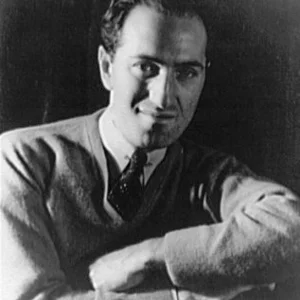

American composer and pianist (1898–1937), George Gershwin revolutionized music by blending jazz, blues, and classical music. The creator of Rhapsody in Blue and the opera Porgy and Bess, he is one of the defining symbols of twentieth-century American culture.
George Gershwin(1898 — 1937)
George Gershwin
États-Unis
8 min read
Frequently asked questions
Famous Quotes
« Life is a lot like jazz... it's best when you improvise.»
« True music must repeat the thought and inspirations of the people and the time.»
Key Facts
- 1898: Born in Brooklyn, New York, to Russian Jewish immigrant parents
- 1924: Premiere of Rhapsody in Blue, a concerto for piano and jazz orchestra
- 1931: Pulitzer Prize denied for Of Thee I Sing, the first musical to receive the award
- 1935: Premiere of Porgy and Bess, considered the first major American opera
- 1937: Died at 38 from a brain tumor in Hollywood
Works & Achievements
A work for piano and jazz orchestra premiered on February 12, 1924, it is considered Gershwin's masterpiece. An unprecedented fusion of jazz and classical music, it remains one of the most performed pieces in the American repertoire.
Commissioned by the New York Symphony Orchestra, this concerto demonstrates Gershwin's growing mastery of classical forms. More elaborate than the Rhapsody in Blue, it confirmed his ambition as a "serious" composer.
A symphonic poem evoking the impressions of an American tourist strolling through Paris. Gershwin incorporated taxi horns he had purchased in Paris to recreate the city's sonic atmosphere, making this work a colorful and inventive piece.
A satirical musical comedy about American politics, it became the first musical to win the Pulitzer Prize for Drama in 1932. It showcases Gershwin's talent for social and political satire.
An opera in three acts adapted from DuBose Heyward's novel, set in a Black community in Charleston, South Carolina. A masterpiece blending opera, blues, and spirituals, it contains celebrated arias such as "Summertime" and is today regarded as one of the great American operas.
Gershwin's first major commercial success, performed by Al Jolson. Selling over a million records and sheet music copies, this song launched the young composer's career on Broadway and in the recording industry.
Anecdotes
In 1928, George Gershwin visited Paris and wished to take lessons from the famous composer Maurice Ravel. Ravel reportedly replied: “Why would you want to be a second-rate Ravel when you’re already a first-rate Gershwin?” This anecdote illustrates the early recognition of Gershwin’s original genius by Europe’s greatest musicians.
Rhapsody in Blue was composed in barely five weeks, after conductor Paul Whiteman asked Gershwin for a piece for his jazz concert at Aeolian Hall in New York on February 12, 1924. The famous opening clarinet glissando was not written in the original score: clarinetist Ross Gorman improvised it during a rehearsal, and Gershwin immediately adopted it, won over by the effect.
Gershwin was also an accomplished painter with a passion for the visual arts. He painted portraits of his friends, including composer Arnold Schoenberg, with whom he regularly played tennis in Los Angeles. These two giants of twentieth-century music, despite being polar stylistic opposites, were genuine friends.
Gershwin died tragically at just 38, in July 1937, from a brain tumor. For several months before his diagnosis, he complained of headaches and the smell of burning rubber — symptoms that were ignored or misinterpreted by doctors. His premature death robbed American music of a creator at the height of his art.
Despite his immense commercial success, Gershwin always sought to improve himself academically. He attempted to obtain composition lessons from Nadia Boulanger in Paris, but she turned him down, fearing that rigorous classical training might harm his natural instincts and his extraordinary melodic genius.
Primary Sources
“Gershwin has something to say, and he says it with remarkable candor, vitality, and originality. Rhapsody in Blue is an ambitious, uneven but dazzling work, which raises the question of what jazz can become in the hands of a true composer.”
“Music is not just technique. It is the expression of something you feel deeply, something you have lived. Jazz is not a style you apply: it is a way of breathing.”
“Mr. Gershwin has composed a work of extraordinary ambition and scope. The music carries within it the colors, rhythms, and emotions of Black American people, while firmly placing itself within the great tradition of Western opera.”
“Ours is an age of nervous, fast, frenetic rhythm. Jazz is the musical expression of that time. It does not stand in opposition to classical music: it is its natural extension in a modern world.”
Key Places
Gershwin was born on September 26, 1898, in the working-class neighborhood of Brooklyn, into a family of Ashkenazi Jewish immigrants from Russia. This multicultural, working-class environment would shape his entire musical sensibility.
This stretch of 28th Street in Manhattan was the heart of the American music industry in the early twentieth century. It was here that Gershwin began as a song plugger at age 15, before establishing himself as a composer.
It was in this New York concert hall that Rhapsody in Blue received its world premiere on February 12, 1924, during Paul Whiteman's concert "An Experiment in Modern Music." This event marked a turning point in the history of American music.
Gershwin stayed in Paris in 1928, seeking to refine his craft alongside Europe's leading composers. The city directly inspired his symphonic poem *An American in Paris*, a musical evocation of Parisian streets and atmosphere.
Several of Gershwin's musicals had their premieres on Broadway, including *Porgy and Bess* in its stage version. Broadway represented the pinnacle of success for an American popular composer.
Gershwin moved to Hollywood in 1936 to compose film scores. It was there that he died in July 1937, at the height of his fame, leaving several compositions unfinished.
Typical Objects

A central instrument in Gershwin's life; he composed and improvised at the piano daily. He was renowned for playing at society gatherings, captivating his audience for hours.

Gershwin wrote down his melodies directly on music paper, often as inspiration struck — even during train journeys. The handwritten score of the Rhapsody in Blue bears witness to the creative urgency that defined him.

The 78 rpm record was the primary medium for music distribution in the 1920s and 30s. Gershwin's recordings — notably the Rhapsody in Blue with Paul Whiteman — sold hundreds of thousands of copies.

Gershwin was a serious painter who produced several dozen works, including portraits and self-portraits. His paintings were exhibited during his lifetime and are now held in private collections.

An avid tennis enthusiast, Gershwin played regularly in Los Angeles, notably with Arnold Schoenberg. Tennis was a typical pastime among the wealthy and artistic circles of the era.

Gershwin's orchestral scores, bringing together dozens of instruments, symbolize his ambition to bring jazz into the great concert halls. They bear witness to meticulous orchestration work, often carried out in collaboration with arrangers.
School Curriculum
Vocabulary & Tags
Key Vocabulary
Tags
Daily Life
Morning
Gershwin rarely rose before ten in the morning, having often stayed up late the night before. He would begin his day by sitting at the piano to improvise, jotting down on loose sheets the melodic themes that came to him spontaneously. These morning sessions were his most fertile period of creation.
Afternoon
Afternoons were devoted to rehearsals with musicians, meetings with Broadway producers or music publishers. Gershwin also worked on the orchestration of his compositions, sometimes with the help of professional arrangers, particularly for large orchestral scores.
Evening
A fixture of New York high society, Gershwin was invited to the most fashionable salons in Manhattan, where he would often play piano for the other guests. These evenings brought together artists, intellectuals, and patrons, forming an essential social network for a Broadway composer.
Food
Like many wealthy Americans of the era, Gershwin enjoyed American cuisine — steaks, hearty dishes — as well as the trendiest New York restaurants. His financial success allowed him to frequent the finest establishments in Manhattan.
Clothing
Gershwin dressed with the elegance characteristic of the artistic and social circles of the 1920s and 30s: three-piece suit, tie, felt hat. His polished appearance reflected his status as a celebrated composer and his place among the cultured elite of New York.
Housing
Gershwin lived in a spacious apartment in Manhattan on Riverside Drive, which he had furnished with taste — a grand piano, paintings (including his own canvases), a music library. His home was a testament to his exceptional success in the American music industry.