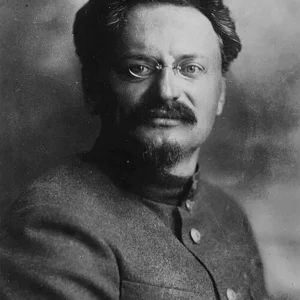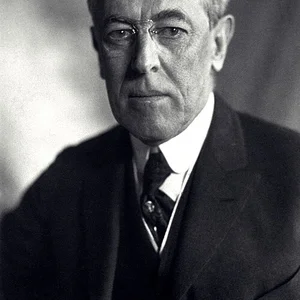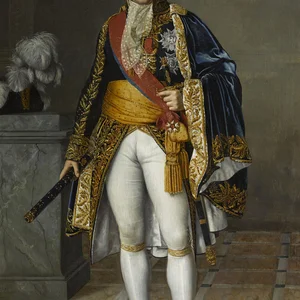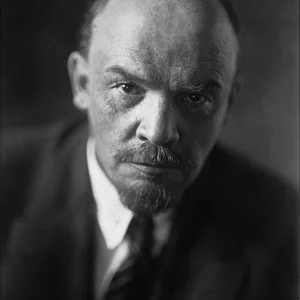

Russian revolutionary and statesman, theorist of Marxism. He led the October Revolution of 1917 and founded the USSR, the first communist state in history, of which he became the first head of government.
Lenin(1870 — 1924)
Lenin
Union soviétique, Empire russe, Russie soviétique
6 min read
Frequently asked questions
Famous Quotes
« Communism is Soviet power plus the electrification of the whole country.»
Key Facts
- Born in 1870 in Simbirsk in the Russian Empire
- Published “What Is to Be Done?” in 1902, theorizing the revolutionary vanguard party
- Led the October Revolution of 1917 and the seizure of power by the Bolsheviks
- Took Russia out of the First World War through the Treaty of Brest-Litovsk (1918)
- Founded the USSR in 1922; died in 1924
Works & Achievements
Essay in which Lenin defends the idea of a disciplined, organized vanguard revolutionary party. Founding text of Leninism.
Marxist analysis linking capitalism to wars and colonialism. An influential work on anti-imperialist thought.
Program calling for the rejection of the Provisional Government and for giving “all power to the Soviets.” Roadmap of the October Revolution.
Theoretical reflection on the state, the dictatorship of the proletariat, and the withering away of the state. A major text of communist doctrine.
The seizure of power by the Bolsheviks, overthrowing the Provisional Government. The first successful large-scale communist revolutionary event.
Creation of the Union of Soviet Socialist Republics, the first communist state in history. Lenin was its first head of government.
Economic policy reintroducing a measure of market activity and private property to revive the ruined country. A pragmatic compromise in the face of crisis.
Anecdotes
In 1887, Lenin's older brother, Alexander Ulyanov, was hanged for taking part in a plot to assassinate Tsar Alexander III. This execution deeply affected the young Vladimir, then 17 years old, and steered him toward revolutionary commitment.
In April 1917, Lenin crossed war-torn Germany in a sealed train, arranged with the German authorities who hoped to destabilize Russia. He arrived in Petrograd at the Finland Station, where a crowd welcomed him and where he gave a speech standing atop an armored vehicle.
Lenin was only a pseudonym: his real name was Vladimir Ilyich Ulyanov. He is said to have chosen it in reference to the Siberian river the Lena, perhaps in memory of his exile in Siberia from 1897 to 1900.
In August 1918, Lenin was the victim of an assassination attempt: Fanny Kaplan shot him as he was leaving a factory and wounded him seriously. He survived, but the bullets left in his body would affect his health until his death.
After his death in 1924, and against the wishes of his widow Nadezhda Krupskaya, his body was embalmed and put on display in a mausoleum on Red Square in Moscow, where it can still be seen today.
Primary Sources
Without a revolutionary theory there can be no revolutionary movement.
No support for the Provisional Government (...) All power to the Soviets!
The state is an organ of class rule, an organ for the oppression of one class by another.
The workers' and peasants' government (...) proposes to all the belligerent peoples and their governments to begin immediate negotiations for a just and democratic peace.
Comrade Stalin, having become General Secretary, has concentrated boundless power in his hands, and I am not sure that he always knows how to use that power with sufficient caution.
Key Places
Lenin's birthplace on the banks of the Volga, renamed Ulyanovsk in his honor in 1924. He spent his childhood here in a cultured family.
Lenin's place of exile between 1897 and 1900, where he pursued his revolutionary reading and writing. It was there that he is said to have coined his pseudonym.
Site of Lenin's triumphant arrival in April 1917 and the epicenter of the October Revolution. The city was the capital of the Empire and then the cradle of the revolution.
Seat of the new Bolshevik power after the capital was moved to Moscow in 1918. From here Lenin led the Soviet government.
The estate where the ailing Lenin spent his final years and where he died on January 21, 1924. It has become a place of remembrance.
Monument housing Lenin's embalmed body, built after his death. It became a powerful symbolic landmark of the Soviet regime.
Liens externes & ressources
Références
Œuvres
Que faire ?
1902
L'Impérialisme, stade suprême du capitalisme
1916
Les Thèses d'avril
1917
L'État et la Révolution
1917
Révolution d'Octobre
1917
Fondation de l'URSS
1922
Nouvelle Politique Économique (NEP)
1921