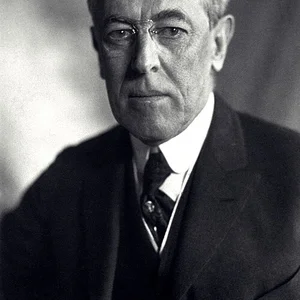

Woodrow Wilson (1856-1924) was the 28th President of the United States, in office from 1913 to 1921. An academic turned statesman, he led his country into the First World War and championed a vision of international order founded on cooperation between nations.
Woodrow Wilson(1856 — 1924)
Woodrow Wilson
États-Unis
7 min read
Frequently asked questions
Famous Quotes
« The world must be made safe for democracy.»
Key Facts
- Elected 28th President of the United States in 1912, took office in 1913, re-elected in 1916
- Brought the United States into the First World War in April 1917 on the side of the Allies
- Presented his “14 Points” in January 1918, a program for a lasting peace
- Took part in the Paris Peace Conference and the Treaty of Versailles (1919), where he advocated for the creation of the League of Nations
- Received the Nobel Peace Prize in 1919; the U.S. Senate, however, refused to ratify the treaty and join the League of Nations
Works & Achievements
Major scholarly work by Wilson analyzing the role of Congress in the American political system. It established his reputation as a political scientist.
Wilson signs the Federal Reserve Act into law, giving the United States a central bank. This system still regulates American currency today.
Driven by Wilson, the United States joins the Allies. Their intervention weighed heavily in the 1918 victory.
A peace program laying the foundations for a new international order, including the right of peoples to self-determination. It profoundly influenced 20th-century diplomacy.
Wilson was the chief promoter of this first major international organization intended to preserve peace. It foreshadowed the United Nations, created in 1945.
An award crowning his efforts toward an organized peace among nations. Wilson is one of the few American presidents to have received it.
Anecdotes
Before becoming president, Woodrow Wilson was a university professor and then president of the prestigious Princeton University, between 1902 and 1910. He remains to this day the only American president to have earned a doctorate (a Ph.D.), which earned him the nickname “the professor president.”
In January 1918, Wilson presented his “Fourteen Points” to Congress, a program to end the war and build a lasting peace. In it he notably championed the right of peoples to self-determination and the creation of an international organization tasked with preserving peace.
Wilson received the Nobel Peace Prize in 1919 for his role in founding the League of Nations. Yet his own country, the United States, refused to ratify the Treaty of Versailles and never joined the organization, for lack of a majority in the Senate.
In the autumn of 1919, while crisscrossing the country by train to convince Americans to support the League of Nations, Wilson suffered a severe stroke that left him partially paralyzed. For months, his wife Edith filtered information and decisions, to the point that some historians speak of a presidency unofficially carried out by the First Lady.
Wilson delivered his first State of the Union address before Congress in person in 1913, reviving a practice abandoned since President Jefferson in 1801. Ever since Jefferson, presidents had simply sent a written message; Wilson restored the tradition of coming to address the elected representatives directly.
Primary Sources
The programme of the world's peace, therefore, is our programme; and that programme, the only possible programme, as we see it, is this... A general association of nations must be formed [...] for the purpose of affording mutual guarantees of political independence and territorial integrity to great and small states alike.
The world must be made safe for democracy. Its peace must be planted upon the tested foundations of political liberty.
There has been a change of government. [...] We see now what we did not see before; the great Government we love has too often been made use of for private and selfish purposes.
The United States must be neutral in fact as well as in name during these days that are to try men's souls. We must be impartial in thought as well as in action.
Key Places
Birthplace of Woodrow Wilson, where he was born in 1856 in a manse. His birthplace home is now a museum.
Wilson studied here, taught here, and then became its president from 1902 to 1910. It was here that he built his reputation before entering politics.
Wilson's residence and seat of power during his two terms, from 1913 to 1921. It was here that he led the United States into the war.
Wilson attended the 1919 Peace Conference in person, an exceptional act for a sitting American president. There he negotiated the Treaty of Versailles and the creation of the League of Nations.
It was before Congress assembled at the Capitol that Wilson delivered his great speeches, including his request for a declaration of war in 1917 and his presentation of the Fourteen Points in 1918.
Wilson spent his final years in a house on S Street in Washington after his presidency. He died there in 1924, and it preserves the memory of his political retirement.
Typical Objects

Wilson wrote many of his own speeches and notes. He was known for personally using a typewriter, a rare habit for a man of his rank at the time.

The text of the Fourteen Points setting out the principles for a new kind of peace. This document became the major diplomatic reference at the end of the First World War.

A symbol of the elegance of early twentieth-century statesmen, Wilson wore it at official ceremonies. It embodied the dignity of the presidential office.

Wilson wore a pince-nez, those armless glasses clipped onto the nose, which heightened his look of an austere academic. It is a recurring feature in his portraits.

Wilson signed many major laws, such as the one creating the Federal Reserve. The pens used for these signatures were sometimes given as keepsakes to the architects of those laws.

Wilson traveled across the country by train during his 1919 tour to defend the League of Nations. It was during this exhausting journey that his health suddenly collapsed.
School Curriculum
Vocabulary & Tags
Key Vocabulary
Tags
Daily Life
Morning
A methodical man of fragile health, Wilson started his day early but made a point of conserving his strength. He often devoted his mornings to reading reports, writing his speeches, and meeting with his advisers.
Afternoon
His afternoons were punctuated by cabinet meetings, audiences, and diplomatic talks. On his doctors' advice, he regularly allowed himself a round of golf to maintain a health that was always under threat.
Evening
In the evening, Wilson enjoyed reading, poetry, and the company of his family. A cultivated man, he liked to recite poems and savored quiet evenings in the heart of the White House.
Food
Wilson followed a simple diet, partly dictated by chronic digestive troubles. He favored plain dishes and gladly began his days with a raw egg beaten into orange juice, as recommended by his doctor.
Clothing
Wilson dressed plainly and neatly, in a dark suit in the fashion of the early 20th century. The pince-nez and, on grand occasions, the top hat completed his silhouette of a scholar turned head of state.
Housing
During his terms in office, Wilson lived in the White House, in Washington. After leaving office, he settled in a comfortable house on S Street, in the capital, where he lived diminished by illness until his death.
Historical Timeline
Period Vocabulary
Liens externes & ressources
Références
Œuvres
Congressional Government (Le Gouvernement congressionnel)
1885
Création de la Réserve fédérale
1913
Entrée des États-Unis dans la Première Guerre mondiale
1917
Les Quatorze Points
1918
Fondation de la Société des Nations
1919-1920
Prix Nobel de la paix
1919