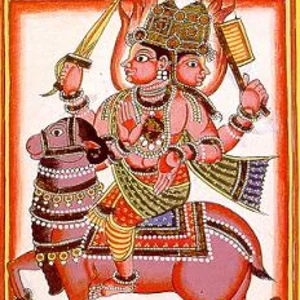

Geryon is a monstrous giant of Greek mythology, endowed with three bodies joined at the waist. The guardian of a herd of red cattle on the island of Erytheia, he is slain by Heracles during the hero's tenth Labour.
Geryon
Geryon
7 min read
Frequently asked questions
Key Facts
- Son of Chrysaor (born from the blood of the Gorgon Medusa) and the Oceanid Callirhoe, according to Hesiod's *Theogony* (c. 700 BC)
- Described as a giant with three bodies (sometimes three heads and six arms) living on the island of Erytheia, in the far West
- Owns a herd of red cattle guarded by the herdsman Eurytion and the two-headed dog Orthrus
- The tenth of the twelve Labours of Heracles is to seize this herd
- Heracles kills Orthrus, Eurytion, then Geryon with an arrow poisoned by the blood of the Lernaean Hydra
Works & Achievements
A genealogical poem on the birth of the gods; it gives the oldest written mention of Geryon, of his lineage and of his death.
A long lyric poem devoted entirely to the battle, which humanizes the giant by giving him doubts and courage in the face of death.
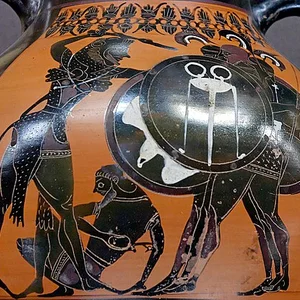
Numerous cups and amphorae showing Heracles fighting the three-bodied Geryon; major sources for his iconography.
A rationalized version of the myth that makes Geryon a king of Iberia, set within a geography of the West.
A mythological handbook that fixes the canonical account of the tenth Labor: the crossing, the guardians and the death of Geryon.
Here Geryon becomes a winged monster with a human face, a symbol of Fraud, who carries Dante and Virgil down to the eighth circle.
Anecdotes
To reach the island of Erytheia, in the far West, Heracles had no boat. Exasperated by the heat, he is said to have threatened Helios, the Sun, with his arrows; amused by such boldness, the god lent him the great golden cup in which he travels each night from west to east. Heracles thus crossed the Ocean as if aboard a skiff.
On the way to Geryon, Heracles raised two pillars (or split a mountain) on either side of the strait separating Europe from Africa: Calpe (Gibraltar) and Abyla (Ceuta). For the Greeks, these “Pillars of Hercules” marked the edge of the known world, beyond which no one dared to venture.
Since Geryon had three bodies joined at the waist, Heracles had to kill him with a single arrow shot from the side, which pierced all three torsos at once. Dipped in the blood of the Lernaean Hydra, the arrow left the giant no chance.
The poet Stesichorus (6th century BC) devoted an entire poem, the Geryoneis, to this battle. In a famous line, he compares Geryon's drooping head to a poppy that withers and lets its petals fall: an image of surprising tenderness for a monster.
Geryon did not guard his herd alone: he was helped by the herdsman Eurytion and by Orthrus, a two-headed dog, brother of Cerberus, the guardian of the Underworld. Heracles had to slay the dog and then the herdsman before facing the giant himself.
Primary Sources
Chrysaor begat three-headed Geryon, after uniting with Callirhoe, daughter of glorious Ocean. Valiant Heracles slew him beside his shambling oxen, in sea-girt Erytheia.
He bent his neck to one side, Geryon, like a poppy that, marring its tender body, at once sheds its petals.
Geryon dwelt outside the Pontus, on the island the Greeks call Erytheia, near Gades, beyond the Pillars of Heracles, on the Ocean.
Geryon reigned in Iberia, endowed with extraordinary strength and three bodies; he had gathered herds of oxen renowned for their beauty, which many coveted.
As his tenth labour, he was ordered to bring back the cattle of Geryon from Erytheia. Geryon, son of Chrysaor and Callirhoe, had the body of three men joined into one from the belly, but divided into three from the flanks and thighs.
Key Places
Mythical island of the far West, washed by the Ocean where the Sun sets. Geryon grazed his herd there; it was there that Heracles killed him.
Strait separating Europe from Africa (Gibraltar), bounded by Calpe and Abyla. Heracles is said to have raised two pillars there on his way to Geryon, marking the edge of the known world.
Wealthy region in the south of the Iberian Peninsula, near the mouth of the Guadalquivir, which the Greeks associated with the kingdom and pastures of Geryon.
Trading post beyond the Pillars of Heracles, described by Herodotus as a neighbour of Erytheia. A landmark for locating Geryon's western domain.
Citadel of King Eurystheus, who imposed the Labours on Heracles. The hero brought the herd of Geryon back there after a long journey across the West.
Typical Objects

The wondrous red-coated cattle that Geryon pastured at the edge of the world. They were the very prize of the tenth Labour of Heracles.

An enormous cup in which the Sun travels back each night from west to east, floating upon the Ocean. Helios lent it to Heracles so that he could reach Geryon's island.

A bow and arrows dipped in the venom of the Lernaean Hydra. A single arrow, shot from the side, pierced all three of Geryon's bodies and killed him.

A warrior with three bodies, Geryon bore three shields, three spears, and three helmets to defend his realm and his herd.

A wooden weapon carved from a wild olive tree, the emblematic attribute of the hero who confronted Geryon. It appears in almost all depictions of him.

The hide of the invulnerable lion slain during the first Labour, which Heracles wears as a breastplate and hood, including in his fight against Geryon.
School Curriculum
Vocabulary & Tags
Key Vocabulary
Daily Life
Morning
At dawn, on the island of Erytheia set at the edge of Ocean, Geryon surveys his pastures with his three pairs of eyes. He checks that his herd of red oxen is complete and scans the horizon, there where no stranger ever lands.
Afternoon
In the afternoon, the herdsman Eurytion leads the animals to the best grasses while Orthrus, the two-headed dog, watches the approaches. A warrior with three bodies, Geryon trains in wielding his three spears and three shields, ready to defend his property.
Evening
In the evening, as the Sun plunges close by into the outer sea, Geryon gathers the herd into its pens. At night, Orthrus stands guard, for at the world's end, even the silence seems to herald a threat.
Food
Master of an immense herd, Geryon feeds on the products of his animals: roasted meats, dairy, and water from the island's springs. The tales dwell on this bovine abundance, a sign of his wealth, rather than on refined dishes.
Clothing
As a giant warrior, he is pictured clad in a triple panoply: three helmets, three breastplates, and three shields, one per torso. Some images also give him wings or an animal hide, in the manner of archaic monsters.
Housing
Geryon dwells at the edges of the West, on the island of Erytheia near Gades, in the rich region of Tartessus. His "house" is an isolated pastoral domain, a kingdom of the setting sun where the world of men comes to an end.
Historical Timeline
Period Vocabulary
Liens externes & ressources
Références
Œuvres
Théogonie, d'Hésiode
VIIIe-VIIe s. av. J.-C.
Géryonéide, de Stésichore
VIe s. av. J.-C.
Vases attiques et chalcidiens à figures noires
VIe-Ve s. av. J.-C.
Bibliothèque historique, de Diodore de Sicile
Ier s. av. J.-C.
Bibliothèque, d'Apollodore
Ier-IIe s. ap. J.-C.
L'Enfer (Divine Comédie), de Dante
1314-1321