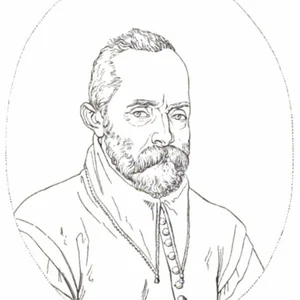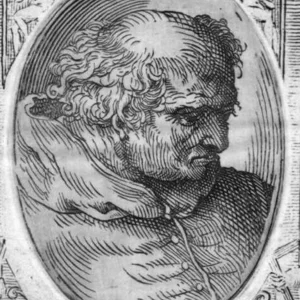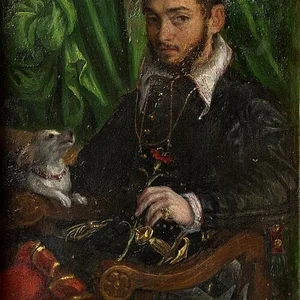

Italian painter active between the late 16th and early 17th centuries, originally from Faenza. He followed the Mannerist tradition of the Roman and Bolognese schools, producing religious and decorative works.
Gian Paolo Zappi(1555 — 1615)
Gian Paolo Zappi
8 min read
Frequently asked questions
Key Facts
- Born around 1555 in Faenza, in the Emilia-Romagna region
- Active mainly in the late 16th and early 17th centuries
- Died in 1615
- Representative of late Mannerism in Italian painting
- Creator of religious compositions intended for local churches
Works & Achievements
Zappi produced several altarpieces for religious institutions in Faenza and the surrounding region, working in a late Mannerist style that blends formal elegance with Tridentine piety. These works form the core of his output.
Like other painters of his generation in Romagna, Zappi contributed to the decoration of oratories and funerary chapels commissioned by religious confraternities and noble families, combining traditional iconography with Bolognese influences.
His works on canvas display solid technical mastery within the Romanesque Mannerist tradition: elongated figures in *contrapposto*, refined colouring, and tight framing on the protagonists of the sacred scene.
Anecdotes
Gian Paolo Zappi was born in Faenza, a city in Romagna that gave its name to faience — the glazed earthenware whose reputation spread across all of Europe. Growing up in a city renowned for its decorative arts gave him a keen sense of color and ornamental composition, qualities that would carry through into his religious works.
Active at a time when the decrees of the Council of Trent were profoundly reshaping Catholic painting, Zappi was required to produce images that were "clear, distinct, and devout" — accessible to ordinary worshippers. Gone were the overly learned or ambiguous iconographic programs of extreme Mannerism: ecclesiastical patrons now took care to ensure that saints were recognizable and scenes properly edifying.
Like many painters from the Italian provinces, Zappi was drawn into the orbit of the Bolognese school. From the 1580s onward, the Carracci brothers established the Accademia degli Incamminati there and championed a return to studying nature as a corrective to Mannerist excess. This pictorial reform spread throughout Romagna, prompting local artists to reassess their own styles.
In the sixteenth century, Romagna was a papal state: major artistic commissions came from ecclesiastical authorities, religious confraternities, and noble families eager to endow their private funerary chapels. Zappi spent his career navigating between these patrons, negotiating each altarpiece as much as a craftsman-entrepreneur as an artist.
Primary Sources
The baptismal and civil records of the parish of Faenza contain mentions of the Zappi family, attesting to the lasting presence of this lineage within the artisan and artistic community of the city during the sixteenth century.
Baglione's *Lives* catalogues painters active in Rome and the Papal States at the end of the sixteenth century, providing valuable context on artistic practices and patronage networks of the generation to which Zappi belonged.
The local chronicles of Faenza record decorative and painting commissions awarded by the city's religious institutions, in which local artists were called upon to adorn altars, chapels, and public buildings.
Notarial records from the region document commissions awarded to local painters: iconographic programme, dimensions, required material quality (gold, lapis lazuli), delivery deadlines, and agreed remuneration.
Key Places
Zappi's birthplace, Faenza is an artistic and craft hub in Romagna celebrated for its glazed ceramics — which gave the world the word *faience*. Its many churches, confraternities, and noble families formed the network of patrons that sustained the painter's career.
The artistic and academic metropolis of the region, Bologna was the cradle of the Carracci reform that reshaped Italian painting from the 1580s onward. Its influence radiated across Romagna and shaped the style of Zappi's entire generation.
The heart of the Counter-Reformation and the destination of Europe's most prestigious artistic commissions, Rome exerted a powerful pull on Italian painters of Zappi's generation. Prints and itinerant artists carried Roman models back to provincial towns throughout the peninsula.
The principal religious building of Faenza, the cathedral was one of the main commissioning venues for local artists. Its side chapels and liturgical furnishings provided a recurring source of work for Faentine painters in the late sixteenth century.
Typical Objects

The Renaissance painter's brushes are crafted from sable hair for fine lines and light highlights, mounted on turned wooden handles. The master owns a collection of varying sizes, each reserved for a specific purpose.

The palette holds colors prepared by the apprentice from ground natural pigments: lapis lazuli for ultramarine, cinnabar for bright red, yellow ochre for flesh tones. Their quality and quantity are often specified in commission contracts.

Before painting a fresco or altarpiece, the painter creates a cartoon — a large full-scale drawing on paper — which can be pounced or traced onto the final support. This is an essential step in the method inherited from the great workshops of the Renaissance.

The primary support for the religious paintings commissioned from Zappi, the altarpiece is intended to adorn the altar of a chapel or confraternity. Its size, subject, and materials are fixed by contract, with the patron often dictating the quality of the blue (lapis lazuli or azurite).

Every major altarpiece or decoration is the subject of a notarial act specifying the subject, dimensions, deadlines, materials, and price. These documents are today the primary source of information on lesser-known painters such as Zappi.

Engravings reproducing famous works — Roman frescoes, Venetian paintings, ancient sculptures — circulated throughout Italy, allowing provincial painters to draw inspiration from models they may never have seen in person. They were the "internet images" of the Renaissance.
School Curriculum
Vocabulary & Tags
Key Vocabulary
Daily Life
Morning
Zappi begins his day at dawn, taking advantage of the natural light for the most delicate work — highlights, faces, hands. After morning prayers in keeping with post-Tridentine Catholic practice, he joins his workshop where his apprentices have already prepared pigments ground in linseed oil. The first hours are devoted to preparatory drawing or transparent glazes.
Afternoon
In the afternoon, as the light shifts toward the south, Zappi supervises his assistants on large background surfaces, drapery, and architectural elements. He sometimes receives his patrons — representatives of confraternities, canons, notaries — to discuss the iconographic program of an altarpiece in progress. Visits to the paint merchant or to fellow artists fill the quieter moments.
Evening
In the evening, by the light of his oil lamp, Zappi studies the engravings circulating in Italian artistic circles: reproductions of Raphael, Michelangelo, and the newly emerging Carracci. These second-hand images are his permanent university. He jots down compositional ideas on sheets of paper and discusses the progress of ongoing commissions with his apprentices.
Food
Zappi's diet is that of a prosperous Romagnol craftsman: bread, polenta, garden vegetables, local cured meats, and fish on the lean days prescribed by the Church (Fridays and the vigils of feast days). Red Romagnol wine accompanies meals. Major religious festivals — Easter, Christmas, the city's patron saint's feast — call for more lavish meals shared with family.
Clothing
In the workshop, Zappi wears a leather or heavy canvas apron to protect himself from splashes of pigment and oil. His everyday dress is that of a craftsman-bourgeois: dark wool breeches and doublet, leather hose. When meeting patrons, he dons more carefully chosen attire, a mark of his status as a skilled artisan clearly distinct from a mere laborer.
Housing
Zappi lives and works under the same roof, as was customary among craftsmen of the period. His workshop, on the ground floor of a town house in Faenza, is fitted with tall windows preferably facing north for steady, glare-free light. Shelves hold jars of pigments, flasks of linseed oil and turpentine, and rolls of preparatory cartoons kept in careful order.
Historical Timeline
Period Vocabulary
Liens externes & ressources
Références
Œuvres
Retables pour les églises de Faenza
fin XVIe – début XVIIe siècle
Peintures décoratives pour confréries et chapelles privées
vers 1585-1610
Compositions sur toile à sujet sacré
vers 1590-1615