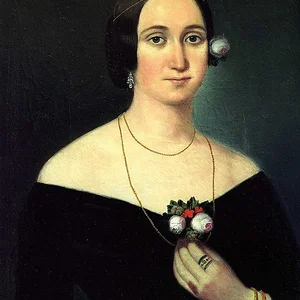

Giuseppina Strepponi was an Italian soprano, one of the leading bel canto singers of the early 19th century. She notably created the role of Abigaille in Nabucco and became the companion, then the wife, of the composer Giuseppe Verdi.
Giuseppina Strepponi(1815 — 1897)
Giuseppina Strepponi
royaume d'Italie
5 min read
Frequently asked questions
Key Facts
- Born in 1815 in Lodi (Lombardy) into a family of musicians, the daughter of an organist and composer
- Began her career as a soprano around 1834-1835 and became one of the most prominent prime donne in Italy
- Created the role of Abigaille at the premiere of Verdi's Nabucco at La Scala in Milan in 1842
- Retired from the stage and settled in Paris as a singing teacher in the late 1840s
- Married Giuseppe Verdi in 1859 after years of living together; died in 1897 at Sant'Agata
Works & Achievements
Her most famous creation: an extremely difficult role that became legendary and sealed the triumph of the young Verdi.
Strepponi shone in operas such as Lucia di Lammermoor and La sonnambula, ranking among the most sought-after sopranos in Italy.
She created the title role of this opera in Rome, confirming her status as a leading singer.
After retiring from singing, she trained young performers, passing on the art of bel canto.
As an adviser, translator and behind-the-scenes secretary, she played a discreet but essential role in the composer's career.
Anecdotes
In 1842, Giuseppina Strepponi created the role of Abigaille in Nabucco at La Scala in Milan. The role is so demanding — with its octave leaps and strained high notes — that it is often said to have helped wear out her still-young voice.
Before becoming Verdi's wife, Strepponi was a celebrated singer who helped the budding composer: it was partly thanks to her support and her reputation that she persuaded the publisher and the theater to stage Nabucco, the opera that truly launched Verdi's career.
Strepponi and Verdi lived together for several years without being married, in Busseto, which scandalized the conservative residents of the small town. Verdi firmly defended his companion in a famous letter to his father-in-law, refusing to let anyone judge their private life.
After leaving the stage, Strepponi taught singing in Paris to earn a living. Multilingual and cultured, she spoke several languages and later became a true behind-the-scenes collaborator for Verdi, translating his correspondence and helping him with his affairs.
The couple finally married discreetly in 1859, in a small village in Savoy, with only the coachman and the church bell-ringer as witnesses.
Primary Sources
In my house there lives a lady, free and independent, who, like me, loves a solitary life, and who possesses a fortune that shelters her from every need. Neither I nor she owes anyone an account of our actions.
Abigaille: Ben io t'invenni, o fatal scritto !... Prode guerriera son io del par.
Letters in which she expresses her devotion and her concerns for the composer's health and career, preserved in the Verdi archives.
Key Places
Town in Lombardy where Giuseppina Strepponi was born in 1815, into a family of musicians.
Strepponi studied singing and piano here, winning a singing prize at the end of her studies.
On this prestigious stage, Strepponi created the role of Abigaille in Nabucco in 1842.
After retiring from the stage, Strepponi taught singing here and lived with Verdi in the late 1840s.
Estate near Busseto where Strepponi lived for many years with Verdi and where she died in 1897.
Village where Strepponi and Verdi married secretly in 1859.