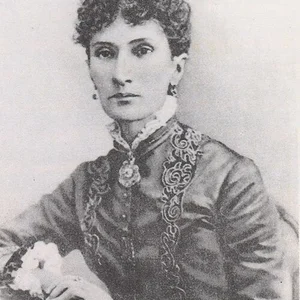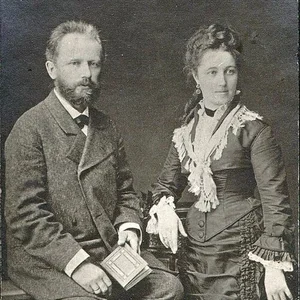

Russian pianist born in 1848, known primarily for marrying composer Pyotr Ilyich Tchaikovsky in 1877. Their union was brief and unhappy, with Tchaikovsky leaving her shortly after the wedding.
Antonina Miliukova(1848 — 1917)
Antonina Miliukova
Empire russe
7 min read
Frequently asked questions
Key Facts
- Born on March 10, 1848, in Russia
- Studied piano at the Moscow Conservatory
- Married Pyotr Ilyich Tchaikovsky on July 18, 1877
- Separated from Tchaikovsky just a few weeks after the wedding
- Died in 1917 in a psychiatric institution in Saint Petersburg
Works & Achievements
A serious musical education that allowed Antonina to move in Moscow's musical circles and come into contact with Tchaikovsky. Her level at the conservatory attests to genuine instrumental skill, beyond the negative image that posterity has attached to her.
A personal account published by Antonina in which she tells her version of the marriage and separation from Tchaikovsky. This document offers a valuable counterpoint to the composer's own account and gives voice to a woman who was long silenced.
The collection of letters exchanged between Antonina and Tchaikovsky constitutes a major historical document on the conditions of their marriage and the place of women in 19th-century Russian society.
Anecdotes
In the spring of 1877, Antonina Miliukova, a student at the Moscow Conservatory, wrote her professor Tchaikovsky a fervent letter declaring her passionate love for him and threatening to take her own life if he did not respond. The letter reminded Tchaikovsky so strongly of the letter scene written for Tatiana in the opera *Eugene Onegin*, which he was then composing, that he agreed to meet her — and eventually to marry her.
Tchaikovsky married Antonina on July 18, 1877, partly to silence rumors about his private life. Only a few weeks after the wedding, he suffered a nervous breakdown so severe that he attempted to drown himself in the Moskva River in the middle of the night. His brother Anatole had to rush to Moscow and take him abroad — first to Switzerland, then to Italy — so that he could recover far from the capital.
While Tchaikovsky recuperated abroad, Antonina continued living in Moscow as though nothing had happened. She sent him affectionate letters that he never answered directly, delegating his brother Modest to reply on his behalf. The couple almost never saw each other again, yet they remained officially married until the composer's death in 1893.
In the years following the separation, Antonina had several children with other men — children she abandoned at the Moscow Foundling Hospital. Her situation deteriorated steadily until, around 1896, she was committed to a psychiatric institution in Saint Petersburg, where she spent the rest of her life until her death in 1917.
In 1913, Antonina published her memoirs, in which she offered her own account of the disastrous marriage. She portrayed herself as the victim of a man who had married her without ever loving her, and sought to defend her reputation against the legend that cast her as an unhinged and importunate woman — at a time when Tchaikovsky's image had already been sanctified by posterity.
Primary Sources
I married without hope of happiness, seeking only peace and the possibility of working. At the ceremony I was like a man walking toward inevitable death.
My wife is guilty of nothing; she is a good person. But I cannot live with her. Fate has played a cruel trick on me: I realized too late that one cannot force one's own nature.
I am on the edge of the abyss. If I do not flee now, I will go mad or die. I blame no one, but my married life is a torment I can no longer endure.
I loved him sincerely and believed I could make him happy. I never understood why he fled from me as he did. I had done nothing to deserve such abandonment.
Key Places
Antonina studied piano there and it was where she met Tchaikovsky, who taught at the institution. Founded in 1866 by Nikolai Rubinstein, the conservatory was the heart of Moscow's musical life.
The city where Antonina lived before and after her marriage. It was here that the wedding ceremony took place on July 18, 1877, and where the couple briefly attempted to build a life together before Tchaikovsky fled.
The imperial capital of Russia, where Antonina was committed to a psychiatric institution from around 1896, and where she died in 1917 amid the turmoil of the Russian Revolution.
The country estate of the Davidov family — Tchaikovsky's sister's household — where the composer often retreated to escape Moscow and Antonina. He stayed there to recover from his nervous breakdown following the marriage.