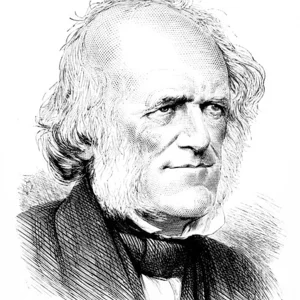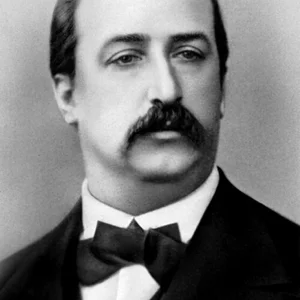

A 19th-century Russian composer and member of The Five, he was also a renowned chemist. He pursued scientific and musical careers side by side, leaving behind the unfinished opera *Prince Igor*.
Alexander Borodin(1833 — 1887)
Alexander Borodin
Empire russe
6 min read
Frequently asked questions
Key Facts
- Born in 1833 in Saint Petersburg, the illegitimate son of a Georgian prince
- Member of The Five alongside Mussorgsky, Rimsky-Korsakov, Balakirev and Cui
- A chemistry professor at the Imperial Medical-Surgical Academy, he discovered the aldol reaction (1872)
- Composed the opera *Prince Igor*, left unfinished at his death and completed by Rimsky-Korsakov and Glazunov
- Died in 1887 in Saint Petersburg
Works & Achievements
An opera that remained unfinished, completed by Rimsky-Korsakov and Glazunov. It contains the famous *Polovtsian Dances*, a pinnacle of Russian national music.
A powerful work evoking the epic of Russian heroes. Considered one of his major achievements.
An evocative symphonic poem depicting the passage of a caravan across the Russian plains. One of Borodin's most frequently performed orchestral pieces.
His first major orchestral work, revealing Borodin's talent under the guidance of Balakirev.
A chamber music work famous for its tender *Notturno*. Dedicated to his wife.
A major discovery in organic chemistry concerning the joining of two aldehyde molecules. Still taught today.
Borodin took part in founding higher medical education for women in Russia, a pioneering initiative for the time.
Anecdotes
Borodin led a double life: by day, he was a respected chemistry professor, and he composed only during his rare moments of leisure, in the evening or while on sick leave. He himself used to joke that his musician friends wished him... a good cold, because that was the only time he could write music!
The illegitimate child of a Georgian prince, little Alexander was officially registered as the son of a serf belonging to that prince. It was his mother who raised him, giving him an excellent education and teaching him several languages and music from a very young age.
In chemistry, Borodin discovered an important reaction, the aldol condensation, and worked on aldehyde reactions. He was also a pioneer of higher education for women in Russia, founding medical courses for young women.
Borodin never saw his opera *Prince Igor* completed: he worked on it for nearly eighteen years without finishing it. After his sudden death at a costume ball, it was his friends Rimsky-Korsakov and Glazunov who completed the work, with Glazunov reconstructing from memory the overture he had heard Borodin play on the piano.
The famous *Polovtsian Dances* from *Prince Igor* enjoyed a second life in the 20th century: their melodies were borrowed for the American musical *Kismet*, whose song "Stranger in Paradise" became a great popular hit.
Primary Sources
In winter, I can only compose when I am sick enough to skip teaching my classes. So my friends, contrary to custom, never wish me good health, but rather some little ailment.
Borodin was a man of immense learning, as well versed in chemistry, to which he devoted his life, as in music. His generous and kind nature made him loved by all.
By treating ordinary aldehyde, one obtains a new substance, aldol, resulting from the union of two molecules of aldehyde.
Key Places
Borodin's birthplace and the capital of the Russian Empire, where he lived, taught, and composed throughout his life. A major intellectual and artistic center of the country.
The institution where Borodin studied medicine and later taught chemistry as a professor. There he ran a laboratory and trained many students.
A German university town where Borodin stayed for his chemistry research and met his future wife, the pianist Ekaterina Protopopova.
An Italian city where Borodin pursued his work in organic chemistry during the 1860s. There he carried out important experiments on halogenated compounds.
A necropolis in Saint Petersburg where Borodin was buried, alongside other great Russian composers. A place of remembrance for the nation's musical heritage.
Typical Objects

Glass vessels from the chemistry laboratory where Borodin carried out his experiments on aldehydes. They symbolize his leading scientific career, running in parallel with his life as a composer.

The instrument on which Borodin composed his works during his rare moments of free time. It was at the piano that he played the pages of *Prince Igor* for his friends.

Sheets on which Borodin jotted down his compositions, often left unfinished for lack of time. The manuscripts of *Prince Igor* had to be deciphered and completed by his friends after his death.

An observation tool used in his research in organic chemistry and medicine. It is a reminder of his training as a physician at the Medical-Surgical Academy.

A small metal instrument that gives the reference note for tuning instruments. An object at the crossroads of acoustic physics and music, it sums up Borodin's two passions.

Writing instruments used both to draft his scientific papers and to keep up an abundant correspondence. Borodin had a command of several foreign languages.
School Curriculum
Vocabulary & Tags
Key Vocabulary
Daily Life
Morning
Borodin began his day at the Medical-Surgical Academy, where he taught his chemistry courses and supervised his students' experiments in the laboratory. His home, adjoining the Academy, was always full of visitors, colleagues, and household pets.
Afternoon
The afternoon was devoted to his scientific research, to writing chemistry papers, and to his administrative duties. A generous man, he spent a great deal of time helping his students, especially the young women whose access to education he championed.
Evening
In the evening, when he could, Borodin would sit down at the piano to compose, but he was often interrupted by visits and obligations. This is why he made very slow progress on his works, which he wrote mainly during his holidays.
Food
The diet of a man of good Saint Petersburg society in the 19th century included black bread, soups such as shchi (cabbage soup) and borscht, fish, and plenty of tea served from the samovar. Borodin, ever hospitable, gladly shared his table with his many guests.
Clothing
As a professor and man of the world, Borodin wore the dark frock coat, waistcoat, and necktie expected within the cultivated middle class of his time. In the laboratory, he put on a smock to protect his clothes from the chemicals.
Housing
Borodin lived in a staff apartment located in the very building of the Academy, in Saint Petersburg. The lodging, modest and always cluttered with scores, instruments, and scientific apparatus, was a place of constant comings and goings for friends, relatives, and students.