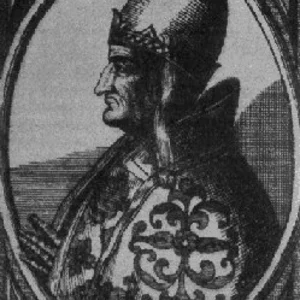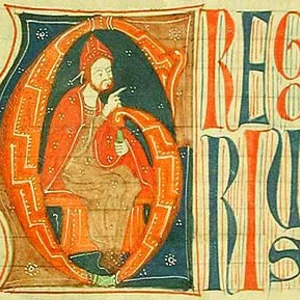

Gregory IX was the 178th pope of the Catholic Church, from 1227 to 1241. A jurist and a man of power, he fiercely opposed Emperor Frederick II and institutionalized the papal Inquisition by entrusting it to the mendicant orders.
Gregory IX(1170 — 1241)
Gregory IX
6 min read
Frequently asked questions
Key Facts
- Elected pope in 1227, succeeding Honorius III
- Promulgated the Decretals (Liber Extra) in 1234, a major collection of canon law
- Institutionalized the papal Inquisition around 1231-1233 by entrusting it to the Dominicans
- Repeatedly excommunicated Emperor Frederick II in the Priesthood/Empire conflict
- Canonized Francis of Assisi (1228) and Dominic (1234), both of whom he had personally known
Works & Achievements
Official collection of canon law compiled by Raymond of Peñafort, which remained the Church's legal reference until 1917.
Establishment of a systematic procedure against heresy, entrusted mainly to the Dominican friars.
Swift elevation to the honors of the altar of the founder of the Franciscans, whom he had known and protected.
Recognition of the sainthood of the founder of the Order of Preachers, a pillar of preaching and of the Inquisition.
Founding charter of the liberties of the University of Paris, often called the “Magna Carta” of universities.
Protection and growth of the Franciscans and Dominicans, who became major instruments of reform and preaching.
Anecdotes
Elected pope at over sixty years of age, Ugolino di Segni took the name Gregory IX. He was the nephew (or close relative) of the great pope Innocent III, and had spent decades in papal diplomacy before ascending to the throne of Saint Peter himself.
Gregory IX was a personal friend of Francis of Assisi, whom he had protected as a cardinal. Once he became pope, he canonized him as early as 1228, less than two years after his death, and laid the foundation stone of the Basilica of Assisi.
His showdown with Emperor Frederick II was spectacular: he excommunicated him because he was slow to leave on crusade, then excommunicated him again when the emperor set off anyway! Frederick retook Jerusalem through diplomacy, but without the pope's blessing.
In 1234, Gregory IX had the “Decretals” published, an immense collection of Church laws compiled by the jurist Raymond of Penyafort. This code remained the foundation of canon law for nearly seven centuries, until 1917.
It was under his pontificate that the papal Inquisition was truly organized around 1231-1233. The pope entrusted it to the Dominican and Franciscan friars, those new mendicant orders that roamed the cities.
Primary Sources
Paris, the mother of sciences, like another Kiriath-Sepher, the city of letters, shines full of brightness.
The peaceful King has, through merciful providence, ordained that his subjects be chaste, peaceful, and governed by laws.
As the eleventh hour drew near, the Lord raised up his servant Francis, a man truly catholic and apostolic.
A voice was heard in Rama: lamentation and wailing, for heresy corrupts the peoples.
Key Places
Small town in Latium, birthplace of several medieval popes including Gregory IX. The pope stayed there to escape the unrest in Rome.
Seat of papal power, where Gregory IX governed the Church and faced the pressure of the imperial armies. He died there in 1241.
Town in Umbria, homeland of Saint Francis. Gregory IX proclaimed his canonization there and launched the construction of the great basilica.
Town in Umbria where Gregory IX resided during his conflicts with Rome and the Empire. A frequent place of refuge for the Curia in the 13th century.
Great intellectual center of medieval Europe. Gregory IX guaranteed the university's autonomy there through the bull *Parens scientiarum* in 1231.
Typical Objects

Crowned headdress worn by the pope as a symbol of his spiritual and temporal authority. In the 13th century, it was gradually adorned with stacked crowns.

Lead seal hung from the most solemn papal documents, which gave its name to papal “bulls.” It bore the heads of Saint Peter and Saint Paul on one side and the pope's name on the other.

Manuscript volume gathering the letters and legal rulings of the Church, promulgated in 1234. It served as a textbook in every university of canon law.

Curved staff shaped like a shepherd's crook, the insignia of bishops and of the pope. It recalls the mission of “shepherd” of the flock of the faithful.

Ring worn by the pope, engraved with the image of Saint Peter casting his nets. It served as a personal seal and was broken upon the pontiff's death.

Solemn act cutting off a Christian from the community of the Church. Gregory IX used it as a political weapon against Emperor Frederick II.
School Curriculum
Vocabulary & Tags
Key Vocabulary
Daily Life
Morning
The pope began his day very early with prayer and Mass, surrounded by his clergy. The morning was devoted to the liturgical offices and the reading of the Scriptures, in the silence of the papal palace.
Afternoon
The afternoon was spent in audiences, receiving legates, ambassadors and litigants who came from all over Christendom. Trained as a jurist, Gregory IX examined matters of canon law and dictated countless letters.
Evening
The evening combined further prayers, a sober meal and councils with the cardinals of the Curia. There they often discussed strategies against the emperor Frederick II or the affairs of the mendicant orders.
Food
The diet of a high medieval prelate remained theoretically sober, paced by the fasts and meatless days of the Church. Bread, fish, vegetables, fruit and wine diluted with water made up the ordinary fare, with meat reserved for non-fasting days.
Clothing
Gregory IX wore the white garments of the pope, topped with the cope and liturgical ornaments for ceremonies. The tiara, the Fisherman's Ring and the pectoral cross marked his supreme dignity.
Housing
He resided in the papal palaces, mainly the Lateran in Rome, but also at Anagni, Perugia or Rieti during times of unrest. These vast stone residences housed the chapel, the chancery and the entire Curia.
Historical Timeline
Period Vocabulary
Liens externes & ressources
Références
Œuvres
Décrétales de Grégoire IX (Liber Extra)
1234
Organisation de l'Inquisition pontificale
1231-1233
Canonisation de François d'Assise
1228
Canonisation de Dominique de Guzmán
1234
Bulle Parens scientiarum
1231
Soutien aux ordres mendiants
1227-1241