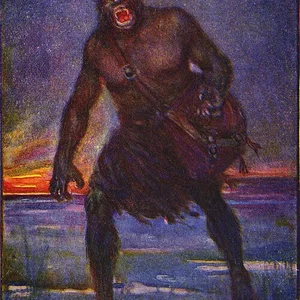

Grendel is a monster descended from the cursed lineage of Cain, who terrorizes the mead-hall of Heorot — home of the Danish king Hrothgar — for twelve years. A creature of darkness and marshes, he is ultimately defeated by the Geatish hero Beowulf in the oldest epic poem in English literature (8th century).
Grendel
Grendel
8 min read
Frequently asked questions
Key Facts
- Grendel appears in Beowulf, the oldest surviving epic poem in Old English, composed around the 8th century
- He terrorizes the mead-hall of Heorot, home of the Danish king Hrothgar, for twelve years
- He is presented as a descendant of Cain, linking the Norse myth to the Biblical tradition
- He is defeated bare-handed by the hero Beowulf, who tears off his arm
- His mother, another creature of the deep, seeks revenge after his death
Works & Achievements
The oldest epic poem in English literature (3,182 lines), in which Grendel is the first antagonist. A founding work of medieval Germanic literature, it weaves together Scandinavian heroic traditions and a Christian framework.
A modern retelling of the myth narrated from Grendel's own perspective, casting him as an existentially lonely and philosophically tormented being. It invites reflection on the monster as a mirror of humanity.
A motion-capture film adaptation that revisits the Grendel myth by adding a psychological dimension and a fresh reading of the relationship between hero and monster, bringing the story to a contemporary audience.
An Anglo-Saxon Latin treatise cataloguing the monstrous creatures of Germanic and classical tradition, providing direct cultural context for the figure of Grendel and his kin in the medieval imagination.
An adaptation that humanizes Grendel by giving him a tragic backstory and understandable motivations, questioning the boundary between monster and victim within medieval heroic traditions.
Anecdotes
Grendel is described in the poem as a 'mearc-stapa,' meaning a 'march-stalker' — a creature that haunts the wild borderlands between the world of men and the realm of darkness. This term reveals the medieval conception of monsters as guardians of the boundary between civilized order and primal chaos.
For twelve consecutive years, Grendel seizes sleeping warriors from the hall of Heorot every night, devours them, and drags them back to his lair in the marshes. The number twelve is no accident: it underscores the complete helplessness of King Hrothgar, whose authority is rendered utterly powerless by the creature.
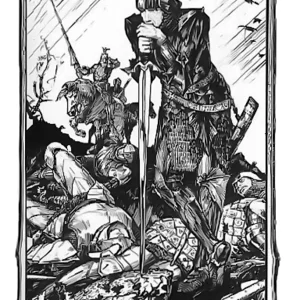
When Beowulf confronts Grendel, he deliberately refuses any weapon, for the monster is said to be immune to iron and steel. With his bare hands, the Geatish hero tears off the creature's entire arm, inflicting a fatal wound. Grendel's arm is then hung as a trophy beneath the roof of Heorot — a triumphant proof of victory.
Grendel is presented in the poem as a direct descendant of Cain, the first biblical murderer according to Genesis. This cursed lineage, blending Germanic mythology with Christianity, reflects the way Anglo-Saxon monks who transcribed the poem wove pagan heroic traditions into a Christian theological framework.
The poem describes Grendel as physically suffering from the sound of singing and harp music in the hall of Heorot. This painful sensitivity to music and human joy makes him a figure of absolute exclusion — condemned to wander in darkness while men celebrate light and fellowship.
Primary Sources
Þa com of more under misthleoþum Grendel gongan, godes yrre bær — 'Then from the moor, under misty cliffs, Grendel came walking, bearing God's wrath.'
Wæs se grimma gæst Grendel haten, mære mearcstapa, se þe moras heold — 'That grim spirit was called Grendel, the notorious prowler of the borderlands, he who ruled the moors.'
Gyrede hine Beowulf eorlgewædum, nalas for ealdre mearn — 'Beowulf dressed himself in warrior's armor, not at all fearing for his life' — passage introducing the mother's vengeance.
An Anglo-Saxon Latin text contemporary with the poem, describing monstrous creatures drawn from Germanic and classical traditions, offering a learned parallel to the bestiary of Beowulf.
Key Places
The magnificent hall of King Hrothgar, identified by archaeologists with the site of Lejre in Denmark, is the place Grendel attacks for twelve years. Excavations have uncovered traces of a large ceremonial hall dating back to the Iron Age.
Grendel's watery, subterranean lair — shared with his mother — is described as a dark lake surrounded by gloomy forests, evoking the marshy landscapes of the Danish Jutland. It is the site of the final confrontation between Beowulf and Grendel's mother.
The only surviving manuscript of Beowulf, damaged in the fire of 1731, is preserved at the British Library in London. This 10th-century codex is the sole repository of the entire story of Grendel.
The homeland of the hero Beowulf, located in what is now southern Sweden. It is from here that the Geatish warrior sets out to face Grendel at the court of Hrothgar, crossing the North Sea.
Typical Objects

Grendel possesses a claw or bag made of dragon skin in which he stuffs his victims. This macabre object symbolizes his predatory nature and his complete dehumanization.

After his defeat, Grendel's arm is hung beneath the rafters of Heorot as proof of Beowulf's victory. It becomes a ritual object that restores the honor of King Hrothgar and the safety of the kingdom.

During the battle against Grendel's mother in the underwater lair, Beowulf discovers a fabulous sword forged by giants — the only weapon capable of severing the dead monster's head. It evokes the pre-human world to which Grendel belongs.

King Hrothgar's great wooden and gilded hall is both the object of Grendel's destructive desire and the symbol of everything forbidden to him: light, music, and the fellowship of men.

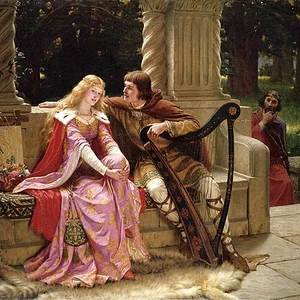
The harp played by the bard (scop) in Heorot is the instrument whose sound tortures Grendel in the darkness outside. It represents civilization, collective memory, and the joy of celebration that the monster cannot bear.

The dark and hellish lake where Grendel and his mother dwell is described as a place where even hunted stags refuse to plunge. This hostile natural setting is the symbolic space of everything that stands opposed to human order.
School Curriculum
Vocabulary & Tags
Key Vocabulary
Daily Life
Morning
Grendel retreats to his watery lair before dawn, for he is a creature of darkness repelled by daylight. He plunges into the black depths of the lake with his mother, into a den adorned with the remains of his victims. The silence of morning is his only rest.
Afternoon
In the depths of his underground lair at the bottom of the lake, Grendel waits for night to return. He is not described as active during the day — his existence is governed by darkness and by the suffering caused by light and human sounds.
Evening
As soon as night falls, Grendel leaves the marshes and approaches Heorot, drawn and tormented by the singing and the light. He seizes sleeping warriors, kills several, devours them or carries them off. The violence of his raids is described as compulsive, driven by hatred and jealousy.
Food
Grendel feeds on human flesh — he devours the Danish warriors he snatches from the floor of Heorot while they sleep. This cannibalistic diet places him outside all community and natural order, making him an embodiment of primordial chaos.
Clothing
No clothing or armor — Grendel is entirely bare, covered only by a thick natural hide impenetrable to man-forged weapons. This bestial nakedness sets him sharply apart from armored warriors and underscores his belonging to the animal and demonic world.
Housing
Grendel lives with his mother in a lair beneath a dark, hellish lake, reachable only by diving into its cold waters. The underwater cave is described as a subterranean space lit by an eerie light and lined with the remains of his victims — the very opposite of the golden warmth of Heorot.
Historical Timeline
Period Vocabulary
Visual Style
Esthétique de manuscrit enluminé anglo-saxon mêlée à un univers sombre et expressionniste, avec un contraste fort entre les ténèbres du marécage et la lumière dorée de la salle d'Heorot.
Sound Ambience
Ambiance nocturne et marécageuse du repaire de Grendel, contrastant les ténèbres froides du dehors avec les sons lointains et douloureux de la fête humaine dans Heorot.
Liens externes & ressources
Références
Œuvres
Beowulf (poème épique en vieil anglais)
VIIIe siècle (manuscrit vers 1000)
Grendel — roman de John Gardner
1971
Liber Monstrorum (Livre des Monstres)
VIIe-VIIIe siècle
Beowulf & Grendel — film islandais de Sturla Gunnarsson
2005