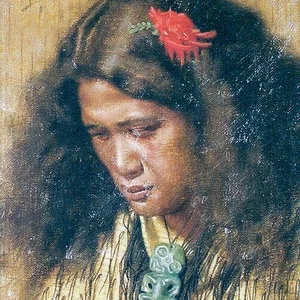

Hinemoa is a heroine of Māori oral tradition, from the Arawa tribe, whose legend has been passed down since pre-colonial times in New Zealand. According to tradition, she swam across Lake Rotorua to reach her lover Tūtānekai on Mokoia Island, defying her family's prohibition. Her story symbolizes the power of love and the courage to challenge social conventions.
Hinemoa
Hinemoa
7 min read
Frequently asked questions
Key Facts
- A figure of Māori oral tradition, passed down long before European colonization in the 18th century
- Belongs to the Arawa tribe, established around Lake Rotorua on the North Island of New Zealand
- Legend holds that she swam across Lake Rotorua (approximately 3 km) to reach Tūtānekai on Mokoia Island
- Her family, of high rank, opposed the union, which adds a transgressive dimension to the story
- The legend was first written down by European missionaries and ethnographers in the 19th century
Works & Achievements
A foundational story of the Māori oral tradition, passed down through generations by the Arawa people. It is one of the most celebrated love stories in Māori culture and an essential testament to its social values.
Poetic compositions passed down through oral tradition, evoking Hinemoa's crossing of the lake, her love for Tutanekai, and Tutanekai's music. Collected notably in Ngā Moteatea by Apirana Ngata.
The first written version of the legend in English, enabling its international reach. This version remains a key reference for researchers and school curricula alike.
Numerous works by Māori and European artists depicting Hinemoa's night swim, reflecting the legend's lasting influence on New Zealand's visual arts.
A sculpture erected in the Rotorua gardens, making Hinemoa a regional and national symbol of identity. It helps anchor the legend in contemporary public space.
Anecdotes
According to Māori oral tradition, Hinemoa was a high-ranking young woman of the Arawa tribe whose family refused all suitors, fearing she would make an unsuitable match. Each night, her lover Tutanekai would play his flute from the island of Mokoia, and the sound carried across the waters of Lake Rotorua, guiding Hinemoa toward him through the darkness.
To cross Lake Rotorua — several kilometers wide — Hinemoa is said to have used empty gourds as floats, since her family had hidden all the canoes to prevent her from leaving. This image of a woman swimming through the night, guided by the melody of a flute, is one of the most celebrated in Māori tradition.
Arriving exhausted on the island of Mokoia, Hinemoa warmed herself in a natural hot spring called Waikimihia. It was there that Tutanekai found her. The island's hot springs are still associated with this legend today and visited by Māori people as a living place of memory.
The legend of Hinemoa is more than a love story: it challenges the rigid social rules of pre-colonial Māori society, where marriage alliances were a matter of political strategy between tribes. By choosing her own partner, Hinemoa embodies a rare form of individual freedom in the face of collective obligation.
Tradition holds that Tutanekai played the Māori nose flute each evening — the nguru or kōauau — facing the mainland. This music was not merely a lover's call: in Māori culture, music carried a spiritual force known as mauri, capable of forging invisible bonds between people.
Primary Sources
George Grey, Governor of New Zealand, collected from Māori chiefs the great narratives of their oral tradition, including the legend of Hinemoa and Tūtānekai, transcribed in Māori and then translated into English.
The official Māori journal published several versions of the legend of Hinemoa, accompanied by illustrations and cultural commentary, reflecting the continued vitality of this tradition throughout the 20th century.
Ethnographer Elsdon Best documented the oral traditions of the Arawa people, including accounts relating to Mokoia, to Tūtānekai, and to the lineages from which Hinemoa descended.
This monumental collection of Māori poetry and song includes compositions associated with Hinemoa, passed down orally from generation to generation within the Arawa tribes.
Key Places
A large volcanic lake on the North Island of New Zealand, the setting of Hinemoa's nighttime crossing. It is sacred to the Arawa people and marked by the geothermal activity characteristic of the region.
An island at the center of Lake Rotorua, home of Tutanekai and the destination of Hinemoa's heroic swim. It remains a symbolic place for the Arawa, still held as tribal property today.
A village on the lakeshore from which Hinemoa is said to have set off swimming according to oral tradition. The site is associated with her memory and visited as part of Māori cultural tourism.
A natural hot spring on Mokoia where Hinemoa is said to have warmed herself after crossing the lake. It marks the site of the final meeting between Hinemoa and Tutanekai.
A city on the North Island founded near the sites of the legend, today a living center of Māori culture in New Zealand. It is home to the Te Ao Mārama museum and numerous sacred geothermal sites.
Typical Objects

A small flute made of bone or wood, played by Tutanekai from Mokoia Island. In the legend, its music travels across the lake and guides Hinemoa to him; this instrument embodies the spiritual and romantic connection between the two characters.

Hinemoa is said to have used empty gourds to help her float across Lake Rotorua at night. They symbolize her ingenuity and determination in overcoming the obstacles placed in her way by her family.

A cloak woven from harakeke (New Zealand flax), worn by high-ranking women. Hinemoa, born into a noble family, wore decorated kākahu as a mark of her high social standing.

A long weapon made of hardwood used by Māori warriors. Present in Hinemoa's world as a symbol of her tribe's warrior power and the defense of Mokoia Island.

An ornament worn in the hair by high-ranking Māori women. It highlights Hinemoa's beauty and status, as the legend emphasizes both her noble lineage and her striking appearance.

A Māori cooking method using heated stones buried in the ground. In Hinemoa's daily world, the hangi was central to community life and tribal celebrations.
School Curriculum
Vocabulary & Tags
Key Vocabulary
Tags
Daily Life
Morning
Morning in a Māori village begins early, with prayers and rituals addressed to the ancestors (karakia). High-ranking women like Hinemoa oversee food preparation and take part in the collective work of weaving flax (harakeke).
Afternoon
The afternoon is devoted to communal activities: fishing on the lake, cultivating kūmara (sweet potatoes), learning genealogies (whakapapa), and practicing traditional songs. As a chief's daughter, Hinemoa receives special instruction in her tribe's history and alliances.
Evening
In the evening, the community gathers in the meeting house (wharenui) to share a meal. It is a time for storytelling, song, and dance. For Hinemoa, the nights are filled with the sound of Tūtānekai's flute carried on the wind from Mokoia Island.
Food
The Māori diet is built around kūmara (sweet potato), lake fish (trout, eel), trapped or snared birds, and edible ferns and roots. Food is cooked in a hāngī (earth oven) or by boiling water with heated stones.
Clothing
Māori women wear skirts (piupiu) made of braided flax fibers and woven cloaks (kākahu), sometimes adorned with feathers. High-ranking women like Hinemoa wear ornaments of bone and jade (pounamu), and carved combs (heru) in their hair.
Housing
Hinemoa lives in a fortified village (pā) on the shore of Lake Rotorua. Māori houses (whare) are built from timber and plant fibers, with ornamental carvings at the entrance. The meeting house (wharenui) is the social and spiritual heart of the village.
Historical Timeline
Period Vocabulary
Visual Style
Esthétique maorie précoloniale : motifs koru en spirale, végétation luxuriante de Nouvelle-Zélande, lac volcanique baigné de clair de lune et lumière chaude des feux de camp.
Sound Ambience
Ambiance nocturne du lac Rotorua : eau tiède, sources géothermiques, chant de flûte maorie porté par le vent et appels d'oiseaux endémiques de Nouvelle-Zélande.
Liens externes & ressources
Références
Œuvres
La légende de Hinemoa et Tutanekai (tradition orale Arawa)
XVe-XVIe siècle (transmis oralement)
Chants (waiata) associés à Hinemoa
XVe-XXe siècle
Transcription de George Grey dans Polynesian Mythology
1855
Peintures et sculptures maories représentant Hinemoa
XIXe-XXe siècle
Statue de Hinemoa à Rotorua
1909