
Duke of Normandy, William the Conqueror became King of England after his victory at the Battle of Hastings in 1066. This event marked one of the most significant conquests of the Middle Ages and profoundly transformed English society.
William the Conqueror(1028 — 1087)
William the Conqueror
duché de Normandie, royaume d'Angleterre
7 min read
Frequently asked questions
Key Facts
- 1035: Becomes Duke of Normandy at the age of seven
- 1066: Battle of Hastings on 14 October, decisive victory against Harold Godwinson
- 1066: Coronation at Westminster Abbey, founding of the Norman dynasty in England
- 1087: Death in Rouen, end of his reign after 21 years as King of England
Works & Achievements
Victory at Hastings and seizure of the English throne, one of the most significant events in European medieval history, which durably transformed English culture, language, and institutions.
Comprehensive survey of all lands and wealth in England, an administrative document unparalleled in Europe at the time, still preserved in the British National Archives.
Building of this iconic fortress to consolidate Norman power over London. The White Tower, completed around 1100, became the heart of the fortified complex.
Benedictine monastery founded by William as an act of penance, which became a model of Norman Romanesque architecture and his place of burial.
Monastery founded by Queen Matilda, William's wife, alongside the Abbaye-aux-Hommes. Matilda was buried there in 1083.
William redistributed English lands to his Norman barons, imposing a more rigorous centralised feudal system than the one in place on the continent.
Anecdotes
William was born in Falaise around 1028, the illegitimate son of Duke Robert the Magnificent and Herleva, daughter of a tanner. This status as a bastard earned him much mockery and assassination attempts from childhood, but also forged his indomitable character.
Before the Battle of Hastings, William reportedly stumbled while landing on the English beach. Rather than seeing it as a bad omen, he grabbed a handful of earth and declared that he was taking possession of England, thus turning the incident into a favorable sign before his troops.
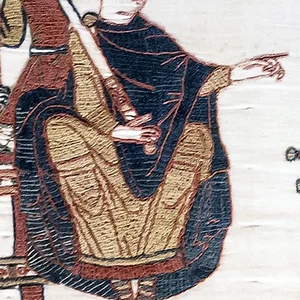
The Bayeux Tapestry, nearly 70 meters long, tells in embroidered images the story of William's conquest of England. This exceptional work, probably commissioned by Bishop Odo of Bayeux, William's half-brother, is one of the most precious visual documents of the Middle Ages.
In 1085, William ordered a comprehensive survey of all the lands, properties, and resources of England, known as the Domesday Book. This extraordinary document, completed in 1086, is one of the oldest administrative records in Europe and served as the foundation for the kingdom's taxation.
At his funeral in Caen in 1087, a macabre incident occurred: William's body, which had become very corpulent toward the end of his life, did not fit into the stone sarcophagus. When an attempt was made to force it in, the body burst, releasing such a pestilential odor that the monks had to rush through the ceremony.
Primary Sources
The Tapestry illustrates in 58 embroidered scenes the events leading to the conquest of England, from Harold's oath to the Battle of Hastings. It stands as a unique visual testimony on the weaponry, ships, and military tactics of the 11th century.
This great survey commissioned by William in 1085 describes with remarkable precision every estate in England: its lands, livestock, inhabitants, and their obligations. It allowed the king to know exactly the wealth of his kingdom.
William of Poitiers, the duke's chaplain, writes that William fought at Hastings with extraordinary bravery, three horses having been killed under him, and that he lifted his helmet to show his troops he was still alive.
This Latin poem attributed to Guy of Amiens describes in detail the course of the Battle of Hastings and the death of King Harold, struck in the eye by an arrow according to tradition.
Key Places
The likely birthplace of William. The fortress dominates the town of Falaise in Normandy and was one of the main ducal residences.
Site of the decisive battle of 14 October 1066, where William defeated King Harold II. Senlac Hill, a few kilometres from the town, was the exact location of the confrontation.
Founded by William around 1063 as penance for his marriage, which the Church deemed consanguineous. He was buried there in 1087 and the building remains a masterpiece of Norman Romanesque architecture.
Fortress whose construction William ordered from 1066 to control London. The central keep, the White Tower, symbolises Norman dominance over England.
Norman town housing the famous Bayeux Tapestry, an embroidery of nearly 70 metres depicting the conquest of England. The bishopric was held by Odo, William's half-brother.
Site of William's coronation on 25 December 1066, establishing the tradition of crowning England's kings in this London abbey.
Typical Objects

Long chainmail coat worn by Norman knights, visible on the Bayeux Tapestry. William wore one at Hastings, where he had to lift his nasal guard to be recognized by his troops.

Conical helmet fitted with a metal piece protecting the nose, characteristic of Norman warriors of the 11th century. It made combatants difficult to identify in battle.

Elongated kite-shaped shield, typical of Norman cavalry. It protected the rider from chin to knee and appears in nearly every combat scene of the Bayeux Tapestry.

William used a wax seal to authenticate his charters and ordinances. His royal seal depicted him in majesty on one side and on horseback on the other.

A blessed standard sent by Pope Alexander II to legitimize William's expedition to England. It was carried at Hastings as a sign of the Church's endorsement.

Official documents by which William founded or endowed abbeys and monasteries, such as the Abbaye-aux-Hommes in Caen, to affirm his piety and authority.
School Curriculum
Vocabulary & Tags
Key Vocabulary
Tags
Daily Life
Morning
Guillaume rose early, attended morning Mass in the castle chapel, then held council with his barons and officers to handle the affairs of the duchy or kingdom. He frequently inspected fortifications and garrison troops.
Afternoon
The afternoon was devoted to hunting, Guillaume's consuming passion — he had the New Forest created in England as a royal hunting reserve. He might also preside over courts, receive ambassadors, or oversee the construction of castles and abbeys.
Evening
Supper was taken in the great hall of the keep, in the company of his vassals and knights. Tales of battles and great deeds were recited by jongleurs. Guillaume would then withdraw to deal with his correspondence or discuss strategy with his closest advisors.
Food
The ducal and later royal table was plentiful: game (deer, boar, hare), roasted poultry, sea and river fish, wheat bread, Norman cheeses, and wines. Guillaume grew very corpulent with age, which earned him mockery from the French king Philippe I.
Clothing
In daily life, Guillaume wore a belted tunic of fine wool, a fur-lined cloak, and breeches. In wartime, he donned a mail hauberk, a conical nasal helmet, and carried his sword at his side. For ceremonies, he wore the crown and a gold-embroidered mantle.
Housing
Guillaume resided in powerful fortified castles, initially timber motte-and-bailey structures and increasingly stone keeps. In Normandy, he stayed at Falaise, Caen, and Rouen. In England, he commissioned the Tower of London and numerous fortresses to control the conquered territory.
Historical Timeline
Period Vocabulary
Visual Style
Style visuel médiéval roman inspiré de la Tapisserie de Bayeux, avec des silhouettes franches aux contours marqués, une architecture de pierre massive et l'imagerie militaire normande des chevaliers en cotte de mailles.
Sound Ambience
L'atmosphère sonore d'un château normand du XIe siècle, entre entraînements militaires dans la cour, chants liturgiques de l'abbaye voisine et le vent marin de la côte normande.
Liens externes & ressources
Références
Œuvres
Conquête de l'Angleterre
1066
Domesday Book
1086
Construction de la Tour de Londres
à partir de 1066
Fondation de l'Abbaye-aux-Hommes de Caen
vers 1063
Fondation de l'Abbaye-aux-Dames de Caen
vers 1063
Réorganisation féodale de l'Angleterre
1066-1087